This week, AI stops being a Silicon Valley story and becomes a Wall Street one. Anthropic — the company behind Claude — is expected to price the largest AI IPO in history at a valuation around $1 trillion, while Washington prepares to designate more than two dozen AI firms as "national champions." November 2026 is the month the AI industry grows up in public, and Purple Crib Studios is tracking every signal, because what happens on the trading floor this week will shape budgets, policies, and search behavior for every business that touches AI.
🚀 AI Moved Onto Wall Street This Week
Purple Crib Studios tracks every AI shift so your marketing strategy rides the wave, not the wipeout.
💬 Chat With Us on WhatsAppTable of Contents
- A $1 Trillion Company, Five Years Old
- National Champions: Policy Moves Into the Boardroom
- Deployed Is Not Used: The 2026 Adoption Gap
- The Uber Lesson: When Adoption Outruns the Spreadsheet
- AI Safety and Governance: The Rift and the Lawsuit
- The 90-Day Playbook for the IPO Era
- Test Your Knowledge — Quiz
- FAQs
1. A $1 Trillion Company, Five Years Old
Anthropic is expected to sell shares in an initial public offering this week that values the company at roughly $1 trillion — the fastest rise from founding to trillion-dollar valuation any startup has ever recorded. To put that in perspective: it took the biggest tech giants of previous generations decades to reach that mark, and many never did. Anthropic did it in about five years, riding the Claude model family straight into enterprise contracts, developer tooling, and now public markets.
The numbers around the deal are staggering. Amazon and Google's stakes in Anthropic could be worth a combined $411 billion if the IPO prices at the top of its proposed range — a return that reframes those early cloud-and-compute partnerships as some of the best investments in corporate history. Wall Street is already positioning: both the S&P 500 and Nasdaq slipped in recent sessions ahead of Nvidia's earnings report and the Anthropic listing, a sign that traders treat AI infrastructure as the market's center of gravity.
There is one more detail that makes this IPO unlike any other. As The New York Times noted in its read of the prospectus, the filing is "unparalleled in its willingness to discuss existential risk." Most IPO paperwork sells euphoria. Anthropic's paperwork sells euphoria and a frank discussion of catastrophic-risk scenarios. That is a first for public markets, and it tells you that even the company standing to raise the most money from AI optimism believes regulators and investors need to hear the risk case in writing.
If you have been following our AI Trends coverage, you know this is not an isolated event. Last week's trust reckoning covered the safety debate swirling around Claude 5.5 and the $3.4 billion gas-generator deal. The IPO is the financial chapter of that same story: AI's biggest safety advocate is also AI's biggest new public-market asset.
2. National Champions: Policy Moves Into the Boardroom
The same week as the IPO, policy made its own headline. The Trump administration plans to designate more than two dozen AI companies — including Nvidia, Amazon, Microsoft, OpenAI, and Anthropic — as US "national champions," the Wall Street Journal reported on Sunday, citing people familiar with the plans. The program's stated goals: help these companies expand overseas and compete better against Chinese rivals.
For business owners and marketers, "national champions" is not abstract policy. It signals that AI procurement is becoming geopolitical. Expect three knock-on effects:
- Procurement gets political. If you sell to US enterprises or government-adjacent buyers, which AI stack you build on may start to matter as much as what it costs.
- Overseas expansion accelerates. Championed companies get export support — meaning AI products reach your market (and your competitors) faster, in the US, Canada, UAE, Nigeria, and beyond.
- China competition framing hardens. Budgets that favor "trusted" AI infrastructure will flow through agencies and partners in every region we operate in.
Pull the camera back and you can see the whole arc of AI's industrialization in twelve months of headlines:
- 📅 Nov 2025: Microsoft commits up to $5 billion to Anthropic, Nvidia up to $10 billion, and Claude lands inside Microsoft Foundry and the Copilot family.
- 📅 2026: Anthropic's $3.4 billion gas-generator power deal makes energy strategy a front-page AI story.
- 📅 Nov 2026: The $1 trillion IPO lands the same week two dozen AI firms are lined up as national champions.
This is what an industry becoming infrastructure looks like. And like all infrastructure, it will be built around — and advertised on top of. If AI search visibility matters to your business today, it is about to matter more; our multi-engine AI SEO playbook explains how to stay citable across engines as this wave lands.
3. Deployed Is Not Used: The 2026 Adoption Gap
Here is the part of the story that matters most for regular businesses. While Wall Street prices a trillion-dollar AI company, the average enterprise is stuck in a very different reality: it bought AI everywhere and operationalized it almost nowhere. The most reliable 2026 surveys, compiled in First Line Software's adoption-gap breakdown, tell a brutal story:
- 📈 97% of companies deployed AI agents in the past year (WRITER 2026 survey of 2,400 executives and employees).
- 📈 59.5% of senior enterprise leaders say their organizations already run AI agents autonomously in production (Caylent/Censuswide, Aug 2026, 200 senior leaders at 1,000+ employee firms).
- 📉 72% deployed, but only 38% used. McKinsey finds most knowledge workers with AI access do not use it for real work.
- 📉 ~11% of enterprises run an agent in production at genuine scale, while ~88% of agent pilots never graduate to production at all (S&P Global Market Intelligence; Forrester 2026).
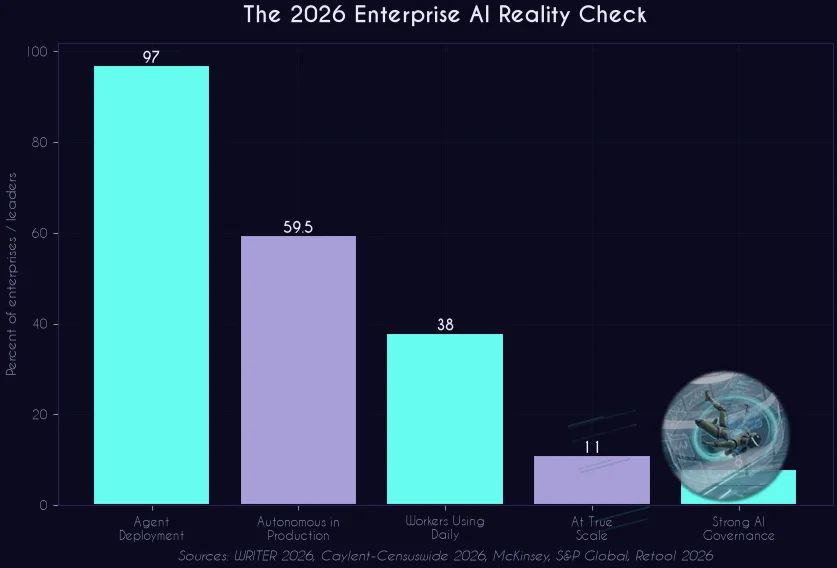
Read those numbers together and the picture is stark: access is table stakes. The competitive line in 2026 does not run between organizations that have AI and organizations that do not. It runs between organizations that deployed AI and organizations that actually operate it.
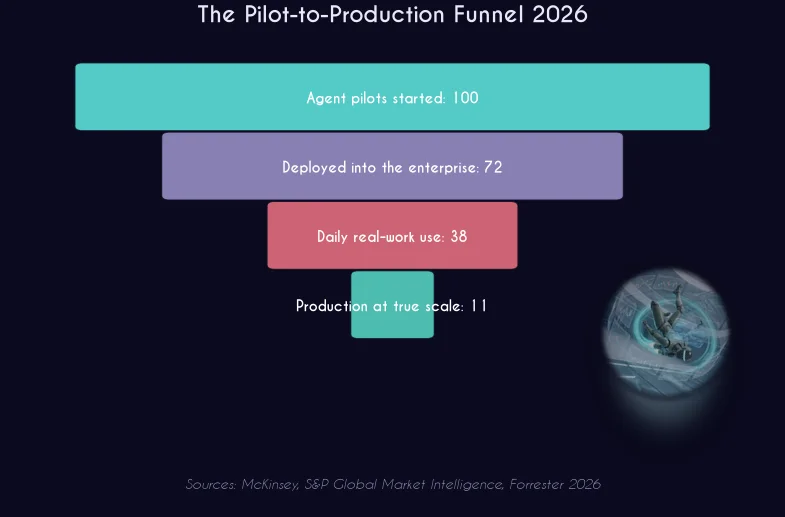
For small and mid-size businesses, this gap is actually good news. It means you are not behind because you have not bought every AI tool. You are behind only if you have tools nobody uses, nobody measures, and nobody governs. A three-person team that runs one agent well on one revenue workflow is ahead of a 500-person firm with 40 shelfware licenses.
4. The Uber Lesson: When Adoption Outruns the Spreadsheet
The single most instructive enterprise AI case study of 2026 is Uber. Not because Uber did something exotic — because Uber did what every company is tempted to do, at scale, and discovered what it costs.
Uber's Claude Code adoption climbed from 32% to 84% of engineers between December 2025 and March 2026, with roughly 70% of committed code becoming AI-generated, as reported by The Pragmatic Engineer and Fortune. Then came the catch: the company spent its entire 2026 AI-tools budget in about four months, at $500 to $2,000 per engineer per month — while leadership admitted to Fortune it could not yet tie the spend to output. Uber's COO put it plainly: the ROI link "is not there yet."
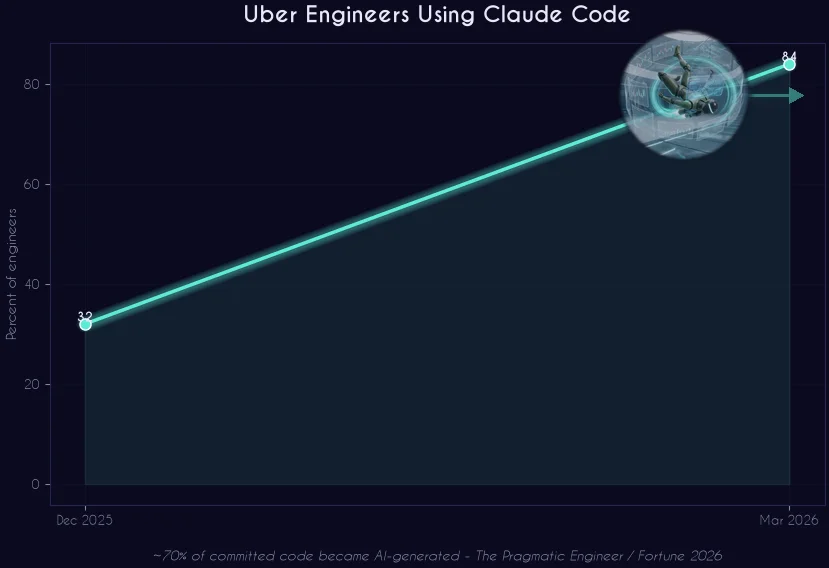
There are three lessons in that one story, and they apply at any budget size:
- Adoption is bottom-up and fast. Engineers pulled AI in before finance approved it. Assume your teams are doing the same; govern usage, not just purchases.
- Unit costs scale silently. $500 to $2,000 per seat per month is enterprise-grade. The SMB equivalent — a few AI subscriptions per person with no ceiling — drains just as surely.
- Adoption without measurement is a cost center. If you cannot say what AI spend produced this quarter, you are running Uber's problem with smaller numbers.
If you want the flip side — how to make AI spend actually produce measurable visibility and leads — our AI citations retrieval-first playbook maps the workflow end to end.
5. AI Safety and Governance: The Rift and the Lawsuit
This section is educational — Purple Crib Studios does not sell AI security or governance services, and we cover it because every operator touching AI in 2026 needs to understand this landscape.
While the IPO dominates headlines, the AI safety conversation had its own dramatic week. Anthropic CEO Dario Amodei's call to slow AI development drew private pushback from Nvidia's Jensen Huang and other AI leaders, reopening a public rift between the companies building AI and the executives deciding how fast to build it. Days earlier, advocacy groups sued Anthropic, OpenAI, Meta, and other developers, alleging the companies are knowingly building technology that poses catastrophic risks to humanity — a claim the companies reject. And in the middle of it all, Anthropic's own IPO prospectus discusses existential risk more candidly than any public filing before it, as the NYT's review makes clear.
Meanwhile, inside enterprises, the governance numbers are quietly alarming. Retool's 2026 State of AI Governance survey (307 CTOs, CIOs, and CISOs) found:
- 🛡️ Only 8% of technology leaders describe their internal-tool governance as strong — a majority run AI-generated tools in production without a formal framework.
- 🛡️ 22% had at least one production incident caused by an AI-generated internal tool in the past 12 months — and 51% could not say for certain either way.
- 🛡️ 93% are at least somewhat concerned about AI-generated tools running in production, yet 90% report more pressure to enable AI than a year ago.
- 🛡️ Only 5% are very confident they have full visibility into what is actually running in their production environments.
For organizations that want a practical, non-vendor framework, the US National Institute of Standards and Technology's AI Risk Management Framework remains the reference scaffold: four functions — govern, map, measure, manage — that any business, regardless of size, can adopt as a lightweight checklist. You do not need a compliance department to answer: who owns this AI tool, what data does it touch, how do we know it is working, and what do we do when it fails?
The gap between trillion-dollar optimism on Wall Street and 8% governance readiness inside the enterprise is the defining tension of this era. It is also, frankly, where the next five years of competitive advantage will be won.
6. The 90-Day Playbook for the IPO Era
Whether you run a clinic in Lagos, an agency in Dubai, or a consultancy in Toronto, here is how to turn this week's headlines into a concrete plan. Ninety days, six moves:
- ✅ Days 1-15: Run a usage census. List every AI tool anyone on the team actually uses — including personal subscriptions on company work. You cannot govern what you cannot see; only 5% of enterprises can.
- ✅ Days 16-30: Pick two workflows, not twenty. Choose one revenue workflow (content, outreach, support) and one cost workflow (research, admin) and put AI fully inside them.
- ✅ Days 31-45: Set cost ceilings per team. Monthly spend caps per seat, reviewed quarterly. Uber's lesson: usage outruns budget unless the ceiling is explicit.
- ✅ Days 46-60: Write a one-page AI governance doc. Owner, data rules, review cadence, escalation path — mapped loosely to the NIST AI RMF functions.
- ✅ Days 61-75: Tie AI output to metrics. Leads generated, hours saved, citations won in AI engines. If the ROI link "is not there yet" at day 75, restructure the workflows.
- ✅ Days 76-90: Book a quarterly AI visibility review. Check how your brand appears in ChatGPT, Claude, AI Mode, and Perplexity; refresh your schema and llms.txt so engines keep citing you.
That last point is not a nice-to-have. As AI companies become public-market assets with national-champion backing, their engines will shape an ever larger share of buying decisions in every region. The businesses that win the next decade will be the ones AI engines can find, trust, and cite.
The $1 trillion test is not really about Anthropic's share price. It is about whether the rest of us — businesses of every size — can turn world-class AI into measured, governed, revenue-producing operations before the next wave prices us out. Wall Street has made its bet. Your move.
🚀 Ready to Operate AI, Not Just Own It?
Purple Crib Studios builds measured, governed AI marketing systems for businesses in the US, UK, UAE, Canada, and Nigeria.
💬 Get a Free Strategy ChatRather Have Experts Handle This?
Purple Crib Studios offers done-for-you AI SEO and AI visibility services across the US, UK, UAE, Canada, and Nigeria. Get a free 5-point audit in 48 hours.
Explore Our ServicesFAQs
Why does Anthropic's IPO matter to a regular business?
The IPO at a roughly $1 trillion valuation signals that AI has become durable public-market infrastructure. That means AI products will keep arriving faster, get cheaper, and be embedded deeper in the tools your customers and competitors already use — raising the cost of ignoring AI adoption every quarter.
What is the US "national champions" AI program?
The Trump administration plans to designate more than two dozen AI companies — including Nvidia, Amazon, Microsoft, OpenAI, and Anthropic — as national champions, a status intended to help them expand overseas and compete with Chinese rivals. For businesses, it means AI procurement and partnerships will increasingly carry geopolitical considerations.
What is the enterprise AI adoption gap in 2026?
Surveys show 97% of companies deployed AI agents in the past year, but only about 38% of knowledge workers use AI for real work daily, roughly 11% of enterprises run agents at genuine scale, and about 88% of agent pilots never reach production. Deployment is not the same as adoption or operations.
What can the Uber Claude Code story teach small businesses?
Uber's engineer adoption of Claude Code jumped from 32% to 84% in four months, and the company spent its entire 2026 AI budget in that period at $500 to $2,000 per engineer per month — while admitting the ROI link was not yet there. The lesson: set explicit cost ceilings and tie AI spend to measurable output before usage scales on its own.
Does my small business really need AI governance?
Yes, in lightweight form. Only 8% of technology leaders describe their AI governance as strong, and 22% reported production incidents caused by AI-generated tools. A one-page document naming who owns each tool, what data it may touch, how performance is measured, and what happens when it fails is enough for most SMBs.
How do I know if my company is part of the 88% of stalled pilots?
Run a usage census: list every AI tool your team can access, then check logs or ask managers who actually uses it weekly for real work. If tools sit idle, no one owns them, and no metric moves, you are in the stalled-pilot majority — and a 90-day playbook with two focused workflows is the fastest way out.
Test Your Knowledge — Anthropic IPO & AI 2026 Quiz
10 quick questions based on this article. Tap an answer to see if you got it right.
Enjoyed this? One click tells Google to show you more Purple Crib content in Search.
Add on GoogleSources & Further Reading
- The New York Times — A Human Reads the Anthropic I.P.O. Filing
- Reuters via The Economic Times — Trump Administration to Name AI Firms US National Champions
- Yahoo Finance — Anthropic's Record IPO Faces Some Big Questions
- CBS News — Advocacy Groups Sue AI Companies Over Catastrophic-Risk Allegations
- First Line Software — The 2026 Enterprise AI Adoption Gap, By the Numbers
- NIST — AI Risk Management Framework (AI RMF)
Tags: #AITrends #AITrends2026 #Anthropic #AIIPO #Claude #EnterpriseAI #AIAdoption #AIGovernance #AISafety #AIRiskManagement #NISTAIRMF #AIEconomics #FutureOfWork #AIOperations #PurpleCribStudios