November 2026 has handed AI SEO its reality check. OpenAI says ChatGPT Search now runs at roughly one-fifth of Google's query volume, while a new 468,000-citation research study reveals that most of the "AI optimization" tactics agencies sell barely move the needle. The real lever is retrieval — and most brands are optimizing the wrong layer entirely. Here is Purple Crib Studios' retrieval-first playbook, built on the freshest data in the industry.
🚀 AI Engines Are Citing Someone — Why Not You?
Purple Crib Studios builds retrieval-first AI SEO systems for brands across the US, UK, UAE, Canada, and Nigeria.
💬 Chat With Us on WhatsAppTable of Contents
- The 20% Question: ChatGPT Search vs Google in Late 2026
- The 468,000-Citation Study That Rewrites GEO
- Pages Are Cited When Searched: Inside the Retrieval Funnel
- The Brand Memory Effect: Brands Are Named When Remembered
- What Still Moves the Needle: The 2026 Signal Hierarchy
- Multi-Region AI SEO: US, Canada, UAE, and Nigeria
- The 90-Day Retrieval-First Plan
- Quick-Wins Checklist
- Test Your Knowledge — Quiz
- FAQs
1. The 20% Question: ChatGPT Search vs Google in Late 2026
On November 5, 2026, Forbes reported that OpenAI now defines a "search" as any prompt that sends ChatGPT out to the web for an answer — and by that measure, ChatGPT Search runs at roughly one-fifth of Google's query volume. Independent estimates from Ahrefs and SEOClarity put it lower, between 7.5% and 12%. Meanwhile, Google itself reported its fastest search query growth in five years.
Both things can be true at once. Google is not dying; AI answer engines are compounding. That is exactly why the AI SEO conversation has shifted from "will AI kill Google?" (we covered the AI Mode traffic paradox in a recent post) to a harder question: when a user asks ChatGPT, Perplexity, Gemini, or Google's AI Overviews a question about your market, does your brand appear in the answer at all?
~20% of Google's query volume is what OpenAI says ChatGPT Search now handles (Nov 2026)
7.5–12% is where Ahrefs and SEOClarity independently estimate it
5 years — Google's fastest query growth streak, reported the same week
For an SMB in Lagos, a clinic in Toronto, or an agency in Dubai, the practical takeaway is simple: your next customer is split across two search surfaces, and most businesses are still optimizing for only one of them.
2. The 468,000-Citation Study That Rewrites GEO
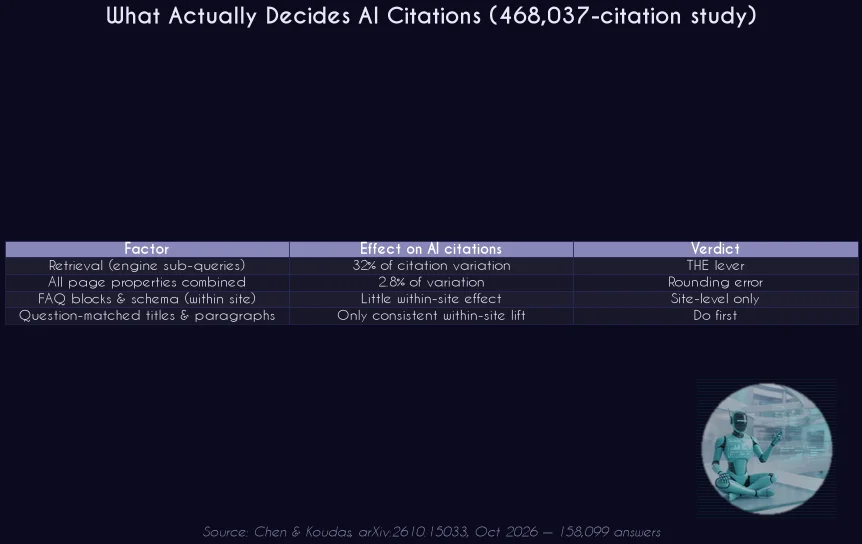
The most important AI SEO research of the season is a study published in October 2026: "What Drives AI Citations? Content, Retrieval and Model Knowledge in Generative Engine Optimization" by Mahe Chen and Nick Koudas. The team analyzed two 90-day collections of answers to commercial questions in contrasting markets — 158,099 answers containing 468,037 citations — across ChatGPT, Gemini, and Perplexity.
Then they replayed the same questions through the engines' APIs to see what actually happened inside. The headline finding is brutal for the checklist-GEO industry:
- Retrieval explains 32% of citation variation — which pages the engine's own search retrieves for its rewritten sub-queries.
- All page properties combined explain just 2.8% — FAQs, structured data, summary boxes, page speed, the works.
- Within a single website, FAQ blocks and schema markup showed little citation effect. Across different websites they matter more — they help the site get retrieved, not a specific page.
3. Pages Are Cited When Searched: Inside the Retrieval Funnel
Here is the mechanism most GEO advice ignores. When you ask an AI engine a question, it does not scan your page for your FAQ block. It generates its own sub-queries — rewritten on every answer — runs them through its own search, and then writes the answer from whatever that search retrieves. Those sub-queries rarely coincide with Google's or Bing's results.
The study found one within-site signal that consistently worked: pages whose title and paragraphs match the questions people actually ask get cited more. Not keyword stuffing. Not "AI-friendly" buzzword salad. Question-matching.
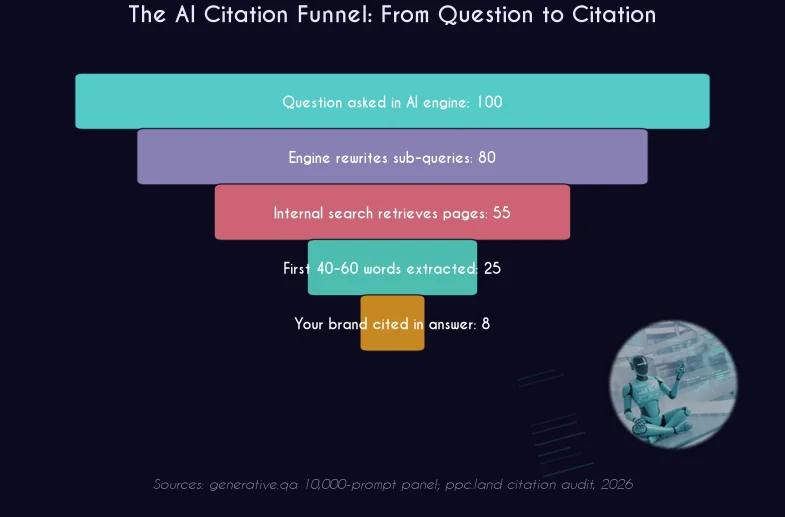
Think of it as a funnel:
- 🔍 Step 1 — The engine rewrites your user's question into sub-queries you never see.
- 📥 Step 2 — Its internal search retrieves a candidate pool (one large-scale audit found ChatGPT cited only ~3.1% of retrieved pages for a given answer set).
- 🎯 Step 3 — The model lifts passages that answer the sub-query — with disproportionate extraction from the first 40–60 words of a page, per a 10,000-prompt panel across six engines.
- 🔗 Step 4 — Your brand and citation survive into the final answer, or it names a competitor instead.
This is why "placement decides whether a passage is candidate material at all, while question-matching decides which passage inside the page is lifted." Front-load the answer. Then match the question. That is the whole opening move.
4. The Brand Memory Effect: Brands Are Named When Remembered
The study's second uncomfortable finding: the model's own knowledge shapes retrieval. ChatGPT writes brands it already knows into its searches, prefers websites it knows, and — most striking — names brands without any supporting page at all. Controlled experiments showed brand names alone reorder the engine's rankings of products with identical facts.
"Pages are thus cited when searched; brands are also named when remembered." That single line from the paper should be framed in every marketing department. It means AI SEO is not only a content discipline — it is a brand-awareness discipline. Consistent naming, entity presence, reviews, mentions across the web, and PR all feed what the model "remembers" about you before it ever retrieves a page.
It also explains why young domains can win AI citations faster than they win Google rankings: if retrieval — not domain authority — is the gate, a young site that answers the engine's sub-queries well can enter the answer pool on day one. For context on where the broader AI agent economy is heading, see our November trends piece on AI profitability and the agent economy.
5. What Still Moves the Needle: The 2026 Signal Hierarchy
None of this means on-page work is useless. It means the hierarchy changed. Here is what measured research — the Princeton GEO benchmark (Aggarwal et al.), the generative.qa 10,000-prompt panel, and the new citation study — actually supports:
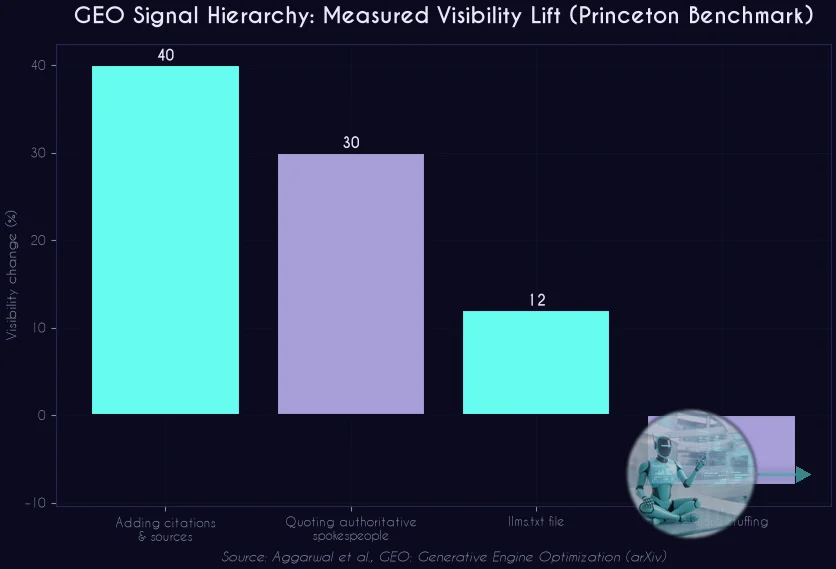
The operating principle that survives every dataset: fact density beats keyword density. A 10,000-prompt panel across six engines confirmed engines disproportionately extract the first 40–60 words of a page — so lead with the answer, stated plainly, backed by a source.
One more sobering stat: a Trakkr audit (October 2026) followed 1,285 statistics cited by major AI engines and found only 40% trace back to a matching study. 11% trace to nothing at all. AI answers are confidence machines, not truth machines — which is exactly why engines reward verifiable, well-attributed sources, and why your brand should be the verifiable one.
Want to know where you stand today? Run your site through our free AI Visibility Checker — it tests AI crawler access, llms.txt presence, schema, and metadata in under a minute. Or try the broader free AI visibility test walkthrough.
6. Multi-Region AI SEO: US, Canada, UAE, and Nigeria
Retrieval-first AI SEO is not a US-only game. Purple Crib Studios operates across four very different search markets, and the playbook shifts by region:
- United States & Canada: Highest ChatGPT/Perplexity adoption, but also the most crowded answer pools. Differentiation comes from original data, named experts, and entity consistency across LinkedIn and industry directories.
- UAE: Bilingual content (English + Arabic) doubles your sub-query surface. Engines rewrite queries in both languages — a page that answers in the language the engine searches in gets retrieved. Local entity presence (Google Business Profile, Dubai business directories) feeds the brand memory effect.
- Nigeria: Lower AI-search share today, but the fastest-growing segment — and Google's AI Overviews already surface for Nigerian commercial queries. Naira-priced comparisons, local phone/WhatsApp details in schema, and Naira-first pricing pages match the questions Nigerian buyers actually ask.
The universal rule across all four: match the question your buyer asks, in the market where they ask it. A Lagos bride asks "how much is pre-wedding photography in Lagos 2026?" — if your page's first 40–60 words answer that, you are candidate material for whatever engine handles the query.
7. The 90-Day Retrieval-First Plan
Here is how we run this at Purple Crib Studios, structured as three 30-day pushes:
Days 1–30 — Map the questions. Collect the 30 real questions your buyers ask (sales calls, WhatsApp threads, reviews, Google's People Also Ask). Rewrite your five most important pages so titles and opening paragraphs answer those questions in the first 40–60 words. Add citations to every claim.
Days 31–60 — Fix the retrieval layer. Deploy llms.txt, FAQPage + Person + LocalBusiness schema, clean robots.txt AI-crawler access (verify with a visibility checker), and consistent brand naming everywhere the engines can read it. Quote named spokespeople; add original statistics where you can.
Days 61–90 — Measure and iterate. Track first-party AI referral traffic (chatgpt.com, perplexity.ai), run monthly prompt-panel tests on your 10 money questions, and compare which pages get cited. Double down on cited pages; rewrite uncited openings.
Google's own AI optimization guide aligns with this: unique, verifiable, people-first content remains the foundation for AI features — not tricks.
8. Quick-Wins Checklist
Run this audit on your site this week:
- ✅ Does your homepage's first 60 words state who you are, what you do, and where you operate?
- ✅ Do your top 5 pages open with a direct answer, not a "In today's fast-paced world…" preamble?
- ✅ Does every statistic on your site carry a source link?
- ✅ Is llms.txt live and listing your key pages?
- ✅ Do AI crawlers (GPTBot, ClaudeBot, PerplexityBot, Google-Extended) have robots.txt access to public content?
- ✅ Do you have Person schema for your founder/author on every content page?
- ✅ Are your brand name, address, and phone identical across your site, directories, and social profiles (the brand memory effect)?
- ✅ Have you tested your 10 money questions in ChatGPT, Perplexity, and Google AI Overviews this month?
AI search in late 2026 rewards the prepared, the verifiable, and the memorable. The engines got bigger, the research got honest, and the playbook is now measurable. Whether you sell photography in Lagos or consulting in Toronto, the funnel is the same: be retrieved, be lifted, be remembered. That is retrieval-first AI SEO — and it works.
🚀 Want to Be the Brand AI Engines Remember?
We'll map your 30 buyer questions, fix your retrieval layer, and run monthly citation tracking — start with a free 5-point AI visibility audit.
💬 Get Your Free AI AuditRather Have Experts Handle This?
Purple Crib Studios offers done-for-you AI SEO across the US, UK, UAE, Canada, and Nigeria. Get a free 5-point audit in 48 hours.
Explore Our ServicesFAQs
What is retrieval-first AI SEO?
It's optimizing for the layer that actually decides AI citations: whether the engine's internal search retrieves your page for its rewritten sub-queries. Research on 468,037 citations found retrieval explains 32% of citation variation, versus just 2.8% for all on-page properties combined. In practice it means matching your titles and paragraphs to real buyer questions.
Does llms.txt really improve AI citations?
It helps modestly — about a 12% lift in AI visibility tests. It's a cheap file to deploy, but it's a supporting signal, not the main lever. Structured data like FAQPage, HowTo, Dataset, and Person schema is associated with 1.8× citation likelihood across websites.
Is ChatGPT Search bigger than Google now?
No. OpenAI says ChatGPT Search runs at roughly 20% of Google's query volume (November 2026), while independent estimates from Ahrefs and SEOClarity place it between 7.5% and 12%. Google also reported its fastest query growth in five years. The market is splitting, not collapsing.
Do FAQ blocks and schema guarantee AI citations?
No. In the 468,000-citation study, FAQ blocks, structured data, summary boxes, and page speed appeared effective only across websites, not within a single site. Schema helps your site get retrieved, but a specific page gets cited when its title and paragraphs match the question the engine is answering.
How do I check if AI engines can find and cite my site?
Start with a free AI visibility checker that tests robots.txt AI crawler access (GPTBot, ClaudeBot, PerplexityBot, Google-Extended), llms.txt presence, JSON-LD schema, and metadata. Purple Crib Studios offers one at purplecrib.ng/ai-visibility-checker — no registration needed.
Does retrieval-first AI SEO work outside the US?
Yes. The mechanism is engine-level, not market-level. In the UAE, bilingual English-Arabic content expands your sub-query surface; in Nigeria, Google's AI Overviews already surface for local commercial queries; in Canada, the same question-matching rules apply. Match the questions buyers ask in your market and language.
Test Your Knowledge — AI Citations Quiz
10 quick questions based on this article. Tap an answer to see if you got it right.
Enjoyed this? One click tells Google to show you more Purple Crib content in Search.
Add on GoogleSources & Further Reading
- What Drives AI Citations? Content, Retrieval and Model Knowledge in GEO — Chen & Koudas, arXiv (Oct 2026)
- GEO: Generative Engine Optimization — Aggarwal et al., Princeton benchmark (arXiv)
- ChatGPT Search Hits 20% of Google's Query Volume, OpenAI Says — Forbes (Nov 5, 2026)
- Google's Guide to Optimizing for Generative AI Features — Google Search Central
- Generative Engine Optimization Statistics 2026 — Omnibound
Hashtags: #AISEO #GenerativeEngineOptimization #GEO #AICitations #ChatGPTSearch #Perplexity #AIOverviews #SearchStrategy #DigitalMarketing #llmstxt #SchemaMarkup #BrandVisibility #AI2026 #PurpleCribStudios #RetrievalFirst