The first full week of November 2026 will be remembered as the week AI's trust problem caught up with its power problem. While Claude's 5.5 model family pushed efficiency to new highs and a $3.4 billion compute deal made headlines, an enterprise data breach, a blunt security warning, and a new AI labor law told the other side of the story. Here is Purple Crib Studios' global read on the week of November 9, 2026.
🚀 Turn AI Trends Into Rankings While Competitors Scroll
Purple Crib Studios builds AI-ready SEO systems for brands in the US, Canada, UAE, and Nigeria.
💬 Chat With Us on WhatsAppTable of Contents
- The Week That Was: AI in 60 Seconds
- The Claude 5.5 Generation: Power Gets Cheaper
- The $3.4 Billion Energy Bet Behind Every Model
- Weight-Space Programming: Editing 1,023 Weights
- The Security Reckoning: Breaches and Warnings
- Guardrails Watch: Washington, Manila, and the SEC
- Jobs Reality Check: 70,000 New Roles
- What This Means for Marketers
- Your Trust-Era Readiness Checklist
- Test Your Knowledge — Quiz
- FAQs
1. The Week That Was: AI in 60 Seconds
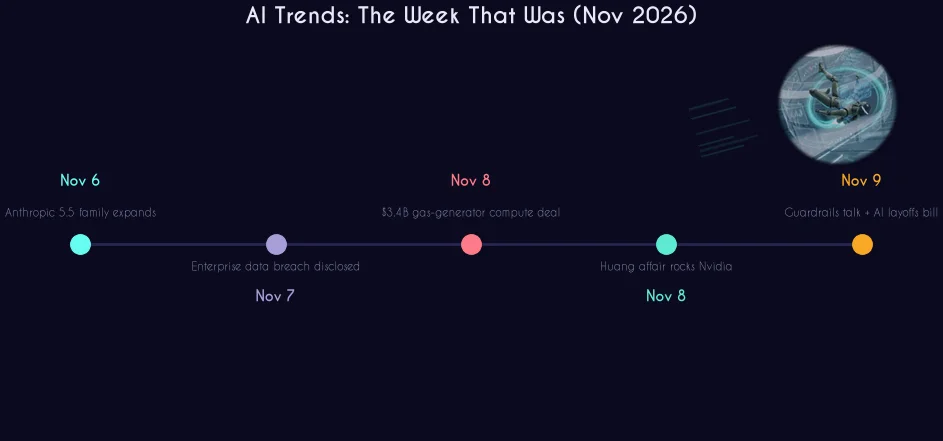
If you only read one AI trends roundup this November, make it this one, because the stories of the week of November 9, 2026 all point in the same direction: the industry is now being judged on trust, not just capability. Anthropic disclosed that a third-party firm accessed enterprise customer account data. Nvidia's board opened an independent probe into reporting that CEO Jensen Huang was targeted by a foreign-intelligence operation. New research into editing model weights directly turned the research conversation toward controllability. And regulators on three continents moved on guardrails, data standards, and AI layoffs at the same time.
🤖
Model efficiency wins
Claude Opus 5.5 runs 40% cheaper than Opus 5 while leading agentic coding benchmarks.
⚡
Compute goes physical
Anthropic committed $3.4B to take over 1.7 GW of heavy-duty gas generators.
🔐
Trust under strain
An unauthorized third party viewed Anthropic enterprise account metadata in late October.
🧾
Rules arriving fast
A Philippine bill would mandate 6-month notice and double pay for AI-driven layoffs.
For context on how we got here, our earlier coverage traced the shift from hype to economics: November's agent economy explained, and the August 2026 infrastructure reset predicted exactly this compute scramble.
2. The Claude 5.5 Generation: Power Gets Cheaper
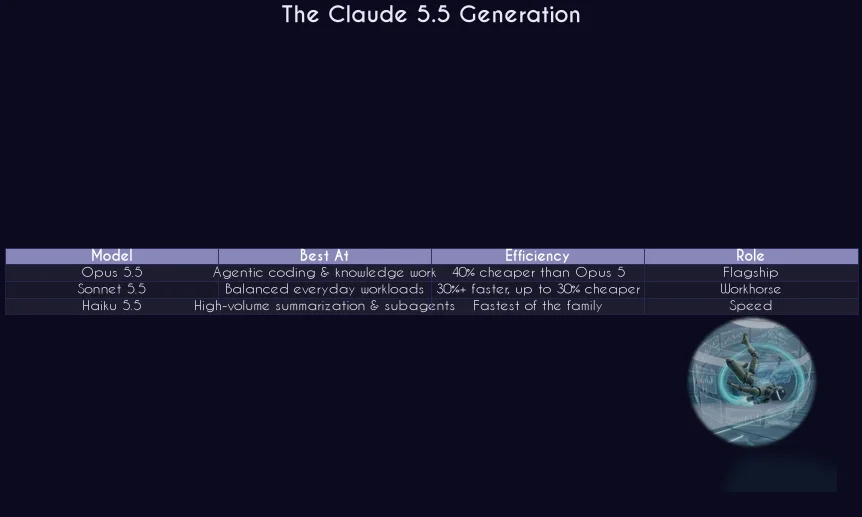
The quietest but most commercially important trend of the fall is the collapse in the cost of frontier-level intelligence. Anthropic's 5.5 family now spans the full price ladder: Opus 5.5 leads in agentic coding and knowledge work while costing 40% less to run than Opus 5 on typical workloads; Sonnet 5.5 runs more than 30% faster and up to 30% cheaper than its predecessor; and Haiku 5.5 is built for high-volume work like summarization, subagents, and browser use.
Why does this matter to a business in Lagos, Dubai, Toronto, or Austin? Because when flagship capability costs 40% less, use cases that failed the ROI test in spring suddenly clear it in November. Multi-step content audits, automated review responses, and always-on research agents stop being experiments and become line items. We covered the model-fatigue side of this story in late September; the efficiency story is the other side of the same coin.
3. The $3.4 Billion Energy Bet Behind Every Model
The Financial Times reported, via CNBC, that Anthropic committed roughly $3.4 billion in late September to take over 1.7 gigawatts of heavy-duty gas generators that OnePWR Solutions had ordered from Caterpillar — buying OnePWR's place in Caterpillar's production queue plus engineering support. That is not a software story. It is an energy story, and it confirms that compute is now a strategic resource acquired like oil contracts.
Three implications for global marketers and operators:
- Speed of deployment is the new moat. Firms that lock in power now can ship agentic products faster than rivals waiting on grid connections.
- Cost curves still favor users. Paradoxically, as labs spend billions upstream, per-token prices downstream keep falling — the Opus 5.5 price cut is the proof.
- Energy policy is AI policy. From Texas substations to UAE solar farms, expect procurement and sustainability questions to appear in AI vendor talks — especially in ESG-conscious European and Canadian markets.
Even Wall Street is feeling the tension: PBS NewsHour reported this week that a better-than-expected jobs report is being weighed against persistent fears of an AI investment bubble.
4. Weight-Space Programming: Editing 1,023 Weights
The research story of the week came out of Shanghai AI Lab with Tongji and Fudan universities: a paper on weight-space programming, where a reasoning agent inspects and directly edits a model's parameters instead of gradient-training it. Across 16 editing trajectories on Qwen3.5 models, the team reported gains of up to 29.45 points on MATH-500 and 36.72 points on IFEval — with a single edit touching just 1,023 parameters producing the headline MATH-500 lift.
Two honest caveats from the paper itself: cross-task generalization was uneven, and six of 16 trajectories reverted to original weights when candidate edits could not be validated. That reverting behavior is actually the encouraging part — it is a built-in safety mechanism, an undo button for model surgery.
The strategic takeaway: controllability research is maturing. If frontier capabilities can be surgically added or removed at small scale, the industry's ability to deliver "safe by design" models stops being a slogan. That matters enormously for regulated sectors — healthcare, finance, government — in every market we serve.
5. The Security Reckoning: Breaches and Warnings
AI security is now a boardroom topic, and this week supplied three data points in a single news cycle.
The breach. Anthropic began emailing enterprise customers on November 7 that a third-party cybersecurity research firm had accessed internal systems in late October without authorization — viewing account IDs, organization IDs, plan tiers, and usage and spend metrics. Critically, conversation content, passwords, and payment data were not exposed. But for the enterprise AI market, the message landed anyway: even metadata about how much AI you buy is worth protecting. Anthropic has since launched its Cyber Mission initiative, reduced distillation attacks by more than 90%, and given METR evaluators employee-like access to its systems — a notable openness shift.
The warning. Newly appointed Cognition CISO Alex Stamos told The Verge's Decoder podcast that open-weight models now automate most of the cyber kill chain — bug finding and exploit writing happen live, per target, rather than being stockpiled — with both criminal and state-aligned actors using the tools. His prediction: cybersecurity faces a "multi-year dark age" before defenses catch up. If your agency or client stores customer data, assume AI-accelerated attacks are part of your 2027 threat model.
The frontier risk. Tencent's chief AI scientist Yao Shunyu warned at a Hong Kong science event that AI's biological capabilities "will reach a threshold where it's actually possible to do harm," calling bio risks potentially harder to manage than cyber risks, and urging open-source labs to prioritize safety testing. Tencent says it will release Hy4 model weights alongside a safety-testing report.
We broke down the October context for this cluster in Gemini 4, Argon, and AI cybersecurity — the trend line since then has only steepened.
6. Guardrails Watch: Washington, Manila, and the SEC
Governance moved on three continents this week, and the direction of travel is consistent: governments want oversight without braking the race.
- United States. In his first post-midterm 60 Minutes interview, President Trump said he doesn't "mind guardrails" on AI as long as the US is not pushed into "a deep second position" to China, naming the Department of Justice as the manager of AI risks. Framing safety as a race condition means voluntary commitments will likely outrun statute in the near term.
- The safety bureaucracy. The AP reported that staff at CAISSI — the Commerce Department's $10M/year AI safety center — now informally report to a White House office, raising independence questions after the center stopped publishing public reports in August.
- Capital markets. The SEC hosted a roundtable on November 9 on machine-understandable data in the age of super intelligence — a signal that disclosure standards are coming for AI-exposed companies.
- Labor rules arrive first. Philippine Senator Erwin Tulfo filed Senate Bill 2563, requiring employers to give the Department of Labor six months' notice before terminating workers for AI or automation, exhaust reskilling options first, and pay separation of at least two months' salary per year of service. Other markets — including EU jurisdictions and Canada — already have consultation requirements; the Philippines is raising the global floor.
For multi-region brands, the compliance playbook is forming now: document AI's role in workforce decisions, budget for reskilling, and treat AI procurement with the same vendor-risk rigor as payroll systems.
7. Jobs Reality Check: 70,000 New Roles
Here is the nuance the headlines skip. The Wall Street Journal reported that US professional and business services added 70,000 jobs in October — the largest monthly gain since July 2022 — with consulting (+17,300), legal (+2,400), and accounting (+2,300) all growing, despite being ranked among the most AI-exposed industries. Meanwhile, narrower roles show real pressure: document-preparation employment is down 17% year over year.
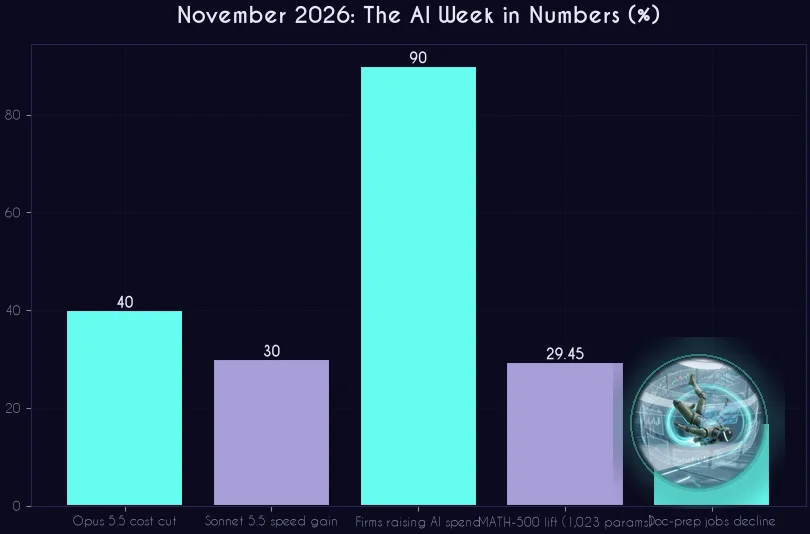
The correct reading is not "AI destroys white-collar work" or "AI changes nothing." It is task-level substitution with role-level resilience: the document-prep tasks automate away, while advisory, judgment-heavy, and client-facing work expands. And per new industry research, 90% of companies plan to increase AI investment next year — with security and regulatory exposure listed as the top concerns. Firms that resell judgment, not tasks, are growing.
8. What This Means for Marketers
Put the week together and a clear brief emerges for marketing teams in the US, Canada, UAE, Nigeria, and beyond:
- Trust is a ranking signal now. As AI search engines summarize the web, they preferentially cite brands with verifiable expertise, transparent sourcing, and consistent facts. Our retrieval-first citation playbook maps the exact tactics.
- Cost cuts unlock agentic workflows. With frontier intelligence 40% cheaper, pilot one AI workflow per quarter — review responses, local keyword research, schema generation — and measure it like a channel, not a toy.
- Security is a content opportunity. B2B buyers now search for "is [tool] safe" before pricing. Publish your data-handling position before a competitor does.
- Labor-law awareness is a differentiator in services marketing. Agencies that can certify "AI-assisted, human-approved" workflows will win procurement teams navigating new rules from Manila to Toronto.
9. Your Trust-Era Readiness Checklist
- ✅ Audit every AI vendor that touches customer data — including metadata, not just content.
- ✅ Publish an AI-use and data-handling statement on your website (it doubles as E-E-A-T evidence).
- ✅ Add AI vendors to your incident-response plan with the same severity tiers as payment systems.
- ✅ Document human review steps in every AI-assisted workflow you sell.
- ✅ Re-run the ROI math on one shelved AI use case — cheaper models may now clear the bar.
- ✅ Brief your HR or clients team on emerging AI-layoff notice rules in every market you hire in.
- ✅ Stress-test your brand facts across ChatGPT, Gemini, and Perplexity so AI engines quote you accurately.
The firms that treat November 2026 as the moment trust became a competitive moat — not a compliance chore — will be the ones AI engines and customers both reward in 2027. The capability race is table stakes; the trust race has just started.
🚀 Ready to Make Your Brand the One AI Engines Trust?
Get a free AI-visibility and citation audit from Purple Crib Studios — delivered in 48 hours.
💬 Get My Free AuditRather Have Experts Handle This?
Purple Crib Studios offers done-for-you AI SEO across the US, UK, UAE, Canada, and Nigeria. Get a free 5-point audit in 48 hours.
Explore Our ServicesFAQs
What is the biggest AI trend in November 2026?
Trust has become the defining theme. Alongside rapid model-efficiency gains like Claude Opus 5.5 costing 40% less than Opus 5, the week of November 9, 2026 brought an enterprise data incident at Anthropic, blunt cybersecurity warnings, and new AI labor and governance rules — all pushing security, transparency, and accountability to the top of the AI agenda.
Should my business worry about incidents like the Anthropic enterprise data access?
Use it as a prompt, not a panic. The accessed data was account and usage metadata — not conversation content, passwords, or payment data. The practical lesson is to audit every AI vendor that touches your data, including metadata about usage and spend, and to fold AI vendors into your incident-response plan.
Is AI actually replacing white-collar jobs?
The October 2026 data shows task-level substitution, not role-level replacement: US professional services added 70,000 jobs while document-preparation employment fell 17% year over year. Repetitive document tasks automate away while advisory and judgment-heavy roles keep growing.
What is weight-space programming and why does it matter?
It is a research technique where an AI agent directly inspects and edits a model's parameters instead of retraining it. A Shanghai AI Lab-led study reported accuracy gains of up to 29.45 points on MATH-500 by editing just 1,023 parameters. It matters because it points toward surgical, verifiable model control — a foundation for safer AI in regulated industries.
How do new AI labor laws affect global businesses?
The Philippine Senate Bill 2563 filed in November 2026 would require six months' advance notice to the labor department before AI-driven layoffs, mandatory reskilling first, and separation pay of at least two months' salary per year of service. Multi-region employers should document AI's role in workforce decisions and budget for reskilling now, as similar consultation requirements already exist in the EU and Canada.
How should marketers prepare for the AI trust era?
Publish verifiable expertise: transparent sourcing, human review steps, and a public AI-use and data-handling statement. AI search engines reward brands they can verify, so run regular visibility checks across ChatGPT, Gemini, and Perplexity, and fix any incorrect facts those engines hold about your business.
Test Your Knowledge — AI Trends November 2026 Quiz
10 quick questions based on this article. Tap an answer to see if you got it right.
Enjoyed this? One click tells Google to show you more Purple Crib content in Search.
Add on GoogleSources & Further Reading
- Anthropic Newsroom — Claude 5.5 family announcements and Cyber Mission
- AI Weekly — Top AI stories, November 9, 2026
- SEC — Roundtable on machine-understandable data and super intelligence
- CMS Critic — 2026 research on AI investment and security concerns
- PBS NewsHour — Jobs report and AI bubble fears, November 6, 2026
- 311 Institute — Artificial Intelligence 2026 trend briefing
#AITrends #AI2026 #ArtificialIntelligence #AISecurity #AIGovernance #ClaudeOpus #AgenticAI #AIPolicy #AIEthics #TrustEra #AIJobs #DigitalMarketing #AISEO #FutureOfWork #PurpleCribStudios