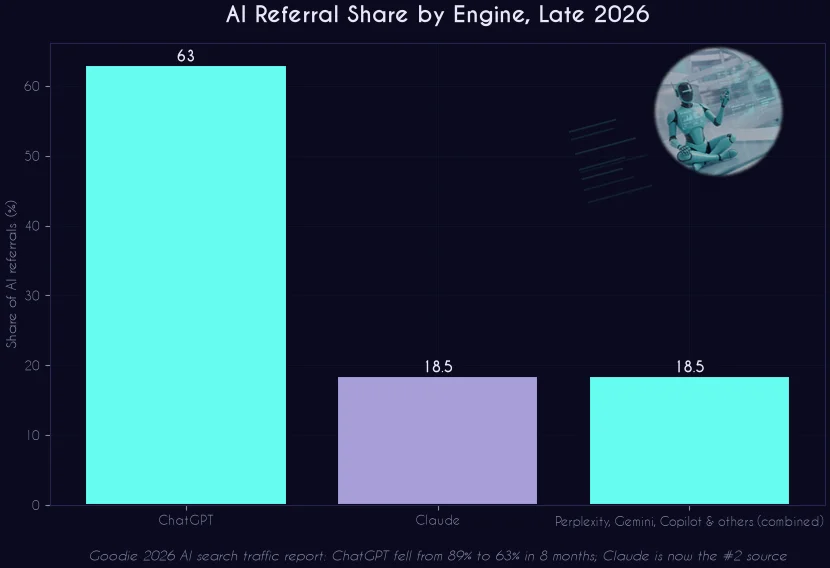
Eight months ago, "AI SEO" basically meant one thing: get cited by ChatGPT. In November 2026 that strategy is officially dead. Semrush's latest research shows Google's AI Mode shares only about 35% of its sources with Google's own top 10 organic results, and ChatGPT overlaps even less. Meanwhile ChatGPT's share of AI referral traffic has fallen from 89% to 63%, while Claude climbed to 18.5% and became the number-two source. Purple Crib Studios built this guide for marketers in the US, Canada, UAE, Nigeria and beyond who need visibility across every engine their buyers actually use.
🚀 One Engine Is No Longer Enough — Audit All Five in One afternoon
Chat with Purple Crib Studios about a multi-engine AI visibility audit for your business.
💬 Message Us on WhatsAppTable of Contents
- The Fragmentation Has Arrived
- What Each AI Engine Actually Rewards
- The Retrieval Basics Every Engine Shares
- Engine-Specific Plays That Pay
- How to Measure Multi-Engine Visibility
- Six Multi-Engine Mistakes to Avoid
- Your 90-Day Multi-Engine Roadmap
- Test Your Knowledge — Quiz
- FAQs
This matters for every business we serve — from Lagos local brands to Dubai agencies — because buyers no longer use one search surface. They ask ChatGPT for quick answers, Perplexity for cited research, Gemini inside Google, Claude for document-grade analysis, and Copilot inside Microsoft 365. If your brand only surfaces in one of them, you are invisible to everyone else.
1. The Fragmentation Has Arrived
For two decades SEO had one scoreboard: Google's ten blue links. In 2026 there are at least five scoreboards, and they barely agree with each other. Semrush's research found that the overlap between AI Mode results and Google's classic top 10 organic results sits at roughly 35% — and when comparing ChatGPT's results to Google's top 10, the overlap is even lower. Search Engine Land has been tracking the same story: Claude and ChatGPT routinely surface different sources for identical questions.
That fragmentation runs all the way down to the referral level. The 2026 AI search traffic report from Goodie shows ChatGPT's share of AI referral traffic collapsing from 89% to 63% in eight months, with Claude rising to 18.5% as the number-two AI referrer. In plain terms: a site that optimized only for ChatGPT citations has quietly lost roughly a third of its addressable AI audience this year.
📊 The Fragmentation in Numbers
- 35% — share of AI Mode sources that also appear in Google's top 10 organic results (Semrush)
- Lower still — overlap between ChatGPT results and Google's top 10 (Semrush)
- 89% → 63% — ChatGPT's fall in AI referral share over 8 months (Goodie, 2026)
- 18.5% — Claude's rise to become the #2 AI referral source (Goodie, 2026)
- +71% — growth in AI Overviews presence on commercial-intent SERPs over six months (Semrush)
The strategic takeaway is not "AI search replaced Google." It is that AI search multiplied. Every engine maintains its own index, its own retrieval logic, and its own ranking preferences. We covered how citations actually get retrieved in our retrieval-first playbook; this guide takes the next step — what to do when the engines keep diverging.
2. What Each AI Engine Actually Rewards
"Single-platform AEO is dead" — that is how one industry analysis put it after the ChatGPT decline data landed. If your strategy is "get cited in ChatGPT," you are now optimizing for barely half the market. Here is how the five major surfaces differ in practice, based on what each engine has consistently rewarded through 2026:
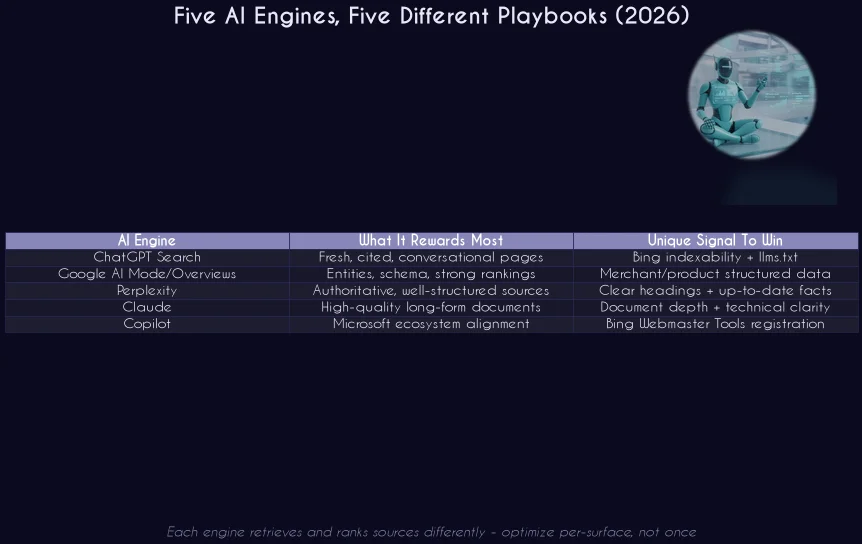
- ChatGPT Search leans on the Bing index and rewards fresh, conversational, well-cited pages. If Bing cannot crawl or interpret your site, ChatGPT struggles to cite you — no matter how good your Google rankings are.
- Google AI Mode and AI Overviews reward entity strength, structured data, and pages that already rank well on classic Google. Overviews now appear on roughly half of queries, and mobile data shows the #1 organic result only appears in the AI Overview about a third of the time — AI re-picks its own sources.
- Perplexity rewards authoritative, well-structured pages with clear headings, current dates, and explicit facts it can quote and cite. It behaves like a research librarian: skimmable structure wins.
- Claude surfaces rich, long-form documents and technical depth. Search Engine Land's testing consistently shows Claude pulling different (often more document-like) sources than ChatGPT for the same question.
- Copilot inherits Microsoft ecosystem logic — Bing Webmaster Tools registration, structured markup, and content aligned with your Microsoft-verified business profile carry disproportionate weight.
None of these preferences are static, but the pattern is stable: each engine has its own retrieval personality. The overlap numbers in section 1 are the statistical proof. A multi-engine strategy does not mean five times the work — it means one strong retrieval foundation plus a small per-engine layer on top.
3. The Retrieval Basics Every Engine Shares
Before you specialize per engine, fix what every engine needs. AI engines cannot rank what they cannot retrieve, parse, and trust. These fundamentals are non-negotiable in November 2026:
🔓 1. Open the gates in robots.txt
Check that GPTBot, ClaudeBot, PerplexityBot, Google-Extended, and Bingbot are not accidentally blocked. Every major AI crawler has been mis-blocked by well-meaning security plugins at some point. Audit quarterly — plugins update and settings revert.
📄 2. Publish an llms.txt file
An llms.txt file at your site root tells AI agents what your most important pages, facts, and tools are. It is quickly becoming the robots.txt of the AI era — Perplexity, ChatGPT, and independent agents increasingly read it. Keep it short, factual, and current.
🏷️ 3. Schema without gaps
Organization, LocalBusiness, Service, FAQ, and Article markup give every engine the same clean entity facts: who you are, where you operate, what you sell, at what price. Consistent schema across engines is the cheapest unifier in a fragmented landscape. Google's own SEO starter guide remains the baseline reference every engine effectively respects.
🧱 4. Entity consistency everywhere
Same name, address, phone, and brand story across your site, Google Business Profile, Bing Places, LinkedIn, and industry directories. Engines cross-check these signals before deciding you are a real, citable business. You can test your own standing free with our AI visibility checker.
Get these four right and you have probably done 60% of the multi-engine work — because the same foundation feeds all five retrieval systems.
4. Engine-Specific Plays That Pay
Once the foundation is solid, add a thin per-engine layer. This is where the 35% overlap data works in your favor: because engines disagree, small targeted moves create outsized deltas.
🤖 For ChatGPT
Verify your site in Bing Webmaster Tools (ChatGPT's search side leans on Bing). Publish dated, citable answers of 100–160 words under question-style headings, and keep llms.txt updated with your ten most important URLs.
🔍 For Google AI Mode / Overviews
Build entity depth: consistent Organization schema, an about page with verifiable credentials, and original data or pricing pages. For e-commerce, watch Google Merchant Center — testing of a new AI performance report for AI Mode and AI Overviews was reported this month.
📚 For Perplexity
Lead each section with a direct, quotable answer under a clear H2. Publish dates prominently. Perplexity rewards pages it can cite cleanly — structure is the ranking factor.
📄 For Claude
Claude gravitates to long-form, document-grade content: guides, whitepapers, technical comparisons. If your best material is scattered across short posts, consolidate it into a pillar document.
🪟 For Copilot
Register with Bing Webmaster Tools, keep your Bing Places profile complete, and mark up services with clean schema. Copilot inherits Microsoft's index — treat Bing hygiene as your Copilot strategy.
Notice how little overlap exists between these plays. That is the whole point: five small bets instead of one large one. For the deeper citation mechanics behind all of these — how engines actually select passages to quote — revisit our AI citations retrieval playbook.
5. How to Measure Multi-Engine Visibility
You cannot manage five engines with one dashboard, but November 2026 measurement is easier than the doom-merchants claim. Start with referral data you already own:
- Segment AI referrals in analytics. Filter for chatgpt.com, chat.openai.com, perplexity.ai, claude.ai, copilot.microsoft.com, and google.com/aiaf referral paths. The Goodie report shows these now carry real volume — and that the mix is shifting away from ChatGPT-only.
- Run a quarterly citation audit. Ask the same ten buyer questions in ChatGPT, Gemini, Perplexity, Claude, and Copilot. Log which surfaces cite or mention you. Ten questions, five engines, thirty minutes — that is your fragmentation scoreboard.
- Track brand mentions, not just links. AI engines cite your brand name and facts without linking. A free AI visibility test gives you a repeatable baseline score.
- Watch engine mix monthly. If one engine's referrals collapse, that is a retrieval problem (crawlers blocked, index dropped) — not a content problem. Fix the pipes before rewriting the pages.
📌 Field note: referral tracking undercounts AI influence. Many buyers read your citation in an AI answer, then search your brand name directly on Google. Treat brand-name search volume as your shadow metric for AI visibility — when citations rise, branded search usually follows within weeks.
6. Six Multi-Engine Mistakes to Avoid
After auditing hundreds of sites across our markets, these are the failures we see most in November 2026:
- ❌ Betting everything on one engine. The 89% → 63% ChatGPT collapse is what happens to single-engine strategies — the market shifted under them in eight months.
- ❌ Blocking AI crawlers by accident. Security plugins and CDN rules quietly rewrite robots.txt. Check GPTBot, ClaudeBot, and PerplexityBot access every quarter.
- ❌ Treating AI traffic as "not converting." AI referrals bounce differently — they arrive mid-research. Judge them by branded-search lift and pipeline, not first-click conversion.
- ❌ Publishing without dates or structure. Engines weight freshness and extractability. A brilliant but undated, unstructured page loses to a mediocre but clean one.
- ❌ Forgetting Bing. ChatGPT and Copilot both lean on the Microsoft index. Bing Webmaster Tools is the single highest-leverage registration most businesses still skip.
- ❌ Optimizing content before retrieval. No imaginable paragraph quality helps if the crawler is blocked or the page is not in the index. Fix retrieval first, then write.
Trust is the other half of the equation — AI engines increasingly prefer sources with visible authorship and accountability, a shift we covered in this month's trust reckoning trends report.
7. Your 90-Day Multi-Engine Roadmap
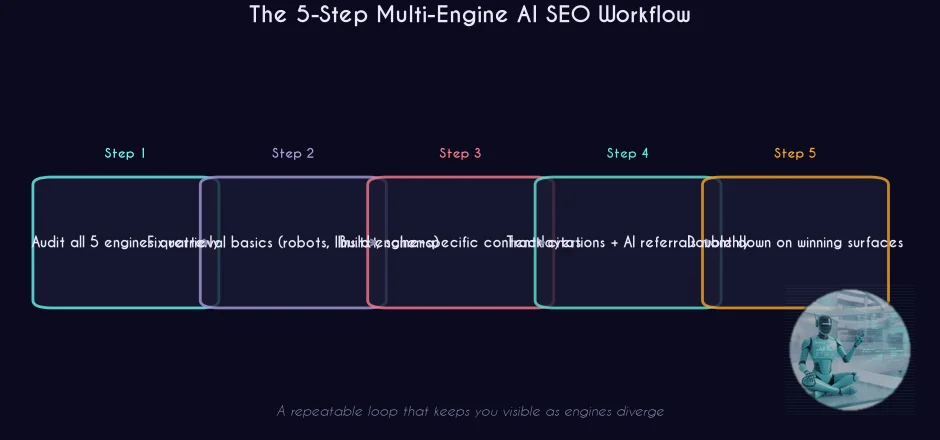
Here is the exact sequence we use with clients. Run it as a loop, not a one-off — engines keep diverging, so the audit cadence matters more than any single fix.
Days 1–30 — Foundation
- ✅ Audit robots.txt access for GPTBot, ClaudeBot, PerplexityBot, Google-Extended, and Bingbot
- ✅ Register and verify the site in Bing Webmaster Tools
- ✅ Publish (or refresh) an llms.txt listing your ten citable pages
- ✅ Complete Organization + LocalBusiness + Service schema across the site
Days 31–60 — Per-Engine Layers
- ✅ Consolidate your best material into one document-grade pillar (for Claude and Perplexity)
- ✅ Add dated, quotable answer blocks of 100–160 words under question-style H2s (for ChatGPT)
- ✅ Strengthen entity signals: consistent NAP, author bios, verifiable credentials (for Google AI Mode)
- ✅ Submit key pages to Bing's index and refresh sitemaps
Days 61–90 — Measure and Double Down
- ✅ Run the five-engine citation audit (ten buyer questions, log every citation)
- ✅ Segment AI referral traffic in analytics; compare against branded-search trends
- ✅ Identify your two strongest engines and build a second content layer for them
- ✅ Schedule the next quarterly audit before closing the current one
The fragmentation of AI search is not a threat — it is the biggest land-grab opportunity since local SEO. Engines are still young, indexes are thin, and the businesses that establish multi-engine visibility now will hold a moat that latecomers cannot easily cross. Pick your five engines, fix your retrieval foundation, layer the plays, measure honestly, and repeat.
🔎 Want to Know Which of the Five Engines Already Cite You?
Purple Crib Studios runs five-engine citation audits and builds your multi-engine roadmap — free first audit for new clients.
💬 Start on WhatsAppRather Have Experts Handle This?
Purple Crib Studios offers done-for-you AI SEO across the US, UK, UAE, Canada, and Nigeria. Get a free 5-point audit in 48 hours.
Explore Our ServicesFAQs
What is multi-engine AI SEO?
Multi-engine AI SEO is the practice of making your business visible and citable across all major AI search surfaces — ChatGPT, Google AI Mode and Overviews, Perplexity, Claude, and Copilot — instead of optimizing for just one. Because studies show these engines share only about 35% or less of their sources with each other, ranking in one no longer guarantees visibility in the others.
Is ChatGPT still the most important AI search engine?
ChatGPT is still the largest single AI referral source, but its dominance is shrinking: its share fell from 89% to 63% of AI referral traffic in eight months, with Claude rising to 18.5% as the number-two source. Treating ChatGPT as the only engine that matters leaves roughly a third of AI-driven discovery on the table.
Do I need llms.txt for AI SEO in 2026?
llms.txt is a plain-text file at your site root that tells AI agents which pages and facts matter most. It is becoming the robots.txt of the AI era, and keeping one is a low-cost way to steer retrieval across ChatGPT, Perplexity, and independent AI agents. It does not replace schema or good content — it complements them.
Why does Bing matter for ChatGPT and Copilot SEO?
ChatGPT's search side and Microsoft Copilot both lean on the Bing index for much of their retrieval. A site that is invisible to Bing can be invisible to both engines even with strong Google rankings. Registering with Bing Webmaster Tools and keeping your Bing Places profile complete is the fastest fix.
How do I measure traffic from AI search engines?
Start by filtering analytics for referrals from chatgpt.com, perplexity.ai, claude.ai, and copilot.microsoft.com, then run a quarterly citation audit by asking the same ten buyer questions in each engine and logging every citation. Also watch branded-search volume — many AI-influenced buyers search your brand name directly on Google afterwards.
Is multi-engine AI SEO relevant for small businesses in Nigeria or the UAE?
Yes — small and mid-market businesses often gain the most, because AI engine indexes are thinner and less competitive than Google's. A clean retrieval foundation, entity consistency, and one document-grade pillar page can make a local brand citable across all five engines faster than competing on traditional SERPs.
Test Your Knowledge — Multi-Engine AI SEO Quiz
10 quick questions based on this article. Tap an answer to see if you got it right.
Enjoyed this? One click tells Google to show you more Purple Crib content in Search.
Add on GoogleSources & Further Reading
- Semrush — What Is SEO (AI Mode / organic overlap data)
- Search Engine Land — 7 AI search shifts you can't afford to ignore
- Goodie — 2026 AI Search Traffic Report (referral share shifts)
- Google Search Central — SEO Starter Guide
- Moz — Beginner's Guide to SEO
- Aergos — ChatGPT Ads and a Big Week in Search
Try our free AI marketing tools:
AI Visibility Checker · JSON-LD Schema Generator · Local Keyword Generator
#AISEO #MultiEngineSEO #AISEO2026 #AEO #GenerativeEngineOptimization #AIsearch #ChatGPTSEO #ClaudeSearch #Perplexity #GoogleAIMode #llmstxt #AIVisibility #SearchStrategy #DigitalMarketing2026 #PurpleCribStudios