There is a quiet problem spreading through marketing departments in November 2026: teams assume their brand appears in ChatGPT, Gemini and Perplexity answers, but almost nobody has actually checked. AI assistants now send only 0.41% of website traffic versus Google's 24.24% — yet that thin slice converts 42% better for retailers who get it. Purple Crib Studios built a free tool that answers the only question that matters in five minutes: can AI find, read and cite your brand?
🚀 Find Out If AI Can See Your Brand — Free
Run the free Purple Crib AI Visibility Checker in minutes and get your 0-100 AI readiness score plus the exact fixes.
💬 Chat With Us About AI VisibilityTable of Contents
- The AI Visibility Gap Nobody Measures
- How Brands Accidentally Make Themselves Invisible
- The Free AI Visibility Checker: 5 Checks Explained
- Reading Your Score: What Each Band Means
- From Score to Fix: The 5-Step Repair Loop
- Global Calibration: US, UK, UAE, Canada, Nigeria
- The 10-Point AI Visibility Checklist
- Test Your Knowledge — Quiz
- FAQs
1. The AI Visibility Gap Nobody Measures
Every marketing dashboard tracks Google rankings, email open rates and paid media ROAS. Almost none of them track what is arguably the fastest-growing discovery channel: AI assistants recommending brands unprompted. The numbers tell a story most teams have not internalized yet.
Traffic Share
62x
Google sends 24.24% of site traffic; all AI assistants combined send 0.41% — but that gap is closing every month (Ahrefs tracker, 112,309 sites).
Conversion Edge
+42%
US retail traffic from AI assistants grew 393% year-over-year in Q1 2026 — and AI referrals convert 42% better than average visitors.
Trust Risk
29%
When AI gets your brand information wrong, only 29% of consumers still trust the brand — you cannot fix what you never measured (Skyword research, June 2026).
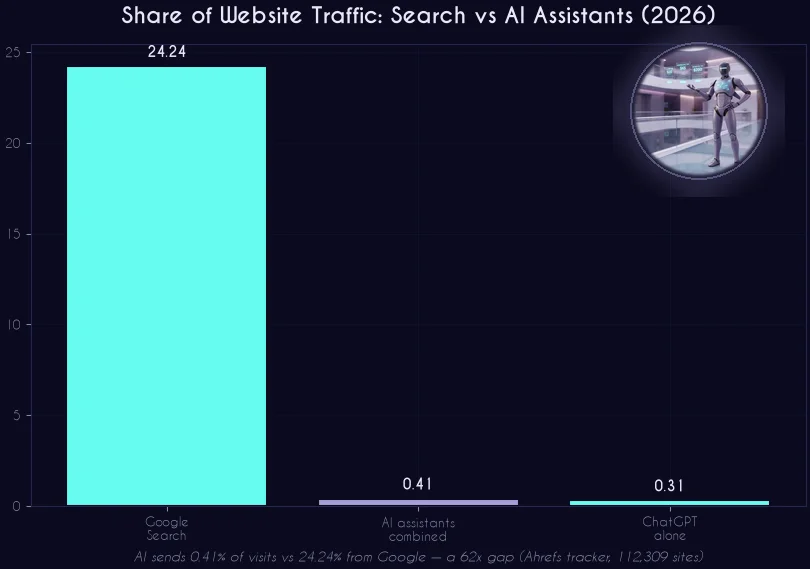
The practical takeaway is simple. A single AI-recommended brand mention behaves like a high-intent referral: someone asked an assistant a question, your brand came back as the answer, and the visitor arrives pre-qualified. That is why we treat AI visibility as its own channel in every strategy we build, not a bolt-on to SEO. If you want the full picture of how AI answers are reshaping traffic economics, see our analysis of the AI Mode traffic paradox.
2. How Brands Accidentally Make Themselves Invisible
Here is the uncomfortable part: most brands that go invisible in AI answers did it to themselves, usually by accident. Three patterns show up over and over when we audit sites.
🚫
Accidental crawler blocks
Research auditing over 1,500 business websites found only about 8% deliberately block AI crawlers — but of the sites blocking GPTBot, 79% also block ClaudeBot. One careless robots.txt line can erase your brand from ChatGPT overnight.
📄
Missing llms.txt
Only 13.7% of reachable domains publish a valid llms.txt file — the curated introduction that tells AI systems what your site offers. AI assistants fill the gap with whatever they can scrape, including outdated and wrong information.
🔤
Unreadable structure
No JSON-LD structured data, missing Open Graph tags and slow pages all lower the odds an AI system can parse, trust and cite your content — even when nothing is blocked.
Google's own guidance is clear that llms.txt is not a ranking requirement (we unpacked the six biggest AI SEO myths, llms.txt included, in this October breakdown). But "not required for Google rankings" is not the same as "useless for AI assistants." ChatGPT, Perplexity and Claude all read your robots.txt and your structured data to decide what to surface. The win is making sure nothing is blocking them and everything they need is machine-readable.
3. The Free AI Visibility Checker: 5 Checks Explained
This is where the free AI Visibility Checker from Purple Crib Studios comes in. No signup, no credit card — you enter a URL and the tool fetches your site exactly the way an AI system would, then grades what it finds from 0 to 100.
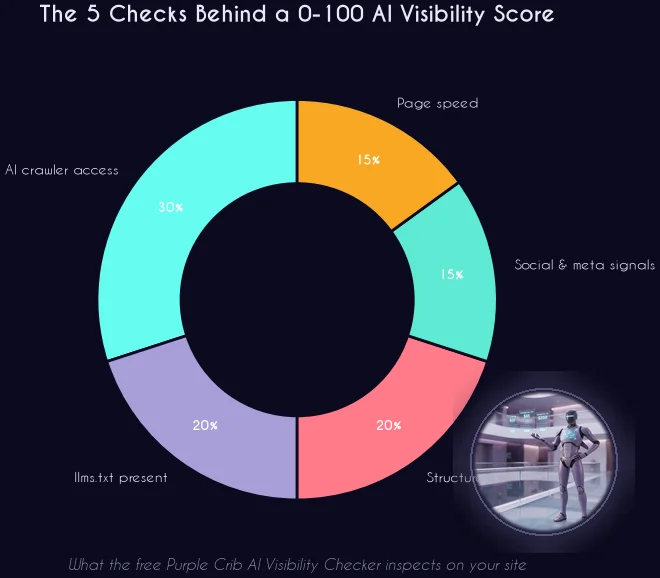
Here is what each check actually inspects:
- AI crawler access (the big one). The checker reads your robots.txt and verifies whether GPTBot, ClaudeBot, PerplexityBot and Google-Extended are allowed to crawl your pages. This is the check that catches accidental blocks — the single most damaging failure mode.
- llms.txt presence. It looks for a valid llms.txt file that introduces your site, services and content to AI systems, so assistants quote what you actually offer rather than a guess.
- Structured data. JSON-LD schemas (Organization, Service, FAQPage, Product, Article) are counted and validated, because structured data is the fastest path to machine-readable trust.
- Social and meta signals. Open Graph tags, meta descriptions and canonical URLs are inspected — the snippets AI systems rely on when deciding what your page is about.
- Page speed. Response time is measured, because slow pages reduce crawl efficiency for AI bots just as they do for Googlebot.
When we ran purplecrib.ng through the AI Visibility Checker ourselves, it scored 90/100 — strong on crawler access and structured data, with speed still on our improvement list. That is the honest benchmark to beat. For a deeper statistical view of how AI Overviews now appear in 39% of US desktop searches, see our earlier research post on AI Overviews hitting 39%.
4. Reading Your Score: What Each Band Means
A 0-100 score is only useful if you know what to do with it. Here is how we interpret the bands when grading client sites:
One rule of thumb we use with clients: a low score is not a penalty, it is a diagnosis. Sites below 50 almost always have a crawler block or a broken meta setup at the root, and fixing that single item regularly jumps the score by 20 or more points on a re-check.
5. From Score to Fix: The 5-Step Repair Loop
Visibility work is not a one-time project — it is a loop you run monthly. Here is the sequence we walk clients through after every free visibility check:
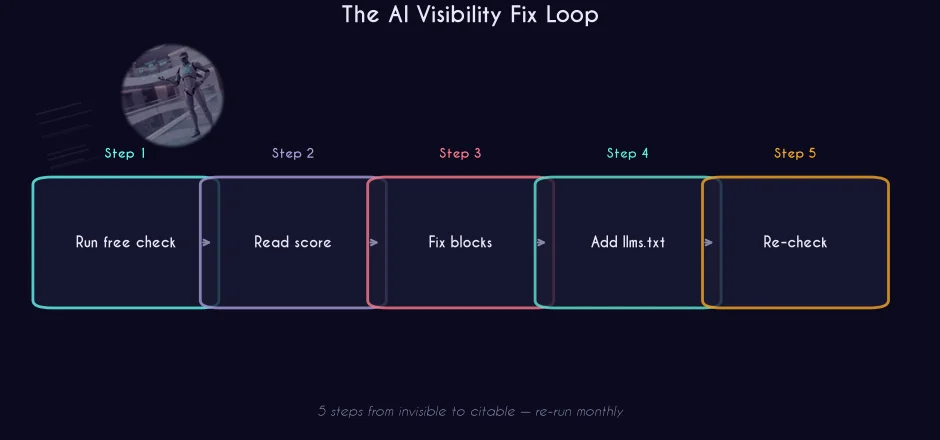
STEP 1
Run the free check
Enter your URL in the AI Visibility Checker and get your baseline score.
STEP 2
Read the findings
Identify which of the five checks failed — crawler access first.
STEP 3
Unblock crawlers
Explicitly allow GPTBot, ClaudeBot and PerplexityBot in robots.txt.
STEP 4
Publish llms.txt
Introduce your brand, services and key pages to AI systems in one curated file.
STEP 5
Re-check monthly
Every new page can change the score — make the check a standing habit.
If you would rather have a team handle this end to end — from crawler rules to structured data to llms.txt maintenance — our AI SEO agency service runs exactly this loop for clients across five markets.
6. Global Calibration: US, UK, UAE, Canada, Nigeria
AI visibility priorities are not identical in every market, and the biggest mistake we see is copy-pasting a US playbook into Lagos or Dubai without adjusting. Here is how the emphasis shifts:
- United States and United Kingdom: the most saturated AI assistant markets. Structured data and llms.txt are table stakes; brand mention monitoring matters because competitors are already measuring share of voice in AI answers.
- UAE: bilingual Arabic-English sites need hreflang and language-aware structured data so assistants cite the right language version. Speed checks matter even more with heavy media-rich pages.
- Canada: local competition is thinner in AI answers, which makes it a fast-win market — small businesses that fix crawler access early can dominate assistant recommendations in their city.
- Nigeria and wider Africa: AI assistant usage is rising fast but business adoption of visibility basics lags. That is the opportunity: a clean robots.txt, llms.txt and schema put you ahead of most local competitors immediately, at effectively zero cost.
The common thread across all five markets: the fundamentals are free to fix, and the overwhelming majority of your competitors have not fixed them. Being early is cheap in November 2026; being late will be expensive.
7. The 10-Point AI Visibility Checklist
Work through this after your check — every item is either free or nearly free:
- ✅ Run the free AI Visibility Checker and record your baseline score
- ✅ Confirm GPTBot, ClaudeBot, PerplexityBot and Google-Extended are allowed in robots.txt
- ✅ Remove any blanket Disallow rules written for old SEO tools — 79% of GPTBot blockers also block ClaudeBot by accident
- ✅ Publish a valid llms.txt that introduces your brand and key pages
- ✅ Add Organization schema with your real name, logo and contact data
- ✅ Add Service or Product schema to your money pages
- ✅ Add FAQPage schema wherever you answer real customer questions
- ✅ Fill every Open Graph tag — AI systems read them to understand your pages
- ✅ Get key pages loading fast enough for efficient AI crawling
- ✅ Re-run the check monthly and after every major site change
AI discovery is not replacing search — it is running alongside it, converting better and growing faster from a small base. The brands that measure it monthly in 2026 will be the ones assistants recommend in 2027. And if you want the whole thing handled for you, that is literally what we do all day.
🤖 Stop Guessing — Measure Your AI Visibility Today
Run the free checker now, or let the Purple Crib Studios team fix your AI visibility across the US, UK, UAE, Canada and Nigeria.
💬 Get Your Free Visibility ReadRather Have Experts Handle This?
Purple Crib Studios offers done-for-you AI SEO and visibility management across the US, UK, UAE, Canada, and Nigeria. Get a free 5-point audit in 48 hours.
Explore Our ServicesTest Your Knowledge — AI Visibility Quiz
10 quick questions based on this article. Tap an answer to see if you got it right.
FAQs
Is the AI Visibility Checker really free?
Yes. Enter any URL at purplecrib.ng/ai-visibility-checker and get your 0-100 score with no signup, no credit card and no limits on how often you re-check.
Does llms.txt affect my Google rankings?
No. Google's own guidance says llms.txt is not a ranking requirement. Its value is for AI assistants like ChatGPT, Claude and Perplexity, which read it to understand what your site offers so they cite accurate information instead of guesses.
Should I block GPTBot or other AI crawlers?
For most businesses, no. Blocking AI crawlers removes your brand from AI answers where competitors appear instead. Only about 8% of business sites deliberately block AI crawlers — and 79% of GPTBot blockers also block ClaudeBot unintentionally, going fully invisible.
What is a good AI visibility score?
90-100 means AI-ready, 70-89 is a solid base with fixable gaps, 50-69 is partial visibility, and below 50 usually means a crawler block or broken metadata at the root. Fixing the crawler issue alone often lifts a score by 20+ points.
How is AI visibility different from regular SEO?
SEO optimizes for rankings on a search results page. AI visibility optimizes for being mentioned and cited inside AI-generated answers. The fundamentals overlap (fast pages, structured data, clean metadata), but AI adds crawler access rules and llms.txt as first-class concerns.
Can Purple Crib Studios manage AI visibility for me?
Yes. Our AI SEO agency service runs the full visibility loop — crawler rules, llms.txt, structured data, metadata and monthly re-checks — for clients across the US, UK, UAE, Canada and Nigeria, starting with a free 5-point audit in 48 hours.
Enjoyed this? One click tells Google to show you more Purple Crib content in Search.
Add on GoogleSources & Further Reading
- Forbes — AI Referral Traffic Converts 42% Better For Retailers
- FirstPromoter — 139 AI Marketing Statistics (Ahrefs tracker, 112,309 sites)
- Rank Crown — AI Crawler Access Study 2026 (llms.txt adoption)
- DataScrape Solutions — Who Blocks AI Crawlers? (79% ClaudeBot overlap)
- PR Newswire — Skyword: When AI Gets Brand Information Wrong
- Search Engine Land — Robots.txt and SEO in 2026
#AIVisibility #AISEO #AISearch #llmsTxt #DigitalMarketing2026 #BrandVisibility #ChatGPT #GenerativeSearch #SearchStrategy #FreeTools #MarketingStrategy #AIAssistant #AEO #GEO #AICitations