Google published its official AI Optimization Guide in May 2026 and updated it in August 2026, and the guidance debunked more SEO tactics than it introduced. If your team is still chasing llms.txt files, special Markdown alternates, or GEO-specific schema, you are burning budget on things Google explicitly says it ignores. This is the October 2026 reality of AI SEO, and Purple Crib Studios breaks down what actually moves the needle.
🚀 Stop Wasting SEO Budget on AI Myths
Purple Crib Studios helps brands across the US, UK, UAE, Canada, and Nigeria win in AI-driven search with proven, no-nonsense strategies.
💬 Get Your Free AI SEO AuditTable of Contents
- 1. The 6 AI Search Myths Google Officially Debunked
- 2. What Actually Works: Google's Confirmed AI SEO Foundations
- 3. RAG and Query Fan-Out: How AI Overviews Actually Source Content
- 4. The Generative AI Performance Report: Your New North Star
- 5. Agentic Search Is Here: Preparing for the Next Shift
- 6. Global AI SEO Playbook: US, UK, UAE, Canada, and Nigeria
- 7. The October 2026 AI SEO Checklist
- Test Your Knowledge — AI SEO Myths Quiz
- FAQs
1. The 6 AI Search Myths Google Officially Debunked
Google's AI Optimization Guide, first published May 2026 and updated August 26, 2026, is remarkably direct about what does not work. After years of speculation, tool vendors selling "GEO solutions," and agencies promising llms.txt optimization, Google drew a line. Here are the six tactics the guide explicitly names as unnecessary for AI Overviews and AI Mode.
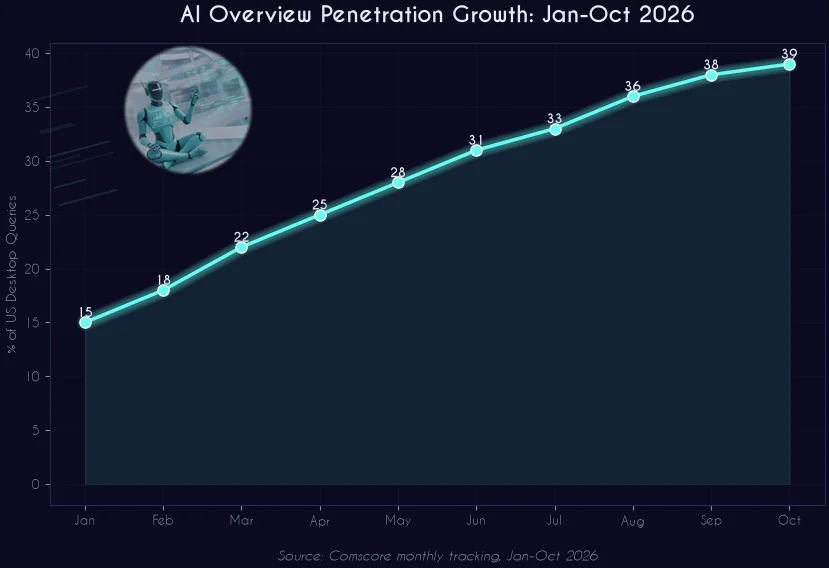
The key takeaway is not that these tools are harmful. Google says publishing an llms.txt file "neither helps nor harms" your Search visibility. The problem is opportunity cost: every hour spent on llms.txt formatting is an hour not spent on the fundamentals Google actually rewards. As we noted in our AI Overviews reality check, 39.4% of US desktop Google searches now trigger an AI Overview, and the pages being cited are the ones with strong foundational SEO, not special AI files.
2. What Actually Works: Google's Confirmed AI SEO Foundations
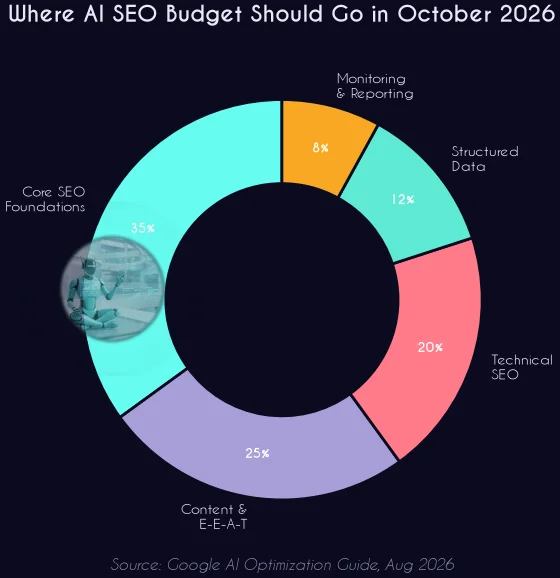
Google's guide confirms five operational foundations that still drive AI Overviews and AI Mode visibility. These are not new. They are the same principles that worked before generative search, now explicitly validated for the AI era.
According to Google's official AI optimization documentation and analysis from Search Engine Journal, the confirmed foundations are:
- Crawlability and indexability: AI Overviews retrieve recent pages from the Search index. If Google cannot crawl or index your page, it cannot appear in generative results. This means clean robots.txt, valid sitemaps, no blocking directives, and server-side rendering of critical content.
- Snippet eligibility: A page must be eligible for a snippet to appear in AI Overviews. Pages with meta robots set to nosnippet or max-snippet:0 are excluded from generative features.
- Original, experience-based content: Google explicitly states that "original, useful content based on real experience is more valuable than another summary of existing material." This is E-E-A-T in action. First-hand research, proprietary data, and expert analysis outperform aggregated content.
- Consistent information across sources: When query fan-out pulls from your product page, return policy, Merchant Center feed, and a comparison article, those sources must not contradict each other. Inconsistency forces Google to resolve conflicting facts, reducing citation confidence.
- Reliable rendering: Google can process JavaScript, but pages where essential content is in the server response are more reliable. Price, availability, and specifications should be present in the HTML, not injected by client-side scripts.
These foundations align with what we cover in our guide to being cited by AI. The shift is not about adding new tactics. It is about executing the fundamentals with more discipline than ever.
3. RAG and Query Fan-Out: How AI Overviews Actually Source Content
Understanding how AI Overviews work under the hood changes how you structure content. Google documents two mechanisms: retrieval-augmented generation (RAG) and query fan-out.
RAG is straightforward. When a user searches, Google retrieves relevant, recent pages from its index, uses those pages to ground the generated answer, and provides links to supporting sources. The key word is "recent." Fresh, regularly updated content has an advantage in RAG retrieval.
Query fan-out is more complex and has bigger implications for SEO. When a user asks a compound question like "best waterproof hiking bag for a 16-inch laptop delivered before Friday," Google generates multiple related searches in parallel: one for dimensions, one for waterproofing, one for delivery options, one for reviews. Each sub-search may pull from a different page on your site, or from different sites entirely.
This means a single AI Overview answer might cite your product page for specifications, your shipping policy for delivery, and a third-party review site for social proof. If any of those sources contain inconsistent information about your brand, product, or pricing, Google has to resolve the conflict, and that resolution may not favor you.
The practical implications are significant:
- Every page on your site should be self-contained and accurate. Do not assume users will read multiple pages to get the full picture.
- Structured data (Product, Offer, AggregateRating, ShippingSettings, ReturnPolicy) should match the visible content exactly.
- Merchant Center feeds, comparison articles, and third-party listings should all tell the same story about your product.
- Content should answer specific sub-questions that a fan-out query might generate. If someone searches for your product, what five sub-questions will Google split into? Answer all of them on your page.
4. The Generative AI Performance Report: Your New North Star
Google Search Console now includes a Generative AI Performance report. This is the first first-party data on how your site appears in AI Overviews and AI Mode, and it changes how you should measure AI SEO success.
The report shows impressions, pages, countries, devices, and dates for generative features. It is more reliable than manually running prompts through ChatGPT or Perplexity to check if your brand appears. However, access is still rolling out, and properties that do not yet see the report should not conclude their content is absent from generative features.
Alongside the performance report, Google introduced a Generative AI in Search inclusion control. As of August 2026, this control is being tested with a subset of site owners. The default setting includes your content in generative features. Excluding your site prevents your links from appearing and your content from grounding AI answers, but:
- It is not a ranking signal for other parts of Search
- It does not replace Merchant Center or Google Ads settings
- It does not control model training
- It may take several days to take effect
For most brands, the inclusion control should remain at its default (included). Excluding your site from AI Overviews means ceding visibility to competitors who stay in.
5. Agentic Search Is Here: Preparing for the Next Shift
AI Overviews are the current frontier, but agentic search is the next one. In agentic search, AI agents do not just generate answers from search results. They browse, compare, evaluate, and take actions on behalf of users. This shift has already begun.
According to industry analysis and data from inblog.ai, agentic search behaviors include autonomous product comparison, price checking across retailers, and even checkout via agent interfaces. Google names UCP (Universal Commerce Protocol) among emerging technologies for agentic experiences, co-developed with Shopify and other industry partners.
For SEO teams, this means preparing for a world where the "searcher" is not a human typing a query but an AI agent executing a task. The implications:
- Machine-readable product data becomes critical: Agents need structured, consistent data to make recommendations. Schema.org, Merchant Center, and API-accessible product feeds matter more than ever.
- Content must answer task-oriented queries: Instead of "best laptops," agents search "find a laptop with 16GB RAM, under $800, shipping to Lagos, available before October 15."
- Multi-source consistency is non-negotiable: Agents cross-reference multiple sources. Inconsistencies between your site, social profiles, and third-party listings will hurt you.
- Page speed and server rendering matter for agents too: Agents may not execute JavaScript. Server-rendered, indexable content is the safe path.
This is the same direction we identified in our coverage of the AI citation economy. The shift from human searchers to AI agents is the most significant change in search since mobile.
6. Global AI SEO Playbook: US, UK, UAE, Canada, and Nigeria
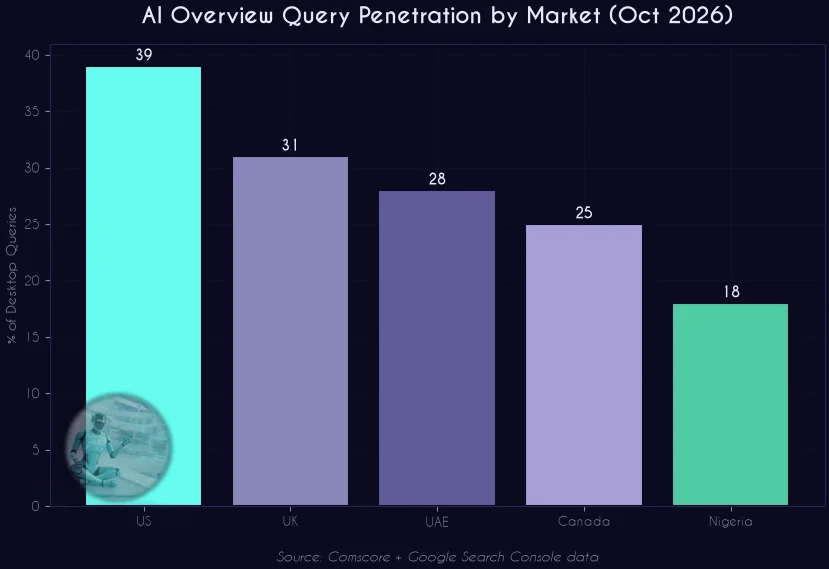
AI Overviews and AI Mode are not uniformly deployed. Google launched AI Overviews in France on July 22, 2026, and the rollout continues globally. Different markets have different levels of AI Overview penetration, different search behaviors, and different competitive landscapes.
For Nigeria specifically, the opportunity is significant. With mobile-first search behavior and growing AI Overview adoption, businesses that invest in fast, crawlable, content-rich pages now will build citation equity before competitors catch up. Our AI SEO agency services cover all five markets with localized strategies.
7. The October 2026 AI SEO Checklist
Based on Google's confirmed guidance and the operational realities of AI Overviews in October 2026, here is a practical checklist to audit your AI SEO readiness.
- ✅ Verify crawlability: Check Google Search Console Coverage report. Every important page should be indexed, not just crawled or discovered.
- ✅ Audit snippet eligibility: Ensure no pages have nosnippet or max-snippet:0 directives. AI Overviews require snippet eligibility.
- ✅ Enable the Generative AI Performance report: If available for your property, monitor impressions and pages in generative features.
- ✅ Check inclusion control: Confirm your site is not accidentally excluded from generative AI features in Search Console.
- ✅ Server-render critical content: Price, availability, specifications, and business details should be in the HTML, not client-side only.
- ✅ Validate structured data: Run Schema.org validator on all key pages. Product, Organization, FAQ, and Article schema should be clean and match visible content.
- ✅ Audit cross-source consistency: Compare your website, Merchant Center, social profiles, and third-party listings. Facts must match everywhere.
- ✅ Publish original research: Google rewards original, experience-based content. Create proprietary data, case studies, and expert analysis.
- ✅ Answer fan-out sub-questions: For each key topic, identify 3-5 sub-questions an AI query fan-out might generate and answer each on your page.
- ✅ Stop wasting time on myths: Remove any budget allocated to llms.txt, Markdown alternates, content chunking, or manufactured mentions.
This is the no-nonsense approach that works in October 2026. No shortcuts, no special files, no secret formulas. Just disciplined execution of the fundamentals, validated by Google's own guidance.
🚀 Ready to Win in AI Search?
Stop guessing about AI SEO. Get a data-driven audit and strategy from Purple Crib Studios.
💬 Chat With Us on WhatsAppRather Have Experts Handle This?
Purple Crib Studios offers done-for-you AI SEO across the US, UK, UAE, Canada, and Nigeria. Get a free 5-point audit in 48 hours.
Explore Our ServicesFAQs
Does Google use llms.txt for AI Overviews?
No. Google's AI Optimization Guide explicitly states that Search does not use llms.txt, special Markdown files, or other AI text files to rank or include a site in generative features. Publishing them neither helps nor harms your Google Search visibility.
Is there special schema.org markup for AI Overviews?
No. Google says there is no special schema.org markup to add for generative Search. Standard Schema.org types like Article, FAQ, Product, and Organization remain useful for rich results but are not required for AI Overviews.
What is query fan-out in AI Overviews?
Query fan-out is when Google's AI model generates multiple related searches in parallel to answer a compound question. For example, a search for the best hiking bag might trigger separate searches for dimensions, waterproofing, delivery, and reviews, each pulling from different pages or sources.
How can I measure my AI Overviews performance?
Google Search Console now includes a Generative AI Performance report that shows impressions, pages, countries, devices, and dates for generative features. Access is still rolling out to all properties.
What is RAG and how does it affect SEO?
RAG stands for retrieval-augmented generation. Google retrieves relevant, recent pages from the Search index to ground AI-generated answers and provide links to supporting sources. This means fresh, crawlable, indexable content with original insights has an advantage in AI Overviews.
What is agentic search and why does it matter for SEO?
Agentic search is when AI agents autonomously browse, compare, and take actions on behalf of users rather than just generating answers from search results. It requires machine-readable product data, multi-source consistency, and content that answers task-oriented queries. Google names UCP as an emerging technology for agentic experiences.
Test Your Knowledge — AI SEO Myths Quiz
6 quick questions based on this article. Tap an answer to see if you got it right.
📌 See More Content Like This on Google
Want Google to show you more of Purple Crib's expert content on SEO, GMB, and AI marketing? It takes one click — add us as a preferred source and Google will prioritise our articles in your Search results.
📌 Make Google Work for You
Tell Google you want to see more Purple Crib content in your Search results.
Click the link below → check the box → done. Google will show more of our content to you from now on.
🔍 Add Purple Crib as a Google SourceHow it works — 3 simple steps:
- Click the button above (or copy this link: https://google.com/preferences/source?q=https://www.purplecrib.ng)
- Check the box next to Purple Crib on the Google Search preferences page
- Google will now show more of our content when you search for SEO, GMB, AI marketing, and digital strategy topics
Share this with a colleague who wants to stay ahead of Google and AI trends too 👇
Sources & Further Reading
- Google Search Central — AI Optimization Guide
- Verity Score — Google Names 6 AI Search Myths to Ignore
- inblog.ai — 5 Changes AI Search Is Driving in 2026
- Search Engine Journal — AI SEO Industry Coverage
- Genesis Edge — Google AI Overviews SEO Guide 2026
- LinkedIn — Google Releases AI Optimization Guidance Analysis
#AI SEO #GoogleAIOverviews #AIOptimization #SearchConsole #RAG #QueryFanOut #AgenticSearch #GEOMyths #E-EAT #AISEO2026 #SearchEngineOptimization #DigitalMarketing #PurpleCribStudios #SEOStrategy #GlobalSEO