AI search just delivered the strangest two weeks of the year. Google says AI Mode now sends billions of clicks to websites every week, while new 2026 research shows an AI Overview on the page cuts the top organic result's click-through rate by more than half. October 2026 is the month AI SEO stopped being about more traffic versus less traffic, and started being about which ledger you are reading. Here is what changed, what Google's pay-for-citations test means, and the dual-ledger strategy Purple Crib Studios now runs for clients.
🚀 AI Search Is Rewriting Your Traffic Report
Purple Crib Studios builds AI SEO strategies for brands across the US, UK, UAE, Canada, and Nigeria. Get a free AI-readiness audit today.
💬 Chat With Us on WhatsAppTable of Contents
- Where AI Search Stands in Mid-October 2026
- The Paradox: More Clicks, Fewer Blue-Link Clicks
- Google's Pay-for-Citations Test: The AI Contribution Report
- The Dual-Ledger AEO Strategy
- What This Means Across Your Markets
- The 10-Point AI Search Measurement Checklist
- FAQs
- Test Your Knowledge — Quiz
1. Where AI Search Stands in Mid-October 2026
The scale numbers deserve the phrase "pinch yourself." Google's AI Mode, which the company describes as the start of a new era for AI Search, has crossed a billion monthly active users and — by Google's own account — is sending billions of clicks to websites every week. ChatGPT sits at roughly 900 million weekly active users with about 50 million paying subscribers. Traffic from generative AI platforms grew close to 800% year over year in 2026 studies, and 63% of websites now report measurable traffic originating from AI-based search engines.
If this were the whole story, the October strategy meeting would be short: pour everything into AI visibility and enjoy the surge. But the same month produced the mirror-image data point, and that is where the paradox lives.
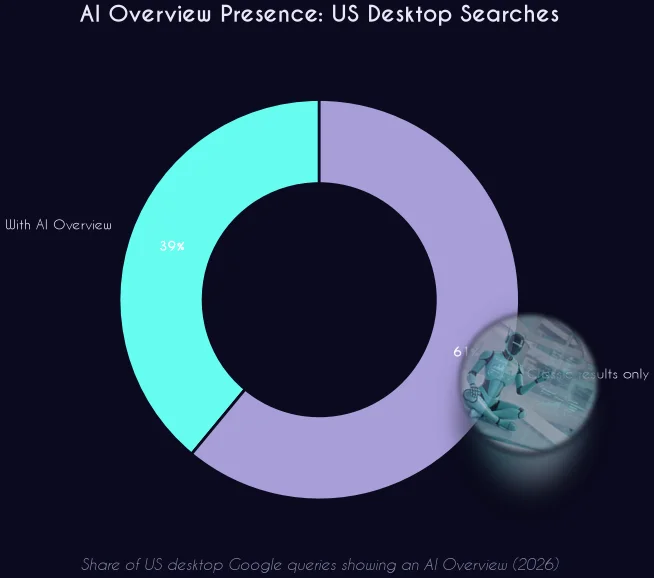
For context on how fast this moved, our AI Overviews reality check from earlier this month covered AI Overviews appearing on 39% of US desktop queries. Two weeks later, the story has already evolved twice over.
2. The Paradox: More Clicks, Fewer Blue-Link Clicks
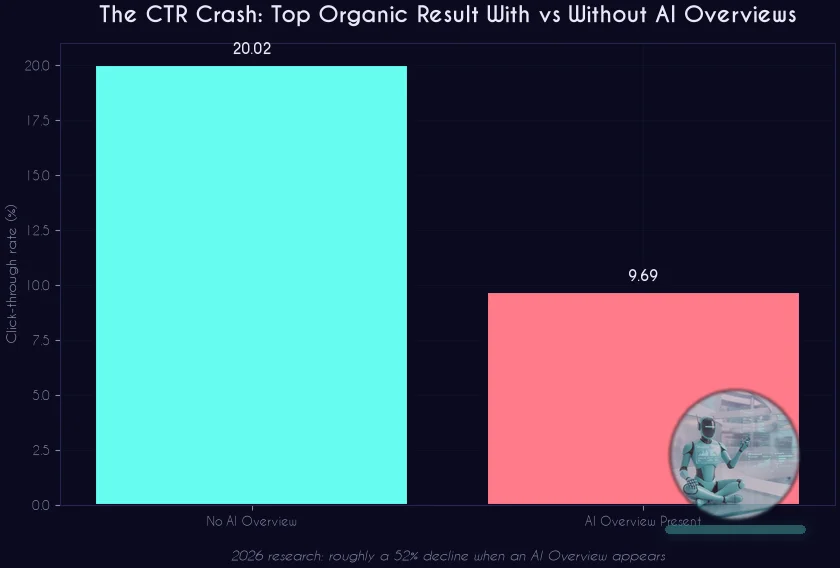
2026 research summarized by M&C Saatchi Performance found that the top organic result's CTR collapses from about 20% to under 10% — a drop of roughly 52% — when an AI Overview appears above it. At the same time, Google reports AI Mode pushing billions of weekly clicks to sites, and early studies show AI-referred visitors convert at higher rates than Google organic visitors.
Both numbers are true. They describe different ledgers.
The reconciliation is behavioral. AI answers absorb the shallow informational queries that used to produce low-intent clicks on position one. What survives — and what AI Mode actively routes — is the deeper demand: users who ask an agent a question, get a citation, click through with a job in mind, and convert. You are losing volume at the top of the funnel and gaining intent at the bottom. A strategy that measures only total sessions will panic; a strategy that measures the ledger will act.
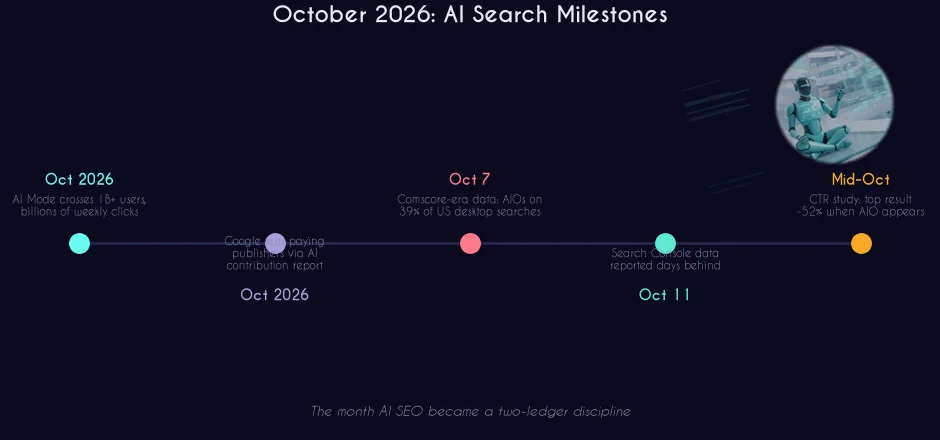
One more October wrinkle: Google Search Console data was reported days behind starting around October 11, 2026. Before diagnosing an AI-driven traffic crash, first check whether your data is even current.
3. Google's Pay-for-Citations Test: The AI Contribution Report
The most consequential October development is easy to miss: Google is testing paying publishers for content used in AI Mode, AI Overviews, and Gemini. The mechanism is a new AI contribution report in Search Console, which tracks where publisher content contributes to AI answers. It is an experiment, not a program — but the direction matters more than the current payout.
For a decade, publishers complained that AI answers used their content without compensation while shrinking their clicks. A functioning pay-for-contribution system changes the economics of citability itself. Being the source an AI system quotes would no longer be just a traffic play; it would be a direct relationship with the platform. That reframes every content investment decision you make this quarter.
Three practical implications, and one caution based on the myths we already debunked in our AI search myths piece: do not chase payment tricks, because the fundamentals of citation remain relevance, authority, and clean answers. There is no schema hack or text file that makes Google pay you.
- Citable content becomes an asset class. Content structured to answer questions directly, with verifiable data and clear attribution, is positioned for both citations and potential contribution credit.
- Measurement adds a new layer. The Generative AI Performance report in Search Console plus the AI contribution report give you visibility into how AI uses your content — track both.
- Authority compounds. The brands cited today are the ones building entity trust aggressively: consistent brand information, expert bylines, original data, and coverage that AI systems can attribute.
4. The Dual-Ledger AEO Strategy
Winning October 2026 means optimizing both ledgers at once. We run this as a four-part loop for clients on four continents.
1. Earn the citation. Keep doing the boring, hard things: front-load direct answers in the first third of the page, structure content around questions people actually ask, publish original data, maintain entity consistency, and grow the brand mentions that AI systems weight heavily. Our AI citation economy playbook details the mechanics.
2. Capture the intent AI sends your way. AI-referred visitors arrive mid-thought, often on mobile, with a specific job. Match landing pages to the question that cited you — the answer they saw must be immediately visible, with the next step one tap away. This is where the higher conversion rates come from, and most sites squander them.
3. Defend the brand marketplace. With AI Overviews now appearing on many branded queries too, make sure brand searches land users somewhere you control: a complete brand entity, clear differentiators, and offers your competitors cannot paraphrase into a generic AI answer.
4. Measure by ledger, not by volume. Segment AI-referred traffic from classic organic. Track conversions and revenue per AI visit, not just sessions. Watch the Generative AI Performance report and the new contribution reporting in Search Console together.
5. What This Means Across Your Markets
The paradox does not hit every market at the same speed, and brands running multi-region strategies should calibrate accordingly.
- United States. Highest AI Overview and AI Mode penetration — the CTR compression is most visible here, and US AI-referred conversion behavior is the benchmark the studies describe. Act on the dual ledger now, not next year.
- United Kingdom. Close behind the US in adoption, with strong Google AI Search coverage. Publisher-ecosystem debates around citations are loudest here, which likely accelerates any pay-for-contribution rollout.
- UAE. AI adoption is rapid across the Gulf, but traditional search and local discovery still carry heavy volume. The play is building authority ahead of the compression — bilingual citable content wins early.
- Canada. Similar dynamics to the US with a slightly slower curve. Bilingual content doubles the citation surface for French-speaking queries.
- Nigeria and emerging markets. Data costs put most local demand on classic search and social for now, meaning the volume ledger still pays well. Cheap insurance: structure today so you are the cited source when AI search arrives at scale.
For the broader AI landscape this month — agentic search behavior and platform changes beyond Google — our Gemini 4 Argon and AI cybersecurity breakdown covers the rest of the picture.
6. The 10-Point AI Search Measurement Checklist
Run this against your analytics and Search Console before the next strategy meeting. It converts the paradox into a decided plan.
✅ 1. Search Console shows the Generative AI Performance report — and someone reviews it weekly
✅ 2. AI-referred traffic is segmented from classic organic in analytics, by source
✅ 3. Conversion rate and revenue per AI-referred visit are tracked, not just sessions
✅ 4. CTR on pages where AI Overviews appear is benchmarked against pages where they do not
✅ 5. GSC data freshness checked — post-October 11 reports may lag days behind
✅ 6. Top pages answer their core question in the first third of the content
✅ 7. Landing pages for AI citations show the promised answer above the fold, with one-tap next steps
✅ 8. Brand queries tested monthly in AI Mode and AI Overviews — check who gets cited
✅ 9. Original data or expert commentary published at least monthly — the assets AI systems quote
✅ 10. The AI contribution report is monitored as the pay-for-citations experiment expands
That is the same audit our AI SEO team runs for clients — and the checklist that decides where each content dollar goes next quarter.
🧠 Both Ledgers, One Strategy
Citations, traffic capture, and AI-ready measurement — Purple Crib Studios runs the full dual-ledger AEO loop for brands worldwide. Book a free AI-readiness audit.
💬 Get My Free AuditRather Have Experts Handle This?
Purple Crib Studios offers done-for-you AI SEO and AEO across the US, UK, UAE, Canada, and Nigeria. Get a free 5-point AI-readiness audit in 48 hours.
Explore Our ServicesFAQs
Is AI search sending more traffic to websites or less?
Both, on different ledgers. Google reports AI Mode sends billions of clicks weekly and 63% of websites now see AI-originating traffic. But when an AI Overview appears, the top organic result's CTR drops roughly 52%, from about 20% to under 10%. AI absorbs shallow informational queries while routing deeper, higher-intent visitors who convert at above-average rates. Total volume can fall while revenue per visitor rises.
What is Google's pay-for-citations experiment?
In October 2026, Google began testing paying publishers for content used in AI Mode, AI Overviews, and Gemini, tracked through a new AI contribution report in Search Console. It is an experiment rather than a confirmed program, but it signals that being cited by AI systems may become a compensated relationship with the platform, not just a click source.
How do I track traffic from AI search engines?
Segment AI-referred sessions by source — ChatGPT, Perplexity, Gemini, Google AI Mode and AI Overviews referrals — and compare their conversion rates and revenue per visit against classic organic. In Search Console, use the Generative AI Performance report, and monitor the new AI contribution report as it rolls out. Note that Search Console data was running days behind starting around October 11, 2026, so confirm data freshness before diagnosing changes.
Do AI-referred visitors actually convert?
Early 2026 studies say yes — AI-referred visitors convert at higher rates than Google organic averages. They arrive with a specific job in mind after an AI answer cited your page. The catch is that the landing page must show the promised answer immediately and offer a clear next step; AI visitors bounce fast from generic pages.
Should emerging-market brands like Nigeria invest in AEO now?
The volume ledger in markets like Nigeria still pays well through classic search and social. But structuring content for citability now is cheap insurance: brands that answer questions directly with clean, attributed content become the sources AI systems cite when AI search reaches mass adoption locally. The cost is editorial discipline, not budget.
Is there a way to guarantee AI citations?
No. Google's own guidance is consistent: there is no special schema, file, or hack that forces AI citation. Citations follow relevance, authority, and clear answers — front-loaded, question-driven structure, original data, expert attribution, and strong brand entity signals. Anything promising guaranteed citations is selling a myth.
Test Your Knowledge — AI Mode Traffic Paradox Quiz
10 quick questions based on this article. Tap an answer to see if you got it right.
Enjoyed this? One click tells Google to show you more Purple Crib content in Search.
Add on GoogleSources & Further Reading
- Google — A new era for AI Search
- Search Engine Roundtable — October 2026 Google Webmaster Report (publisher pay test)
- M&C Saatchi Performance — GEO Data, Trends and Tactics (CTR study)
- Peec AI — GEO Statistics 2026 (AI search adoption)
- Digital Agency Network — GEO Statistics 2026 (AI-driven site traffic)
- Semrush — AI SEO Statistics for 2026
#AISEO #AIMode #AIOverviews #AEO #GEO #GenerativeSearch #GoogleSearch #SearchConsole #AITraffic #ContentStrategy #DigitalMarketing #SEO2026 #MarketingStrategy #ChatGPTSearch #OrganicSearch