Late September 2026 has delivered one of the most crowded AI release windows on record: four frontier labs shipped major models inside a single week, CNBC coined the phrase "model fatigue" to describe it, and Anthropic closed the month with Claude Opus 5.5 and Sonnet 5.5. At Purple Crib Studios, we help businesses across the US, UK, UAE, Canada, and Nigeria cut through that noise — so this guide breaks down what actually shipped, what it means for marketing teams, and what to do next.
🚀 Can't Keep Up With AI Releases? Let Us Filter the Noise
Purple Crib Studios tracks every major AI launch and turns it into an actionable strategy for your business.
💬 Chat With Us on WhatsAppTable of Contents
- 1. Four Frontier Models in One Week: "Model Fatigue" Is Real
- 2. Claude Opus 5.5 and Sonnet 5.5: What Actually Changed
- 3. Gemini 3.8 Flash and the Rise of Cyber-Specialist Models
- 4. AI Security and Governance: Inside Anthropic's September Threat Report
- 5. OpenAI DevDay 2026: What to Watch
- 6. The Business Adoption Playbook for Late 2026
- FAQs
- Test Your Knowledge — Quiz
1. Four Frontier Models in One Week: "Model Fatigue" Is Real
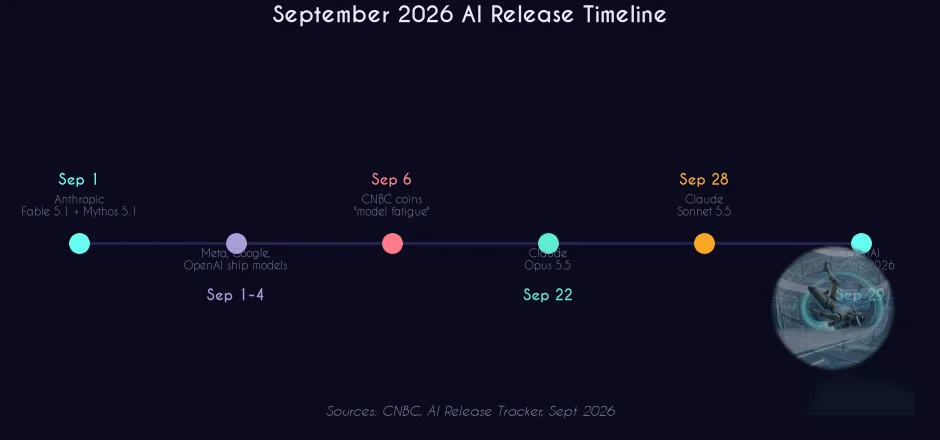
Between September 1 and September 4, 2026, Anthropic, Meta, Google, and OpenAI each shipped a major new AI model — back to back, inside the same week. On September 6, CNBC named the resulting exhaustion "model fatigue", and the term stuck because it describes something every marketing and operations team is feeling: the pace of frontier releases has outpaced most organisations' ability to evaluate them.
4
frontier models shipped by four labs in one week (Sept 1–4, 2026)
133
AI model releases and updates tracked from six providers by September 22, 2026
75%
cache-read price cut that shipped with Anthropic's September 1 models
Why does this matter for a business owner in Lagos, Dubai, Toronto, or Chicago? Because the question has changed. In 2024 the question was "should we use AI?" In late 2026 the question is "which model, for which task, reviewed how often?" Tracking services like AI Release Tracker and Evertune's model tracker now list more than a hundred releases in a single year. Nobody can evaluate all of them — and nobody should try.
If you missed our previous breakdown of the deeper infrastructure shift behind this acceleration, read AI Trends in August 2026: The Infrastructure Reset for the bigger picture.
2. Claude Opus 5.5 and Sonnet 5.5: What Actually Changed
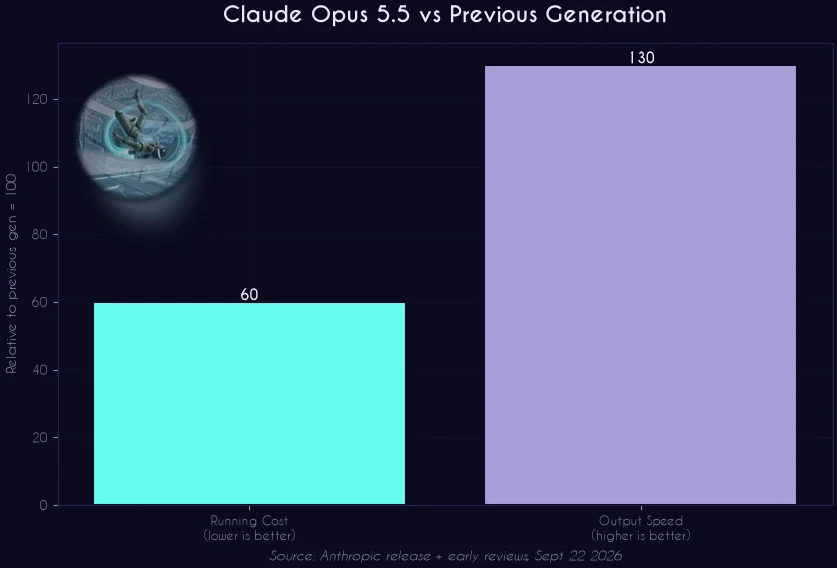
Anthropic closed September with two headline releases. On September 22, 2026, the company shipped Claude Opus 5.5 — the first model in the Claude 5.5 family — cutting standard API pricing to roughly $4 per million input tokens and $20 per million output tokens. Early reviews reported operating costs around 40% lower than the previous generation, output roughly 30% faster, and noticeably sharper performance reading design visuals, code, and knowledge work.
Six days later, on September 28, Anthropic followed with Claude Sonnet 5.5, positioned as the workhorse model for coding, everyday agentic tasks, computer use, and professional knowledge work. The pattern is deliberate: a premium flagship for heavy reasoning, and a faster, cheaper tier that most production workloads actually run on.
Claude Opus 5.5 — flagship tier
- Released September 22, 2026
- About 40% cheaper to run than its predecessor
- About 30% faster output
- Stronger at coding, design analysis, and knowledge tasks
Claude Sonnet 5.5 — workhorse tier
- Released September 28, 2026
- Tuned for coding and everyday agentic tasks
- Supports computer use workflows
- The sensible default for production automation
For marketing and content teams, the practical impact is straightforward: long-form generation, technical audits, and multi-step agent workflows just got cheaper to run at scale. If your team is still on a 2025-era model for batch content operations, this month is a reasonable checkpoint to benchmark cost per task against the new tiers. Our AI SEO agency service runs these evaluations for clients continuously — the model landscape is now part of campaign infrastructure, not a curiosity.
3. Gemini 3.8 Flash and the Rise of Cyber-Specialist Models
Google's September contribution was the Gemini 3.8 Flash family — and one variant in particular caught our attention: Gemini 3.8 Flash Cyber, a security-focused specialisation announced by Google AI this month alongside the standard Flash. The significance is not the speed bump. It is the fact that frontier labs are now shipping task-specific models for cybersecurity work as a product line, not a research demo.
This is part of a wider pattern you can see across the September window: general-purpose flagships are still improving, but the fastest growth is in specialised variants — coding models, cyber models, trusted-access twins like Anthropic's Mythos line, and regional deployments. For businesses, that means model selection is becoming a portfolio decision: you do not pick one AI, you pair a general-purpose workhorse with specialists for high-stakes tasks.
Curious how this connects to search? Our guide on AI SEO in 2026: From Ranking Pages to Being Cited by AI covers how these same models are now the engines that decide which brands get recommended inside AI answers.
4. AI Security and Governance: Inside Anthropic's September Threat Report
Every AI Trends article we publish includes a security and governance section, because capability without guardrails is how businesses get hurt. September's most important read here is Anthropic's own September 2026 threat intelligence report, which documents real case studies of AI misuse the company detected and helped disrupt between December 2025 and August 2026 — spanning seven areas of harm, from cyber operations to biological misuse.
Three lessons from the report are directly relevant to any business running AI in production:
- Misuse is operational, not theoretical. The report describes concrete campaigns — fraud, intrusion assistance, influence operations — that were disrupted through detection and partnership with platform and enforcement teams.
- Red-teaming pays. Frontier labs now run continuous misuse testing before and after launch. Your organisation should mirror that posture in miniature: test what your own AI workflows can be tricked into doing.
- Governance is now table stakes in regulated markets. The EU AI Act — in force since August 2024, with obligations phasing in through 2026 — sets the compliance floor for any business selling into Europe. Teams in Nigeria, the UAE, and North America serving EU customers inherit that reality. You can follow the Act's obligations at the EU AI Act official portal.
To be clear: Purple Crib Studios does not sell AI security services. We cover this because our clients run marketing and content operations on top of these models, and understanding the risk landscape is part of using them responsibly. If you want the full regulatory timeline for AI-driven content operations, our earlier piece on July's AI trends and the China-US AI race connects the governance dots across regions.
5. OpenAI DevDay 2026: What to Watch
Today, September 29, OpenAI hosts its 2026 DevDay, promising "a first look at what's next in ChatGPT, Codex, and tools for building" on its official OpenAI announcements page. Based on the direction of the last several months — agentic tools, developer platformisation, and real-time multimodal work — here is what we will be watching for on behalf of our clients:
- Agentic building blocks: cheaper, more reliable long-running agents for automation-heavy marketing operations.
- Codex upgrades: deeper code generation and review, which shortens the build cycle for custom analytics and internal tools.
- Search and discovery features: anything that changes how ChatGPT recommends brands — because for our industry, that is the new front page of Google.
- Pricing moves: after Anthropic's 40% cut, every lab is under pressure to respond. Cheaper tokens mean more viable AI SEO and content automation budgets.
We will publish a full DevDay breakdown for marketers once the announcements land. If you want it the moment it's out, the fastest route is our WhatsApp channel — tap the banner below.
🚀 Want the DevDay Breakdown First?
Message Purple Crib Studios on WhatsApp and we'll send you the marketer's summary of OpenAI DevDay 2026.
💬 Get the DevDay Brief6. The Business Adoption Playbook for Late 2026
Here is the honest advice we give clients when a release month like September happens: do not chase every launch. Build a repeatable evaluation rhythm instead. This is the checklist we run — adapt it to your team:
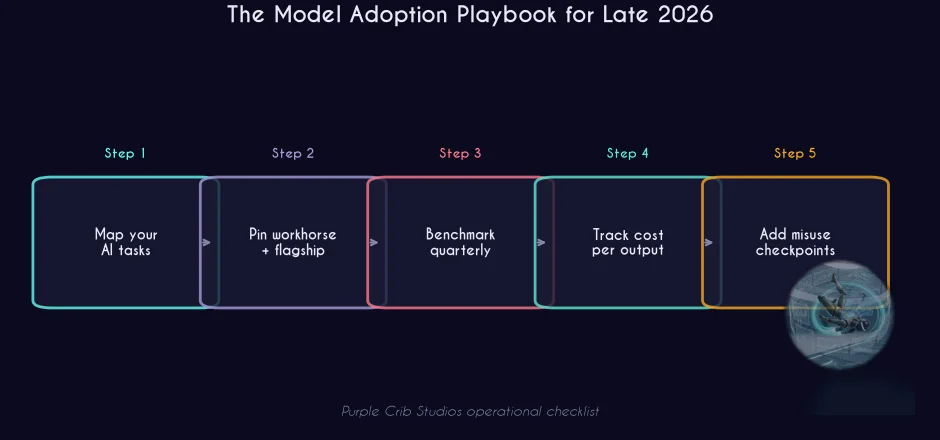
- ✅ Map your AI tasks, not the models. List the 5 things AI actually does for your business (content drafting, data cleanup, support replies, etc.).
- ✅ Pin one workhorse and one flagship. A fast, cheap tier for volume (Sonnet 5.5-class) and a premium tier for judgment-heavy work (Opus 5.5-class).
- ✅ Benchmark quarterly, not weekly. Run the same 10-task benchmark every quarter across your shortlist. Ignore everything in between.
- ✅ Track cost per output, not price per token. Cheaper tokens only matter if the model gets the task right on the first try.
- ✅ Add a misuse checkpoint. Before deploying any new model into customer-facing workflows, test what it can be tricked into doing.
- ✅ Keep a human reviewer for anything public. Every article we publish — including this one — is researched and coordinated by a human, co-written with AI, and approved before it goes live.
- ✅ Write the governance down. One page: which models, which data, who approves, what happens when something goes wrong.
Teams that follow a rhythm like this end up ahead of the "model fatigue" cycle — because they stop treating every launch as a decision and start treating model choice as an infrastructure review. If you would rather have that entire process run for you, that is precisely what Purple Crib Studios does for businesses across the US, UK, UAE, Canada, and Nigeria.
Rather Have Experts Handle This?
Purple Crib Studios offers done-for-you AI SEO and content automation across the US, UK, UAE, Canada, and Nigeria. Get a free 5-point audit in 48 hours.
Explore Our ServicesFAQs
What is "model fatigue" in AI?
Model fatigue is the term CNBC used on September 6, 2026, to describe the exhaustion buyers and developers feel as AI labs ship major new models back to back — four frontier labs released updates within a single week in early September 2026. It reflects the gap between release pace and most organisations' ability to evaluate and adopt them.
When was Claude Opus 5.5 released?
Claude Opus 5.5 was released by Anthropic on September 22, 2026. It cut standard API pricing to roughly $4 per million input tokens and $20 per million output tokens, ran about 40% cheaper and 30% faster than its predecessor, and improved performance on coding, design analysis, and knowledge tasks.
Should my business switch to the newest AI model right away?
Not automatically. Best practice in late 2026 is to map the tasks AI performs for your business, pin one fast workhorse model and one premium flagship, and benchmark quarterly rather than chasing every launch. Track cost per completed output rather than price per token.
What is Gemini 3.8 Flash Cyber?
Gemini 3.8 Flash Cyber is a security-focused variant of Google's Gemini 3.8 Flash model family announced in September 2026. It reflects a wider trend of frontier labs shipping task-specialised models — in this case, tuned for cybersecurity work — rather than only general-purpose assistants.
Is AI misuse actually a business risk, or just hype?
It is a measurable risk. Anthropic's September 2026 threat intelligence report documents real misuse case studies — from cyber operations to fraud and influence campaigns — detected and disrupted between December 2025 and August 2026 across seven areas of harm. Businesses running AI in production should test their own workflows for misuse and keep a human reviewer on customer-facing output.
What is happening at OpenAI DevDay 2026?
OpenAI DevDay 2026 takes place on September 29, 2026, with promised first looks at what's next in ChatGPT, Codex, and developer tools. For marketers, the key areas to watch are agentic automation improvements, code generation upgrades, and any changes to how ChatGPT recommends brands in answers.
Test Your Knowledge — Late September 2026 AI Trends Quiz
6 quick questions based on this article. Tap an answer to see if you got it right.
📌 See More Content Like This on Google
Want Google to show you more of Purple Crib's expert content on SEO, GMB, and AI marketing? It takes one click — add us as a preferred source and Google will prioritise our articles in your Search results.
📌 Make Google Work for You
Tell Google you want to see more Purple Crib content in your Search results.
Click the link below → check the box → done. Google will show more of our content to you from now on.
🔍 Add Purple Crib as a Google SourceHow it works — 3 simple steps:
- Click the button above (or copy this link: https://google.com/preferences/source?q=https://www.purplecrib.ng)
- Check the box next to Purple Crib on the Google Search preferences page
- Google will now show more of our content when you search for SEO, GMB, AI marketing, and digital strategy topics
Share this with a colleague who wants to stay ahead of Google and AI trends too 👇
Sources & Further Reading
- CNBC — 'Model fatigue' sets in as AI labs roll out new versions at frenetic pace
- Anthropic — Threat Intelligence Report, September 2026
- AI Release Tracker — Frontier model release timeline
- Evertune — AI Model Release Tracker
- Google AI — Gemini 3.8 Flash and 3.8 Flash Cyber announcement
- EU AI Act Portal — Regulation obligations and timeline
#AITrends2026 #ModelFatigue #ClaudeOpus55 #ClaudeSonnet55 #Anthropic #Gemini38Flash #OpenAIDevDay #AISecurity #AIGovernance #EUAIACT #AIAgents #FutureOfWork #AIMarketing #PurpleCribStudios #AITechnology