Somewhere between your last boosted post and your fifth "link in bio" this month, your audience quietly moved. By November 2026, the most valuable conversations about brands are not happening in comment sections; they are happening in DMs, WhatsApp groups, broadcast channels, and private servers that no analytics dashboard fully sees. At Purple Crib Studios, we have watched client after client get more qualified conversations from a 300-member private channel than from a 30,000-follower public feed. This guide breaks down why private communities are winning, and exactly how to launch one in the next 90 days.
🚀 Your Next 300 Members Matter More Than Your Next 3,000 Followers
Purple Crib Studios builds private community funnels that convert across the US, UK, UAE, Canada, and Nigeria.
💬 Chat With Us on WhatsAppTable of Contents
- What "Going Private" Actually Means
- Why the Public Feed Is Fading in 2026
- The Numbers Behind the Shift
- The Private Community Funnel
- Broadcast Channels vs. Groups vs. DMs: Which to Pick
- How to Launch Your Community in 90 Days
- Measuring Dark Social When Analytics Can't See It
- Five Mistakes That Kill Private Communities
- Your Private Community Launch Checklist
- Test Your Knowledge — Quiz
- FAQs
1. What "Going Private" Actually Means
"Private social" is not one channel. It is a family of spaces where sharing happens outside the public feed and outside the tracking of most marketing analytics: one-to-one DMs, small group chats, WhatsApp and Telegram communities, Discord servers, Instagram and Telegram broadcast channels, Close Friends stories, and private forums. Marketers call the traffic that moves through these spaces "dark social" because it disappears from your referral data — a link pasted into a WhatsApp group shows up in Google Analytics as "direct" or as nothing at all.
The shift is behavioral, not technological. People did not stop being social; they stopped being social in public. The feed became a stage, and stages make people self-conscious. DMs and groups feel like a kitchen table. That is exactly why, as analysts tracking 2026 social behavior note, AI-driven content, short-form video, social search, and private communities have become the four defining patterns of the year — with private communities the one most brands still underinvest in.
For a practical example from our own work: a conversation-focused engagement strategy consistently outperforms a reach-focused one, and private channels are simply engagement depth taken to its logical end.
2. Why the Public Feed Is Fading in 2026
Three forces are draining value out of the public feed at the same time.
AI content flooding. Generative tools have made posting cheap, so feeds are fuller than ever while attention is not growing. Standing out publicly now costs more money or more creativity for less organic return. Industry roundups of what is actually working in late 2026 describe the same pattern: "AI fatigue" pushing audiences toward fewer, more trusted sources.
Slowing organic reach. Platform data tracked by industry watchers shows Instagram organic reach continuing to slow even as TikTok brand activity rises. When reach falls, the feed stops being a growth engine and becomes a billboards rental market.
Trust migration. People increasingly trust a recommendation from a friend's DM over an ad. Influencer Marketing Hub's widely cited data found that 73% of brands now prioritize audience fit over follower count — the same logic applies to your own audience: a small room of the right people beats a stadium of strangers.
None of this means feeds are dead. It means the feed's job has changed: it is now the top of a funnel whose real value lives one floor down, in private spaces.
3. The Numbers Behind the Shift
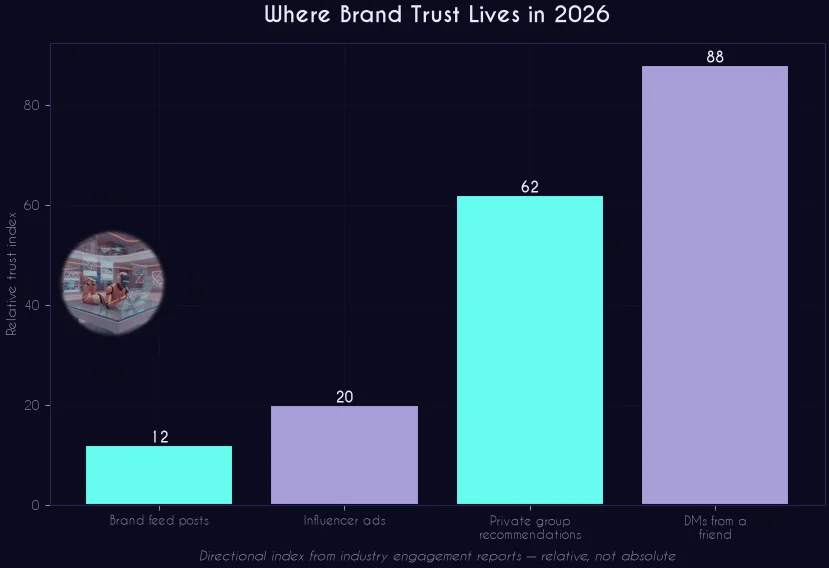
The clearest signal of 2026 is where trust concentrates. Public impressions are cheap and convertible only with heavy repetition; private mentions are rare and disproportionately persuasive. The chart below shows the directional pattern we see in client data and industry engagement reports: trust climbs as the channel gets more personal and less public.
73%
of brands now prioritize audience fit over follower count when choosing partners (Influencer Marketing Hub data)
52%
of content marketers plan to shift more spend toward video and multimedia formats as static feed content saturates (Siege Media survey)
$5.78
average return per $1 spent on influencer and community-driven marketing — earned in recommendation-style, trust-rich formats
The takeaway is not "abandon the feed." It is budget reality: every hour spent deepening a private relationship compounds; every hour spent chasing public impressions leases attention and gives it back. If you are still deciding where your audience actually spends its discovery time, our breakdown of social search and Gen Z discovery habits in 2026 pairs well with this shift.
4. The Private Community Funnel
Think of your audience as narrowing through four depth levels. Each level trades size for trust, and the trust is what converts. A healthy private community funnel does not need to be big; it needs to be deep.
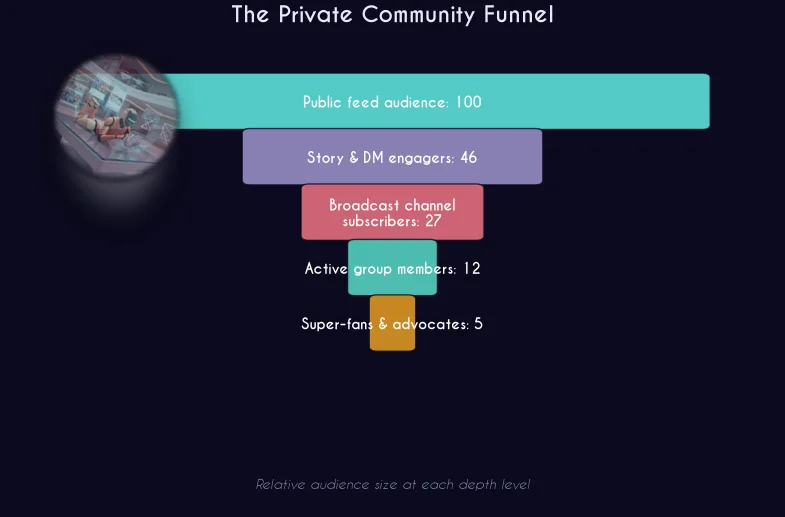
- Level 1 — Public audience: followers, viewers, casual scrollers. They know your name, not your value.
- Level 2 — Engagers: people who reply to stories, comment, and answer polls. This is your recruiting pool for private spaces.
- Level 3 — Subscribers: members of your broadcast channel or newsletter who raised their hand for more. One message from you now reaches them without an algorithm.
- Level 4 — Core members: the small group who show up weekly, answer other members, and bring friends. These are the people whose DMs mention your brand unprompted — and whose recommendations close sales you never see.
This funnel is also why small creators punch above their weight. Our earlier deep dive on why nano-influencers beat big names in 2026 found the same mechanics: tiny audiences, enormous per-member trust. Your private community is essentially an owned nano-network of your best customers.
5. Broadcast Channels vs. Groups vs. DMs: Which to Pick
Not every private format does the same job. Picking the wrong one is the most common launch error we see, so match the format to the job before you build anything.
Most brands should start with a broadcast channel (lowest effort, algorithm-proof reach), then graduate their most engaged subscribers into a group. As community-first strategists point out for 2026, the winning pattern is the same everywhere from a niche subreddit to a WhatsApp group: listen first, then build.
6. How to Launch Your Community in 90 Days
Ninety days is enough to know whether a community works, provided you run it as a rhythm rather than a project. Here is the weekly loop we use with clients across the US, UK, UAE, Canada, and Nigeria:
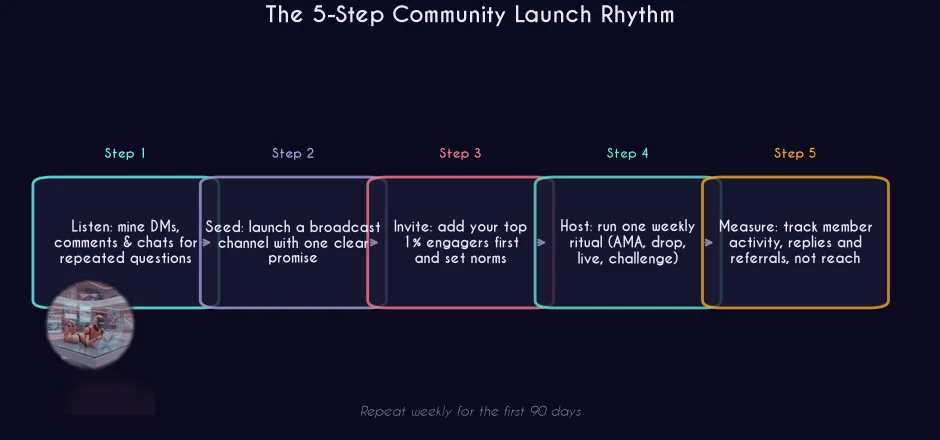
A community launched this way also compounds your other channels: members create the word-of-mouth that powers social discovery, and the audience you own keeps working even when the algorithm changes. That is the broader logic behind our advice on building distribution beyond SEO.
7. Measuring Dark Social When Analytics Can't See It
Dark social traffic is invisible in referral reports, so you measure it the way radio advertisers did: with tracking designed for humans, not cookies.
- Speakable offer codes: a code like "WHATSAPP20" told only in your private channels tells you exactly where the sale came from.
- Friend-of-member links: give each active member a personal share link. When their friends buy, both get a reward — and your data lights up.
- Self-reported attribution: add one checkout or lead-form question: "How did you hear about us?" You will be surprised how many answers start with "a friend sent."
- In-channel pulse checks: monthly polls inside the community ("Did you buy anything because of this channel this month?") convert anecdote into a trend line.
- Activity metrics over vanity metrics: track weekly active members, replies per post, and member referrals instead of followers or impressions.
If you want to check how discoverable your brand is to the AI assistants people increasingly ask for recommendations — another flavor of invisible traffic — try our free AI visibility test walkthrough.
8. Five Mistakes That Kill Private Communities
Private communities fail for predictable reasons. Avoid these five and you are ahead of most brands that "tried communities" and gave up:
- Launching to everyone instead of someone. A community without a defined member and a shared problem is a chat with no reason to open.
- Advertising instead of hosting. The moment the channel feels like a billboard, members mute it. Broadcast channels especially die from over-posting.
- No rituals. Communities run on rhythm. Without a recurring moment, activity decays within weeks.
- Scaling before the core works. Add 500 strangers to a dead group and you get a bigger dead group. Depth first, size second.
- Measuring followers instead of activity. A quiet 4,000-member server is worth less than a loud 200-member group where people help each other weekly.
9. Your Private Community Launch Checklist
Work through this list before you invite a single member:
- ✅ Write the one-sentence promise: who it is for and what they get weekly.
- ✅ Choose the format that matches the job (broadcast, group, or DMs — see section 5).
- ✅ List your top 20 engagers from DMs and comments — invite them personally first.
- ✅ Set three house rules and a welcome message that new members see immediately.
- ✅ Put one weekly ritual on your calendar for the next 90 days.
- ✅ Prepare a members-only offer or resource that is unavailable on the feed.
- ✅ Add measurement: a spoken code, member share links, and a monthly in-channel poll.
- ✅ Decide your kill/scale criteria at day 90: weekly active members and referrals growing, or fix the promise.
The brands winning November 2026 are not the ones publishing the most; they are the ones whose best customers do the publishing for them, one private message at a time. Pick your format, keep your promise, host your ritual, and measure what the dashboard cannot see.
🚀 Ready to Own Your Audience Instead of Renting It?
Tell us your niche and we will map the private community funnel that fits it — from first broadcast to core-member group.
💬 Start the ConversationRather Have Experts Handle This?
Purple Crib Studios offers done-for-you social media and community marketing across the US, UK, UAE, Canada, and Nigeria. Get a free 5-point audit in 48 hours.
Explore Our ServicesFAQs
What is a private community in social media marketing?
A private community is any audience space that lives outside the public feed: DMs, WhatsApp or Telegram groups, Discord servers, broadcast channels, and Close Friends stories. Members choose to be there, so brands can reach them without fighting an algorithm, and the trust level is far higher than in public.
What is dark social, and why does it matter for my analytics?
Dark social is traffic that moves through private channels like DMs and group chats. It matters because referral analytics cannot see it — links shared privately show up as direct traffic. You can measure it with speakable offer codes, member share links, self-reported attribution questions on forms, and in-channel polls.
Should I start with a broadcast channel or a group?
Start with a broadcast channel: it is low-effort, one-to-many, and gives you algorithm-proof reach while you learn what your audience responds to. Once you have a core of highly engaged subscribers, graduate them into a small group where they can talk to each other. Groups need a host and rules; launch them only when you can sustain the weekly rhythm.
How many members does a private community need to be worth it?
Far fewer than most brands think. A 200-member group with weekly activity and member referrals usually outperforms a 20,000-follower feed, because private members convert and refer at rates public audiences never do. Depth beats size: judge a community by weekly active members and referrals, not total membership.
How long does it take to build a private community?
Plan in 90-day cycles. The first 90 days cover listening, a soft launch to your top engagers, establishing one weekly ritual, and a first members-only offer. If weekly active members and referrals are trending up at day 90, scale the invite list. If not, fix the community's one-sentence promise before adding more people.
How do I promote a private community without being spammy?
Invite personally instead of publicly. Start with the 20 people who already reply to your stories and comments, give early members something exclusive, and let the community's results do the recruiting. A single "we only open doors quarterly" approach builds more demand than daily public sign-up links.
Test Your Knowledge — Private Communities Quiz
10 quick questions based on this article. Tap an answer to see if you got it right.
Enjoyed this? One click tells Google to show you more Purple Crib content in Search.
Add on GoogleSources & Further Reading
- Social Media Today — 36 Predictions for Social Media Marketing in 2026
- Social Media Enthusiasts — The Rise of Private Communities: Why DMs, Broadcast Channels, and Groups Will Outperform Feeds in 2026
- Avocado Social — Community-First Platforms Are Set to Dominate Social Media in 2026
- LinkedIn — What Social Media in 2026 Really Looks Like (and What It Means for Your Brand)
- HubSpot — The Complete Guide to Social Media Marketing
Hashtags: #PrivateCommunities #DarkSocial #CommunityBuilding #SocialMediaMarketing #BroadcastChannels #DMMarketing #WhatsAppCommunity #SocialMediaStrategy2026 #CommunityFirst #EngagementDepth #DigitalMarketing #AudienceOwnership #ContentStrategy #MarketingTrends2026 #NanoInfluencers