November 2026: brands are quietly rewriting their influencer budgets. While boardrooms still debate celebrity endorsements, the fastest-growing corner of the creator economy is happening at the bottom of the follower pyramid. Nano-influencers (1,000–10,000 followers) now make up 75.9% of Instagram’s entire influencer base and deliver engagement rates mega-celebrities can only dream about. Here is Purple Crib Studios’ evidence-based breakdown of why small creators are winning 2026 — and exactly how your brand can ride the shift.
🚀 Want a Nano-Influencer Campaign Built for Your Market?
Purple Crib Studios builds and manages creator campaigns for brands across the US, UK, UAE, Canada and Nigeria.
💬 Chat With Us on WhatsAppTable of Contents
- The 2026 Creator Economy in Numbers
- The Engagement Math: Why Nano Beats Mega
- What Each Creator Tier Is Actually Good For
- The Authenticity Premium: Why Real Beats Polished
- The Global Angle: Five Markets, One Playbook
- The 7-Step Nano-Influencer Playbook
- Measuring ROI and Avoiding Costly Mistakes
- Your 10-Point Nano Readiness Checklist
- Test Your Knowledge — Quiz
- FAQs
1. The 2026 Creator Economy in Numbers
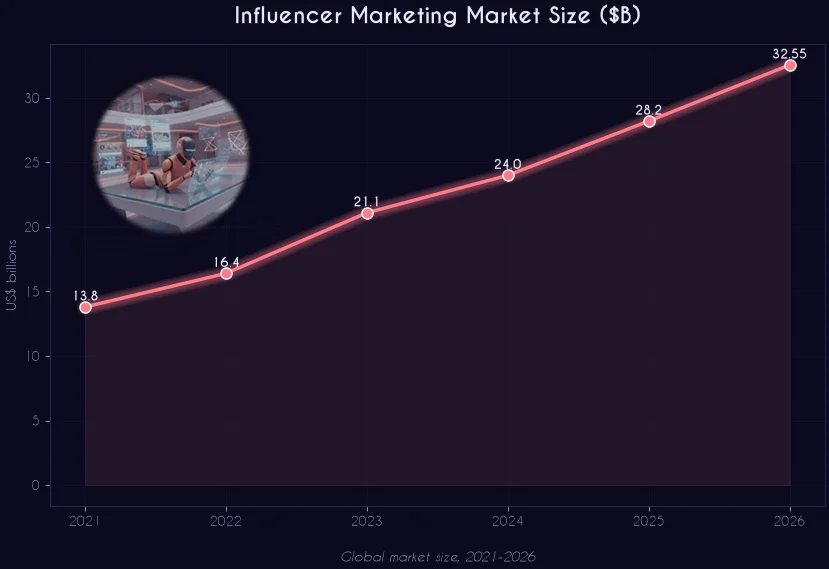
The scale of social in 2026 is hard to overstate: DataReportal counts 5.79 billion social media user identities, or 69.9% of everyone on Earth. Against that backdrop, the influencer marketing industry has grown into a $32.55 billion global market in 2026, and brands now push up to 25% of their digital marketing budgets into creator campaigns, according to creator-economy data compiled for 2026.
But the most telling number is the shape of the creator base itself. The influencers brands actually work with are overwhelmingly small:
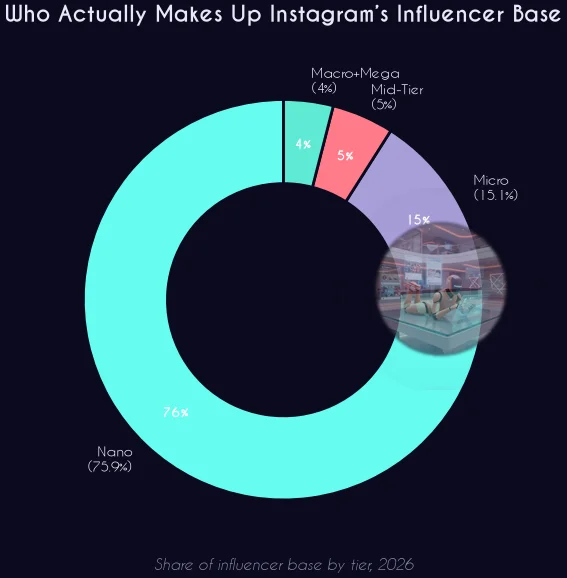
That 75.9% is not a niche. It is the market. And as we covered in Social Search in 2026: Why Gen Z Picks TikTok Over Google, younger audiences now discover brands through creators and feeds, not search boxes — which makes the person sharing your product matter more than the size of their following.
Platform growth in late 2026 also shows where audiences are drifting. According to Statista’s October 2026 audience data, Pinterest recorded 76.8% year-over-year audience growth — the fastest of any major platform — ahead of TikTok (17.4%) and LinkedIn (16.6%). And Pew Research’s October 2026 fact sheet finds 95% of US adults aged 18–29 use YouTube, 79% use Instagram and 65% use TikTok, confirming that creator-led video and visual feeds remain the primary arena for brand discovery.
2. The Engagement Math: Why Nano Beats Mega
Here is the uncomfortable truth for anyone still paying celebrity rates: engagement collapses as follower counts grow. Industry benchmark data for 2026 shows nano-influencers (1,000–10,000 followers) pull a median Instagram engagement rate of 1.79% — roughly five times the 0.33–0.35% managed by macro and mega influencers.
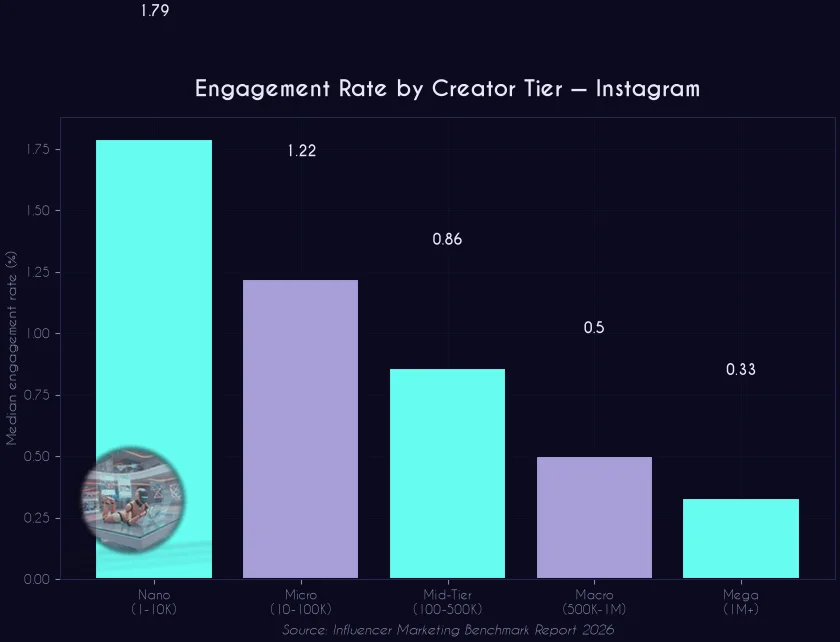
On TikTok the gap is even wider: nano-creators average 10.3% engagement, per influencer industry benchmark statistics. The physics are simple — a creator with 7,000 followers still replies to DMs, knows most commenters by name, and posts about things they genuinely use. A creator with 7 million followers is broadcasting.
Do the multiplication: 20 nano-creators with 5,000 followers each reach 100,000 people at high trust and a fraction of one celebrity’s fee — and if one flops, you lose 5% of your budget, not 100%. This is also why reach-first tactics are dying, as we dissected in Social Media in October 2026: The Algorithm Reset Killing Reach-First Marketing.
3. What Each Creator Tier Is Actually Good For
The smart move in 2026 is not picking one tier forever — it is matching the tier to the job.
Nano (1K–10K): trust, niche credibility, UGC generation, authentic advocacy. Best for conversion-heavy offers, local credibility, and building a content library you can reuse in ads.
Micro (10K–100K): the sweet spot for scaling proven messaging. Still personal, but with enough reach to move regional numbers.
Mid & Macro (100K+): awareness bursts, product launches, social proof by association. Use sparingly, measure hard.
Mega / Celebrity: pure awareness plays where borrowed fame is the point. In 2026 this is a PR buy, not a performance buy.
One more tier-warping fact: income is brutally concentrated at the top. The top 1% of creators took 21% of all creator payments in 2026, and just 3% of YouTubers earn 90% of platform payouts. The middle and bottom of the market — exactly the nanos you want — are hungry, affordable and far more likely to say yes to a genuine collaboration.
4. The Authenticity Premium: Why Real Beats Polished
2026 is the year AI-generated content flooded every feed, and audiences responded by raising the price of authenticity. Creator-economy data for 2026 shows nearly half of full-time creators earn $10,000–$100,000 a year — these are real people posting from real kitchens about products they actually use, and their followers can tell. Among US creators, TikTok (37.8%) edges YouTube (34.1%) as the primary earning platform, with Instagram close behind.
For B2B brands the same logic applies one network over: 91% of B2B marketers use social media content marketing, and 85% rate LinkedIn as their most effective platform — which is exactly where employee-creators and founder-led nano presence outperform corporate page broadcasts. The era of “business influencers” is not coming; it is here.
The pattern connects directly to what we showed in Social Commerce in 2026: The $1.64 Trillion Shift: buyers convert where trust already lives, and trust lives with small, believable creators — not with the biggest logo money can rent.
5. The Global Angle: Five Markets, One Playbook
Purple Crib Studios runs creator campaigns across five very different markets, and the nano principle holds everywhere — only the texture changes.
The trajectory says the same thing: the influencer market has climbed from roughly $13.8 billion in 2021 to $32.55 billion in 2026 — and the nano tier is where the expansion is most explosive.
United States & Canada: mature disclosure rules (FTC/Ad Standards), product-seeding culture, and strong nano rates on TikTok and Instagram. Nobody expects — or trusts — over-produced content.
United Kingdom: ASA disclosure compliance, high receptiveness to niche hobbyist creators, and strong local-community nanos around food, fitness and finance.
UAE (Dubai & Abu Dhabi): creator rates are higher, but the nano tier is exploding in Arabic and English micro-communities; luxury, F&B and real estate brands win with shelf-credibility rather than billboard glamour.
Nigeria (Lagos & beyond): WhatsApp-adjacent creator culture — nano creators drive conversations that continue in group chats and status updates. Budgets stretch dramatically further at this tier, and ₦-level fees buy genuine advocates.
Everywhere: pay attention to payment rails and local currency (USD, CAD, GBP, AED, NGN) — friction here kills otherwise great partnerships.
6. The 7-Step Nano-Influencer Playbook
Here is the exact sequence we use when building a nano-creator program for clients:
1Define the job before the creator. Awareness, conversion, UGC or social proof? Each needs a different tier mix and success metric.
2Find them where they already talk about your category. Search hashtags, locations and comment sections — not influencer marketplaces full of price-gamed profiles.
3Vet the last 30 posts, not the follower count. Check reply quality, comment authenticity, posting consistency and audience overlap with your market.
4Recruit in batches of 10–30. Expect 30–50% to respond or fit — redundancy is the strategy, not a failure.
5Brief the outcome, not the script. Give must-say points and no-go zones; let creators translate into their own voice. Scripted nanos defeat the purpose.
6Pay fairly and fast. Tier rates vary by market (USD/CAD/GBP/AED/NGN) — research the going rate, never haggle a nano below their floor, and pay on delivery. Word travels.
7Renew your top 20%. Long-term ambassadors compound: their audience sees repeated, genuine use — the single strongest conversion signal in social.
7. Measuring ROI and Avoiding Costly Mistakes
Nano campaigns reward measurement discipline. Track saved and share rates (not just likes), comment depth, story link taps, promo-code redemptions per creator, and cost per genuine conversation rather than cost per impression. With nano campaigns the killer metric is usually engaged reach per dollar — the multiple by which your nano cohort beats a single macro buy.
The classic failure modes:
Buying follower counts disguised as nano rates. A 6,000-follower account with 12 likes per post is not a bargain.
Over-scripting. Nano creators convert because they sound like themselves. Corporate-copy-paste captions read as ads — and underperform them.
One-and-done flips. A single post from a stranger converts little; the second and third posts from a familiar face convert much better.
Ignoring disclosure rules. FTC, ASA, UAE and Nigerian standards all require clear ad disclosure — and audiences punish stealth ads harder than regulators do.
8. Your 10-Point Nano Readiness Checklist
Run your brand through this before the first outreach message goes out:
- ✅ You have written down the campaign’s job (awareness / conversion / UGC / proof) in one sentence.
- ✅ Your target tier mix is defined (suggested start: 70% nano / 20% micro / 10% mid).
- ✅ You have a vetting rubric: last 30 posts, comment quality, market overlap.
- ✅ A shortlist of at least 3x the creators you actually need has been built.
- ✅ Per-market rates are researched so offers are fair (USD, CAD, GBP, AED, NGN).
- ✅ Payment rails are set up for fast, local-currency payouts.
- ✅ The brief template covers must-says, no-gos and disclosure language — nothing more.
- ✅ Tracking is ready: promo codes or UTM links per creator, saves/shares in the report.
- ✅ A renewal path exists for your top 20% performers.
- ✅ Success is defined as engaged reach per dollar — not vanity follower totals.
Nano-influencer marketing is not a cheaper version of celebrity marketing — it is a different strategy built on trust at scale. Brands that treat the small-creator tier as a portfolio, brief it lightly, pay it fairly and measure it honestly are consistently out-converting brands that buy one big name and pray. Purple Crib Studios builds exactly these systems for clients across five markets, and the 2026 data says the window is wide open.
🤝 30 Nano Creators Will Outsell One Celebrity. Want Proof?
Get a free creator-strategy audit — we'll map your ideal nano tier mix and market rates in 48 hours.
💬 Start on WhatsAppRather Have Experts Handle This?
Purple Crib Studios offers done-for-you creator and social media marketing across the US, UK, UAE, Canada, and Nigeria. Get a free 5-point audit in 48 hours.
Explore Our ServicesFAQs
What exactly is a nano-influencer?
A nano-influencer is a creator with roughly 1,000 to 10,000 followers. They typically have the highest engagement rates of any tier (a 1.79% median on Instagram and about 10.3% average on TikTok in 2026) because their audience is largely real friends, family and genuine niche followers.
Why do nano-influencers get better engagement than celebrities?
Engagement decays as audiences grow: a follower count in the thousands leaves room for personal replies, real community trust and believable recommendations, while million-follower accounts broadcast to passive audiences. Benchmark data shows macro and mega creators average just 0.33–0.35% Instagram engagement versus 1.79% for nanos.
How many nano-influencers should a small brand work with?
Build in batches of 10–30 at a time, recruiting at least 3x the number you need since response rates are typically 30–50%. A practical starter mix is 70% nano, 20% micro and 10% mid-tier creators, renewed around the top 20% of performers.
Are nano-influencers worth it for B2B brands?
Yes. 91% of B2B marketers use social media content marketing and 85% rate LinkedIn as their most effective platform. Employee-creators, founders and niche industry analysts function exactly like nano-influencers for B2B: small audiences, high trust, outsized conversion influence on buying committees.
How much should I pay a nano-influencer in 2026?
Rates vary widely by market and platform. Expect product-plus-modest-fee to low-hundreds-per-post ranges in Western markets, materially lower in markets like Nigeria, and higher in the UAE. The rule that matters most: pay fairly for the market, pay fast, and never haggle below a creator's floor — nano communities talk.
How do I measure the ROI of a nano-influencer campaign?
Track engaged reach per dollar rather than raw impressions: saves, shares, comment depth, story link taps and per-creator promo code or UTM redemptions. Because you are buying many small placements instead of one large one, the portfolio's blended engaged reach per dollar is the number that proves the strategy.
Test Your Knowledge — Nano-Influencer Marketing Quiz
10 quick questions based on this article. Tap an answer to see if you got it right.
Enjoyed this? One click tells Google to show you more Purple Crib content in Search.
Add on GoogleSources & Further Reading
- Pew Research Center — Americans' Use of Social Media in 2026 (Oct 2026)
- Statista — Global Social Media Platforms YoY Audience Growth, October 2026
- SQ Magazine — Social Media Statistics 2026 (DataReportal data)
- Influencer Marketing Statistics 2026: Spend, ROI & Myths
- Creator Economy Statistics 2026: 120+ Data Points
#NanoInfluencers #InfluencerMarketing #CreatorEconomy #SocialMediaMarketing #ContentMarketing #DigitalMarketing #BrandPartnerships #MarketingStrategy #SocialMediaROI #UGC #CreatorCollabs #MarketingTips #PurpleCribStudios