Every week in November 2026, businesses pour budget into national keywords they will never rank for, while cheaper local wins sit untouched. Nearly half of all Google searches now carry local intent, and Purple Crib Studios keeps seeing the same pattern: the brands that map their local keywords first are the ones that own their city's Local Pack.
🚀 Get 30+ Local Keywords for Your Business in Under a Minute
Purple Crib's free Local Keyword Generator builds your city-level keyword list instantly — no tools to buy, no accounts to create.
💬 Chat With Us on WhatsAppTable of Contents
- Why Local Keywords Are the Cheapest Wins in 2026
- The 5 Intent Groups That Drive Local Rankings
- How the Free Local Keyword Generator Works
- The 30-Minute Local Keyword Playbook
- Where to Place Your Local Keywords
- Common Local Keyword Mistakes to Avoid
- Your 10-Point Local Keyword Checklist
- Test Your Knowledge — Quiz
- FAQs
1. Why Local Keywords Are the Cheapest Wins in 2026
Local search is no longer a sideshow. In 2026, 46% of all Google searches carry local intent, and the US alone generates more than 1 billion "near me" searches every month. Mobile "near me" searches have grown by more than 500% in the past two years, which means your next customer is very likely typing a location-aware query right now.
46%
of all Google searches have local intent (Mobal, 2026)
1B+
"near me" searches per month in the US alone (Ranko Media)
500%+
growth in mobile "near me" searches over two years (MapLabs)
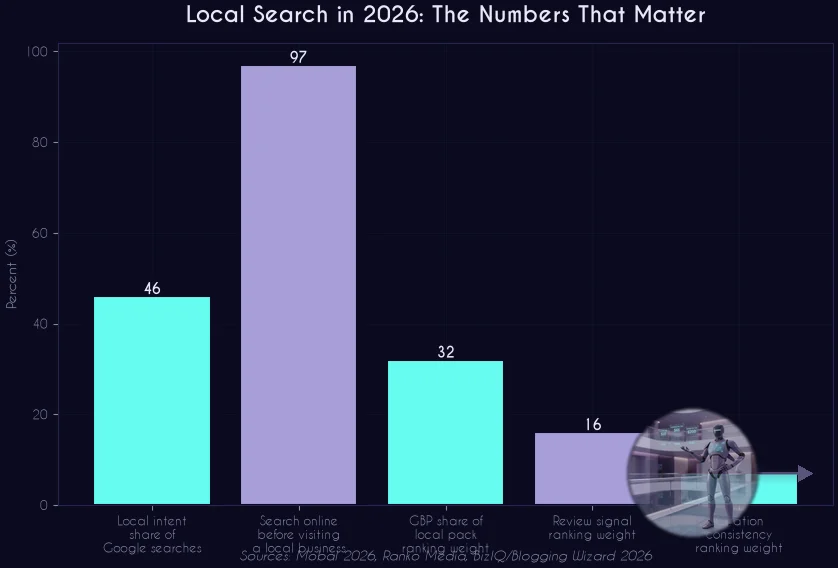
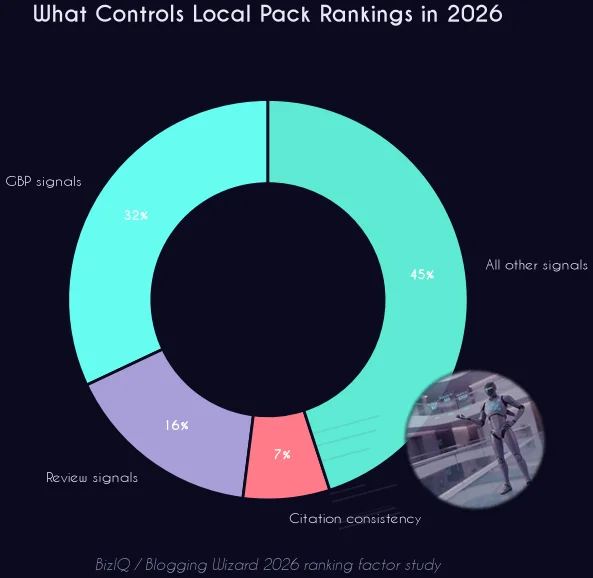
Here is why this matters for your budget. Local keywords have a fraction of the competition of national terms, they map directly to purchase intent, and they feed the exact signals Google uses to rank your Local Pack listing. In 2026 studies, Google Business Profile signals control about 32% of local pack ranking weight, with review signals at 16% and citation consistency at 7%. Keywords are the connective tissue: they tell Google which searches your profile deserves.
If you have never run a structured local keyword build for your business, start with the free Local Keyword Generator — it takes your business type and city and returns a starter list in five organized groups.
2. The 5 Intent Groups That Drive Local Rankings
Most local keyword lists fail because they are just one long undifferentiated list. The fix is grouping keywords by what the searcher is actually trying to do. Every strong local strategy covers these five intent groups:
A healthy local profile has keywords in all five groups, because each group lives in a different part of your marketing: service keywords belong in your GBP services list, question keywords belong in blog content and FAQs, comparison keywords belong in review-driven proof pages, and booking keywords belong in your calls-to-action. Purple Crib's free Local Keyword Generator organizes your list into exactly these groups, so you always know where each keyword should go.
3. How the Free Local Keyword Generator Works
The tool is deliberately simple, because keyword research should not require a paid subscription or a marketing degree. You enter two things — your business type and your city — and the generator returns 30+ local keywords sorted into the five intent groups above.
- Enter your business type — for example "dental clinic", "photography studio" or "accounting firm".
- Enter your city — Lagos, Dubai, Toronto, Houston or any city you serve.
- Get your keyword set — organized by intent group so you can copy it straight into your GBP, website pages and content plan.
No signup, no credit card, no limits. If you want a hand-audited version that layers in competition levels and content gaps across the US, UK, UAE, Canada and Nigeria, that is what our local SEO service does — but the free generator covers the keyword-building step for most small businesses.
You can pair it with our other free tools: the GMB Grader audits the profile you will be putting those keywords into, and the Schema Generator builds the structured data that helps Google connect your keywords to your business.
4. The 30-Minute Local Keyword Playbook
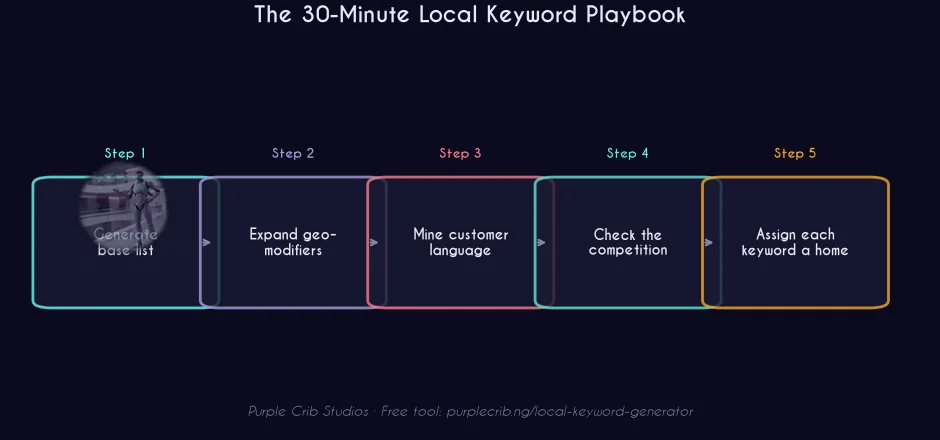
Here is the exact process we run with clients, compressed into a single 30-minute session. You can repeat it every quarter as your services and city coverage evolve.
STEP 1 · MINUTES 0-5
Generate your base list
Run the Local Keyword Generator with your business type and city. Copy the full output into a spreadsheet.
STEP 2 · MINUTES 5-12
Expand your geo-modifiers
Add neighborhoods, districts and nearby cities you serve. "Dentist Lagos" becomes "dentist Victoria Island", "dentist Yaba", "dentist Ikeja" — each one a separate ranking opportunity.
STEP 3 · MINUTES 12-18
Mine real customer language
Read your last 20 reviews and 10 WhatsApp enquiries. Note the exact words customers use — those phrases, not industry jargon, are your true keywords.
STEP 4 · MINUTES 18-24
Check the competition
Search your top 5 keywords and study the Local Pack. If the same three chains dominate a keyword, prioritize a longer, more specific variation where you can realistically win.
STEP 5 · MINUTES 24-30
Assign every keyword a home
Give each keyword one destination: a GBP field, a website page, a blog post or a booking link. Keywords without a home never rank — they just sit in a spreadsheet.
5. Where to Place Your Local Keywords
Placement is where most businesses go wrong — they either stuff one keyword everywhere or leave fields generic. Google reads your local keywords across five surfaces, and each surface has a job:
- Google Business Profile: primary category (the single strongest field), business description, services list and weekly posts. On average local businesses get about 943 profile views on Search versus roughly 25% of total views coming from Maps — keyword-rich profiles capture both.
- Homepage and location pages: your city + service combinations belong in the page title, H1 and first paragraph of the page you want ranking for them.
- Service pages: one page per major service keyword, so "teeth whitening" and "dental implants" each get their own optimized URL.
- Blog content: question-intent keywords become posts — this is exactly how our recent guides, like Google Business Profile's new rules and the free 15-point GMB audit, capture research-stage searches.
- Structured data: LocalBusiness schema repeats your area served and service keywords in a format both Google and AI assistants parse directly — generate yours with the free Schema Generator.
For a fuller picture of how profile signals interact with keywords across markets, see our 2026 global GBP optimization playbook.
6. Common Local Keyword Mistakes to Avoid
These are the five mistakes we correct most often when taking over local SEO accounts:
- Chasing the city only. "Lagos dentist" is brutal to rank for. Neighborhood terms convert better and rank faster for the businesses actually located there.
- Ignoring near-me queries. You cannot keyword-stuff "near me" — you optimize for it with a complete GBP, accurate address and service areas. That is the whole trick.
- One keyword list, forever. Cities change, services change, search behavior changes. Rebuild your list quarterly, not once in 2023.
- Writing for industry jargon. Patients search "teeth whitening price", not "cosmetic dentistry solutions". Mirror customer language.
- Keywords without content. A keyword assigned to no page is a wish, not a strategy. Every keyword needs a home (see Section 5).
7. Your 10-Point Local Keyword Checklist
Run this checklist top to bottom and you will have a working local keyword system in a single afternoon:
- ✅ Generated your base list with the free Local Keyword Generator
- ✅ Added neighborhood and district geo-modifiers
- ✅ Mined 20 recent reviews for customer language
- ✅ Checked the Local Pack competition for your top 5 keywords
- ✅ Assigned every keyword to a GBP field, page, post or booking link
- ✅ Updated your GBP primary category and services list
- ✅ Created one service page per major money keyword
- ✅ Published one question-intent blog post this month
- ✅ Added LocalBusiness schema with your service area
- ✅ Scheduled a quarterly calendar reminder to refresh the list
Local keyword research is the foundation every other local channel sits on — the profile, the reviews, the content, the ads. Spend 30 minutes on it before anything else this week, and every later investment works harder. That is the Purple Crib approach across every market we serve, from Lagos to Dubai to Toronto.
🚀 Want Us to Build Your Local Keyword Map?
Purple Crib Studios runs done-for-you local SEO and GBP optimization across the US, UK, UAE, Canada and Nigeria — starting with a full keyword and visibility audit.
💬 Message Us on WhatsAppRather Have Experts Handle This?
Purple Crib Studios offers done-for-you Local SEO across the US, UK, UAE, Canada, and Nigeria. Get a free 5-point audit in 48 hours.
Explore Our ServicesFAQs
What is local keyword research?
Local keyword research is the process of finding the search phrases customers use when looking for a service in a specific place — like "dentist near me" or "accounting firm Dubai Media City". It groups phrases by intent and location so each keyword can be placed in your Google Business Profile, website pages and content.
How many local keywords should a small business target?
Most small businesses can effectively target 20-40 local keywords, spread across the five intent groups: service + location, near-me, question, comparison and booking intent. The free Local Keyword Generator produces a starter set of 30+ keywords in this structure.
Can I rank for "near me" searches without an office in that area?
For true "near me" searches, Google prioritizes proximity, so you need a verified address or a properly configured service area in your Google Business Profile. What you can do without a physical office is target service + location keywords for the areas you travel to, and be transparent about where you are based.
Is the Local Keyword Generator really free?
Yes. The Local Keyword Generator at purplecrib.ng/local-keyword-generator is completely free, requires no signup or credit card, and has no usage limits. It exists as part of Purple Crib's free tools suite, alongside the GMB Grader, AI Visibility Checker, Review Response Generator and Schema Generator.
How often should I refresh my local keyword list?
Refresh your local keyword list every quarter, and immediately whenever you launch a new service, open a new location or expand into a new city. Search behavior shifts fast enough that a list built in 2025 is usually stale by late 2026.
Do local keywords help with AI assistants and AI Overviews, or just Google Search?
Both. Local keywords placed in your Business Profile, site copy and structured data teach AI systems what you offer and where — which improves how you are described in AI Overviews and AI assistants, not just how you rank in Search. Question-intent keywords are especially valuable for AI surfaces because AI answers research questions directly.
Test Your Knowledge — Local Keyword Research Quiz
10 quick questions based on this article. Tap an answer to see if you got it right.
Enjoyed this? One click tells Google to show you more Purple Crib content in Search.
Add on GoogleSources & Further Reading
- Mobal — 10 Local SEO Statistics That Matter in 2026
- Ranko Media — 10 Local SEO Statistics Backed by Real Data for 2026
- BizIQ — Local SEO Statistics 2026: Ranking Factors, GBP & ROI Data
- MapLabs — Top Local Search Statistics
- Shopify — Local SEO Statistics 2026: 16 Data Points
- Hooked Marketing — Local SEO Statistics 2026: 52+ Data Points
FOLLOW THE CONVERSATION
#LocalSEO #LocalKeywords #KeywordResearch #GoogleBusinessProfile #LocalSearch #SmallBusinessMarketing #SEO2026 #DigitalMarketing #NearMeSearch #LocalPack #GBP #MarketingStrategy #GeoModifiers #SMBGrowth #PurpleCribStudios