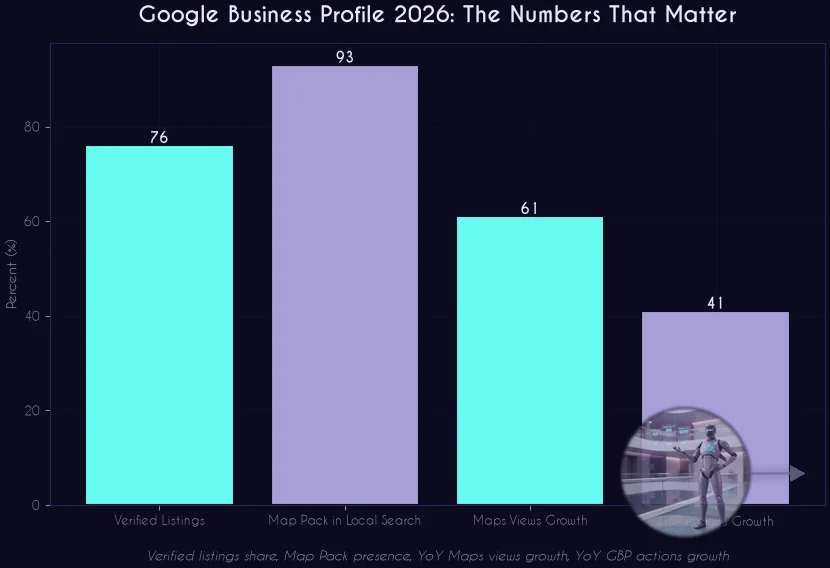
Google Business Profile optimization stopped being a local-only discipline in 2026. With more than 200 million business listings worldwide and the Map Pack appearing in 93% of local searches, the brands winning across the US, UK, UAE, Canada, and Nigeria are the ones running their profiles like international products, not local listings. Here is the global playbook Purple Crib Studios uses with clients on four continents, updated for October 2026.
🚀 Your Competitors Are Everywhere. Is Your Profile?
Purple Crib Studios manages Google Business Profiles for brands across the US, UK, UAE, Canada, and Nigeria. Get a free profile audit today.
💬 Chat With Us on WhatsAppTable of Contents
- Why Google Business Profile Optimization Went Global in 2026
- What Changed in 2026: Ask Maps, Freshness, and the Gemini Connection
- The Three Ranking Pillars Google Actually Confirms
- The Regional Playbook: US, UK, UAE, Canada, and Nigeria
- Managing Profiles Across Multiple Countries
- Benchmarks: What Good Looks Like in 2026
- The 10-Point International GBP Checklist
- FAQs
- Test Your Knowledge — Quiz
1. Why Google Business Profile Optimization Went Global in 2026
A Google Business Profile is no longer a directory entry; it is a conversion surface that works the same way in Houston, Manchester, Dubai, Toronto, and Lagos. The scale tells the story. More than 200 million businesses now have listings globally, about 76% of them verified, and Google Maps views grew 61% year-over-year into 2026. Actions from Google Business Profile listings — calls, direction requests, website clicks, bookings — surged 41% between 2025 and 2026.
For brands that operate internationally, this changes the operating model. A profile is not something a local store manager updates when they have time. It is a product with an owner, a content calendar, a review workflow, and performance targets in every market you serve. Businesses that treat it that way compound visibility quarter after quarter.
If you are new to how AI Overviews changed the local pack itself, our earlier deep dive on Google Business Profile and AI Overviews in October 2026 covers that shift, and our Gemini integration playbook explains how Google's AI now reads your profile data.
2. What Changed in 2026: Ask Maps, Freshness, and the Gemini Connection
Three platform changes define 2026, and each one rewards brands that manage profiles centrally and consistently across markets.
Q&A became Ask Maps. Google retired the old question-and-answer section on profiles and moved customer questions into Ask Maps, where Google's AI answers using your profile data, your website, and third-party sources. You can no longer rely on planting your own Q&A pairs. Your profile fields, product catalogs, and website content have to answer questions before anyone asks them.
Freshness became a real factor. Stale profiles now visibly decay. Posts, photos, offers, and business hour updates published within the last 30 days keep a profile in Google's active zone; profiles that go quiet for a month or more lose Map Pack momentum. This is why mature international brands run a publishing calendar per market, not per whim.
Profiles connected to Gemini. Google began rolling out the ability to connect your Google Business Profile directly to Gemini for real-time performance insights, review analysis, and business detail checks. For multi-market brands, this is an early warning system: AI surfaces inconsistencies between what your profile says and what your website says faster than any manual audit.
Under the hood, the Business Profile API keeps evolving too — the October 9, 2026 update added dietary restrictions support for food menus, which matters for restaurant groups operating across regions with different labeling regulations.
One new conversion feature deserves a place in every international playbook: businesses can now add a WhatsApp contact directly on the profile. For brands in the UAE, Nigeria, and much of the emerging world where WhatsApp is the default business channel, this single field shortens the path from Maps discovery to conversation.
3. The Three Ranking Pillars Google Actually Confirms
Everything else is tactics. Google's own guidance says local ranking rests on three pillars, and each one scales internationally when you systematize it.
Google's official tips map directly onto these pillars: verify your business, keep information complete and up to date, respond to every review, add photos and videos, and publish products and services. None of these steps knows a border — but each one needs a local accent, which is where the regional playbook comes in.
4. The Regional Playbook: US, UK, UAE, Canada, and Nigeria
The mechanics of optimization are universal. The weights are not. Here is how the same profile looks different market by market, based on what we see managing profiles across these regions.
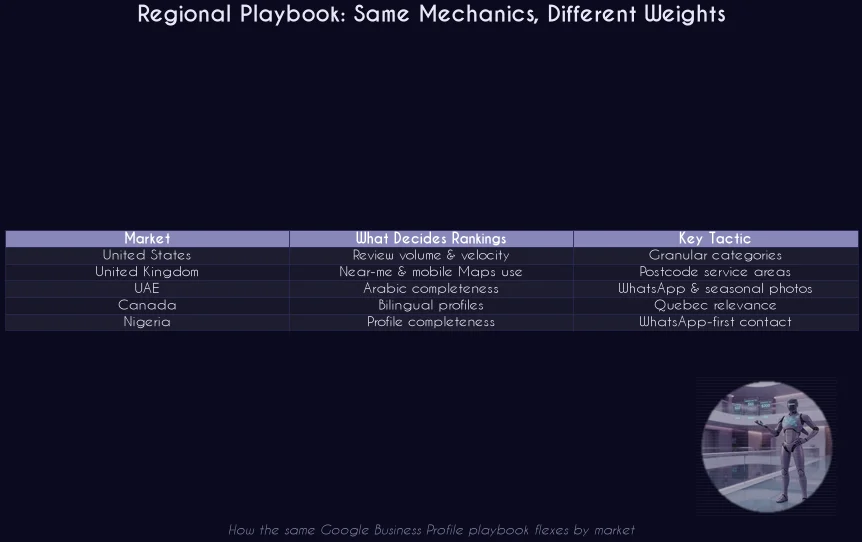
United States. Review volume and velocity decide the local pack in most US metros, and categories are extremely granular. Multiple locations need distinct review strategies per metro, because a Chicago profile competing against 400-review incumbents needs a different plan than a suburban market with sparse listings.
United Kingdom. UK searchers lean heavily on "near me" and Maps on mobile, so complete attributes and booking links pay off fast. Service-area businesses should define coverage precisely by postcode region rather than whole cities.
UAE. Dubai and Abu Dhabi markets are hyper-competitive in hospitality, retail, and real estate. Arabic-language completeness, the WhatsApp contact field, and high-frequency photo refreshes for Ramadan and seasonal campaigns are the differentiators. Verification requirements are stricter for certain license categories, so allow extra onboarding time.
Canada. Bilingual profiles matter: French descriptions and services for Quebec markets materially improve relevance matching. Categories map cleanly to US ones, which makes template reuse easy, but review culture is more conservative, so sustained low-pressure review requests outperform bursts.
Nigeria. Lagos, Abuja, and Port Harcourt reward profile completeness more than raw review counts, because a large share of competitors still run incomplete listings. Landmark-based directions, WhatsApp-first contact preferences, and locally accurate opening hours convert better than imported playbooks.
Region-specific landing support matters too: our GMB optimization services, UAE page, Canada page, and Nigeria local SEO page each translate this playbook into done-for-you execution.
5. Managing Profiles Across Multiple Countries
Once you operate in three or more markets, manual management breaks. The brands that scale cleanly follow a five-stage loop.
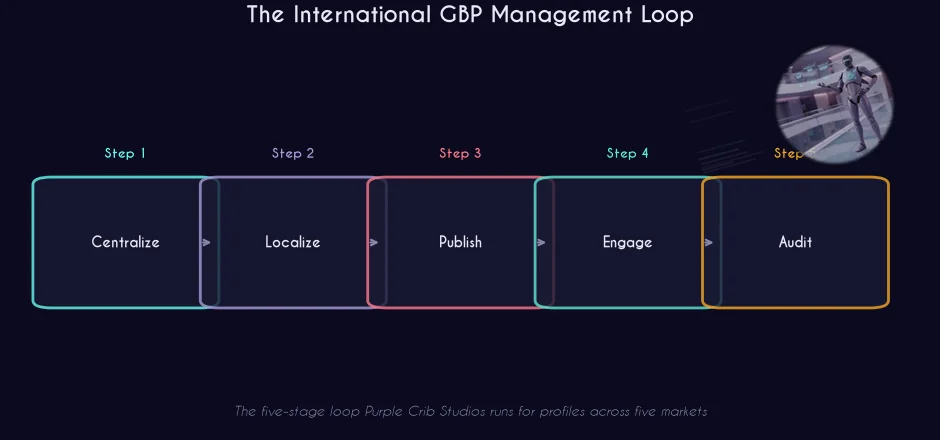
1. Centralize. One owner account structure, one category taxonomy, one naming convention. Local teams get editor access, not ownership, so the system stays consistent when staff turn over.
2. Localize. Descriptions, service lists, hours, and holidays differ by market. A profile template with locked global fields and open local fields keeps the brand voice intact while letting local relevance breathe.
3. Publish on a calendar. With freshness on a 30-day clock, every market gets a minimum monthly cadence: one offer or update post, one photo drop, one hours or attribute review. Markets in seasonal swings — Ramadan in the Gulf, December in the West, festive periods in Nigeria — run on a faster cadence.
4. Close the review loop. Same-day response targets, templates in every local language, and escalation paths for negative reviews. Reviews are the one pillar where a single bad week in one market can spill into brand search results everywhere.
5. Audit quarterly. Bulk exports through the Business Profile API or the bulk upload interface catch category drift, duplicate listings, and inconsistencies between profile data and website data before Google's AI does.
6. Benchmarks: What Good Looks Like in 2026
You cannot manage what you do not measure, and international programs need shared benchmarks to compare markets fairly. Three numbers anchor our client dashboards.
Review velocity. SOCi's data shows a roughly 3% lift in Google Business Profile conversions for every 10 new reviews a business adds. That makes a steady stream of fresh reviews worth more than a one-time surge — and it makes review pauses visible in conversion data within weeks.
Action growth. With GBP actions up 41% year-over-year, a flat profile is falling behind even if its raw numbers look stable. We treat zero growth in calls, direction requests, and bookings as a red flag regardless of absolute volume.
Completeness. Every profile should run with a complete attribute set, services list, product catalog where relevant, weekly-hours-plus-holiday-hours, and a WhatsApp or booking field where the market supports it. In competitive metros, a complete profile is table stakes; in emerging markets, it is often still the differentiator.
Our local trust stack guide breaks down the trust signals layer by layer if you want the deeper framework behind these benchmarks.
7. The 10-Point International GBP Checklist
Run this against every market you operate in. It takes about 30 minutes per profile and catches the issues that cost rankings.
✅ 1. Profile is verified, with ownership held centrally and local teams on editor access
✅ 2. Primary category is the most specific one available — not "the closest match"
✅ 3. Name, address, phone, and hours match the website exactly, in every market
✅ 4. Description uses the market's primary language and its real search vocabulary
✅ 5. Services and products lists are complete, priced where appropriate, and current
✅ 6. Fresh content published inside the last 30 days (post, offer, or photo drop)
✅ 7. Every review from the last 90 days has a response in the reviewer's language
✅ 8. WhatsApp contact field is set wherever WhatsApp is the market's default channel
✅ 9. Attributes and holiday hours match each market's calendar (Ramadan, public holidays)
✅ 10. Quarterly bulk audit completed: no duplicates, no category drift, no data mismatches
That checklist is the exact framework behind our done-for-you Google Business Profile management — the same audit runs against every profile we take on.
🌍 One Playbook, Every Market
From Houston to Lagos, Purple Crib Studios runs Google Business Profiles as international products. Book a free 5-point profile audit.
💬 Get My Free AuditRather Have Experts Handle This?
Purple Crib Studios offers done-for-you Google Business Profile optimization across the US, UK, UAE, Canada, and Nigeria. Get a free 5-point audit in 48 hours.
Explore Our ServicesFAQs
Is Google Business Profile optimization the same in every country?
The core mechanics are the same everywhere: verification, complete and accurate information, categories, services, photos, reviews, and fresh content. What differs is the weighting. Review volume dominates in competitive US metros, Arabic completeness matters in the UAE, bilingual profiles matter in Canada, and profile completeness itself is still a differentiator in many Nigerian markets. The playbook is global; the accent is local.
What is the 30-day freshness rule for Google Business Profiles?
In 2026, Google treats profile freshness as a visible ranking input. Profiles that have not published a post, photo, offer, or hours update within roughly 30 days start losing Map Pack momentum. International brands solve this with a per-market publishing calendar rather than ad-hoc updates.
What is Ask Maps and why did GBP Q&A disappear?
Google retired the old question-and-answer section on business profiles and moved customer questions into Ask Maps, where Google's AI composes answers using your profile data, your website, and third-party sources. The practical consequence: you can no longer seed your own Q&A pairs, so your profile fields, services, and website content must answer customer questions before they are asked.
Should every international location use a WhatsApp contact on its profile?
Enable it wherever WhatsApp is the market's default business channel — the UAE, Nigeria, and much of the Middle East, Africa, Latin America, and Asia. In markets where WhatsApp adoption is low, prioritize booking links and phone fields instead. The goal is always to shorten the path from Maps discovery to conversation in the way each market prefers.
How many Google Business Profiles can one business manage?
There is no fixed cap for legitimate businesses with real locations or service areas. The constraints are operational: every profile must represent a genuine, verifiable presence, and large groups manage at scale through the Business Profile API or bulk upload tools. Brands with dozens or hundreds of locations typically centralize ownership and give local teams editor access.
How much do reviews affect Google Business Profile conversions?
According to SOCi data, businesses see roughly a 3% lift in Google Business Profile conversions for every 10 new reviews. Steady review velocity beats bursts, because both customers and Google's freshness signals respond to continuous activity more than one-time campaigns.
Test Your Knowledge — International GBP Playbook Quiz
10 quick questions based on this article. Tap an answer to see if you got it right.
Enjoyed this? One click tells Google to show you more Purple Crib content in Search.
Add on GoogleSources & Further Reading
- Google — Tips to improve your local ranking on Google
- Google — Latest Business Profile API updates
- Explore Digital — Biggest Google Business Profile Changes in 2026
- BizIQ — Google Business Profile Statistics 2026
- Shopify — Local SEO Statistics 2026
- Digital Applied — Local SEO Statistics 2026
#GoogleBusinessProfile #GBMOptimization #LocalSEO #InternationalSEO #GlobalMarketing #MapPack #GoogleMaps #LocalSearch #DigitalMarketing #SEO2026 #SmallBusinessSEO #MultiLocationMarketing #MarketingStrategy #UAE #Nigeria