On 10 November 2026 OpenAI opened something that looks a lot like Google Business Profile: a place where a business can claim a profile inside ChatGPT, correct its own details, and watch how often it gets mentioned. It is called Businesses in ChatGPT, it is in beta, and it is the first time a major AI assistant has offered businesses a front door of their own. For local businesses in Lagos, London, Toronto, Dubai or Houston, the question is no longer whether AI search matters. It is whether you exist in it by default or by design. Purple Crib Studios tracks this shift because it changes what "being found" means in 2026.
🤖 Is Your Business Invisible Inside ChatGPT?
We check how AI engines see your business and fix what blocks them — across Nigeria, the UK, the US, Canada and the UAE.
💬 Get a Free AI Visibility CheckTable of Contents
- What OpenAI Actually Launched
- ChatGPT Profile vs Google Business Profile
- Who Can Claim Right Now (And Who Cannot)
- How to Claim Your Business, Step by Step
- What Business Hub Analytics Actually Tell You
- Business Agents: The Part Nobody Is Talking About
- What This Means in Nigeria, the UK, Canada and the UAE
- The 30-Day Action Plan
- Five Mistakes to Avoid
- Test Your Knowledge — Quiz
- FAQs
1. What OpenAI Actually Launched
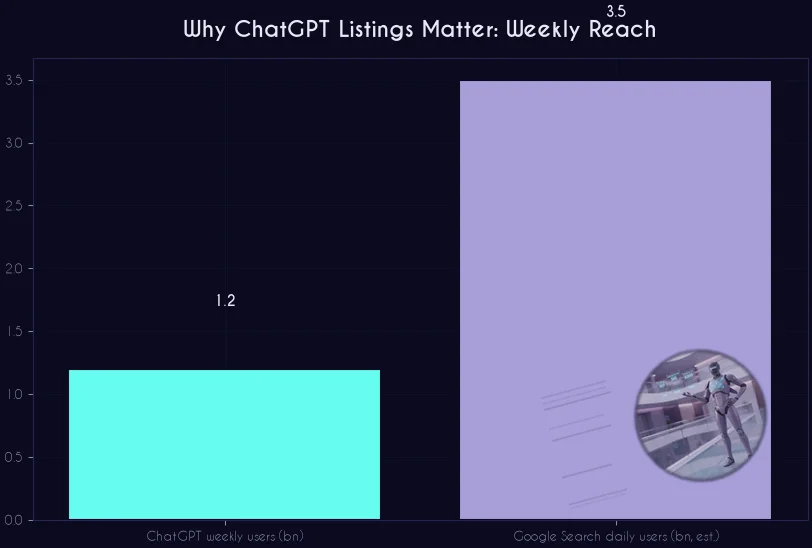
OpenAI announced Businesses in ChatGPT on 10 November 2026 as a beta, pitched at the 1.2 billion people it says use ChatGPT each week. The announcement is deliberately modest in tone and quite large in scope. It introduces three things at once.
Business Hub
Claim the business, verify it, then correct the details customers see.
Insights
Mentions, website clicks and the themes that trigger your business.
Business Agents
A scoped chat that answers questions using your own information.
Two sentences in the announcement matter more than the rest. The first: claiming does not guarantee higher placement or sales, because ChatGPT keeps making independent recommendations and comparisons. The second: ChatGPT may show information about a business whether or not that business has claimed a profile. Read together, they describe a system where your business already has a presence in AI answers, and claiming gives you the ability to influence it rather than control it.
This is the same pattern we covered in the shrinking map pack, and it rhymes with Google Business Profile becoming a social feed: fewer guaranteed slots, more algorithmic judgement, and a premium on being the clearest available source of truth about yourself.
2. ChatGPT Profile vs Google Business Profile
They rhyme, but they are not the same product. Google Business Profile is a local directory with a map, a phone button and a review system built for proximity. ChatGPT's version is a knowledge surface with a verification badge, tuned for description and comparison. The table below is the honest comparison as of November 2026.
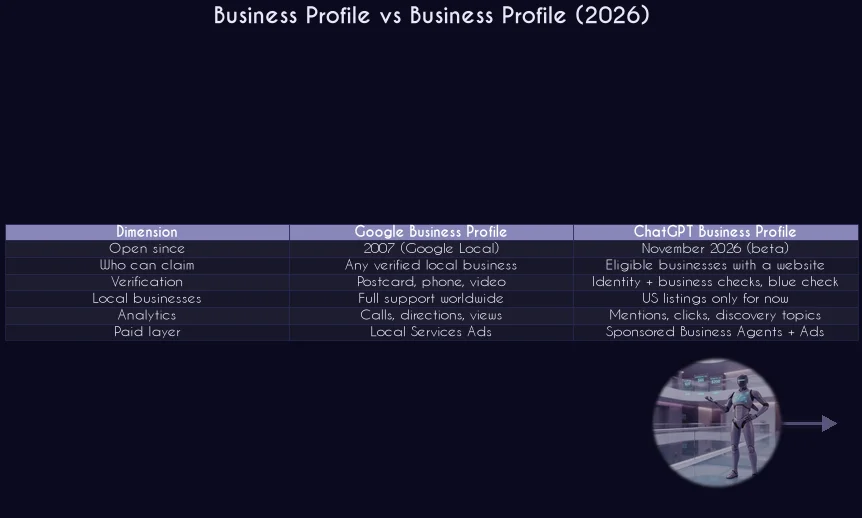
The practical consequence: ChatGPT is not replacing your Google profile this year, and it is not a reason to neglect it. Google data still powers the map, the reviews and a large share of the signals other AI systems read. What changed is that there is now a second place where your business has a self-description, and most businesses have not touched it.
3. Who Can Claim Right Now (And Who Cannot)
This is where the hype meets the terms and conditions. OpenAI states that eligibility depends on industry, location, and verification and integrity checks, and that claiming is initially available to eligible businesses with a website. You must own the business or be authorised to represent it.
Reported limitations worth knowing before you promise anything to a client:
- Local storefronts: local stores and restaurants can currently claim an existing US listing rather than create a new one.
- Business Agents: limited to eligible ecommerce and online service businesses in the United States, with categories defined by OpenAI.
- Multi-location brands: each location is claimed and verified separately. There is no bulk upload or partner feed yet, which is painful for anyone with twenty branches.
- Markets: availability follows where ChatGPT is offered, and OpenAI says it plans to expand both markets and categories over time.
So if you run a Lagos dental clinic, a Toronto salon or a Dubai consultancy, the honest answer today is: build the foundations, watch eligibility, and do not let a beta gate stop you from doing the work that matters regardless of who wins the directory war.
4. How to Claim Your Business, Step by Step
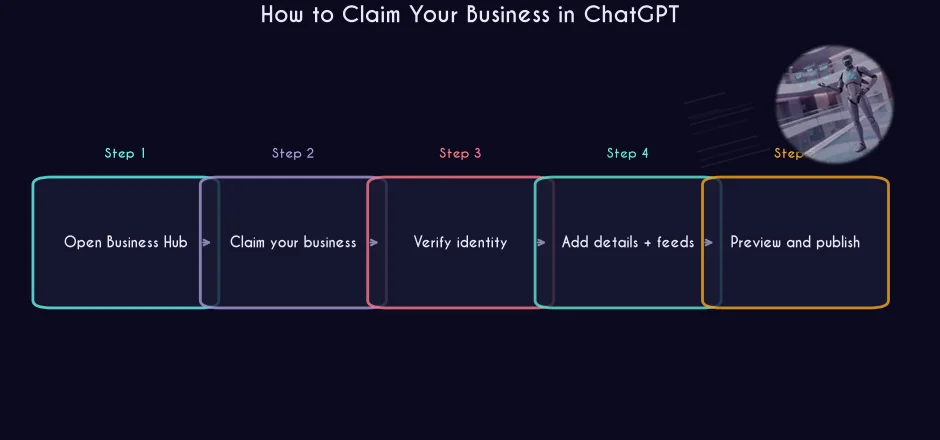
The flow is short enough to finish in one sitting, provided your business documents are ready.
STEP 1
Open Business Hub
Sign in and search for your business name. If it already appears, you are claiming an existing profile.
STEP 2
Claim and verify
Identity and business checks, often including a government ID. Expect a person, not a bot, on the other side.
STEP 3
Correct the details
Description, services, hours, links. Write for a model that will summarise you in one sentence.
STEP 4
Add a feed or an agent
Retailers can push product feeds with pricing and availability. Eligible US businesses can preview an agent.
Shopify merchants have a shortcut: connect the store from the Shopify admin or from Business Hub, and the catalogue details flow through automatically. That route is the fastest path we have seen for a product business.
5. What Business Hub Analytics Actually Tell You
Three numbers, and one of them is genuinely new to local marketing.
Mentions count how often your business appears in ChatGPT conversations. Website clicks count people who left ChatGPT for your site. Discovery topics are the themes across conversations where your business gets cited, which is the closest thing to a keyword report that AI search has produced so far.
OpenAI is explicit about privacy: user conversations and Business Agent chats are not shared with businesses, and insights are aggregated with thresholds, meaning small businesses may see nothing at all until volume builds. That is a real limitation, and it is the same reason we tell clients not to expect precise attribution from AI traffic in 2026.
If you want the wider picture of how each engine behaves, our multi-engine AI SEO guide covers where ChatGPT, AI Mode, Perplexity, Claude and Copilot diverge. For the mechanics of getting cited at all, see the retrieval-first playbook.
Use discovery topics the way you would use a query report: if people find you while asking about "wedding photography packages in Lagos", the answer is not to write that phrase into your profile five times. It is to make sure the page you control answers that question in the first paragraph.
6. Business Agents: The Part Nobody Is Talking About
A Business Agent is a scoped conversation that runs on your information, with guidelines you set, clearly labelled and separate from the user's main chat. When your business appears in an answer, a person can click through and ask it follow-up questions.
Two things about that deserve attention. First, it is a conversion surface, not a ranking surface: it helps someone already interested decide. Second, it is sponsored inventory. Businesses can sponsor their agent and use it as the destination for ChatGPT Ads, which means the paid layer is being built on top of the profile from day one.
For a service business, the interesting part is the discipline it forces. If your agent can answer "what does it cost, how long does it take, do you serve my area", then a human has already written those answers down clearly. Most agencies discover, while building the agent, that their own service pages never said.
7. What This Means in Nigeria, the UK, Canada and the UAE
The beta is narrow, the underlying shift is not. ChatGPT answers questions about businesses everywhere it operates, claimed or not, and the information it draws on is whatever it can retrieve from the open web.
- Nigeria: fewer businesses have claimed or corrected anything, so the marginal gain from accurate, machine-readable information is unusually high. Local search here still runs on Google Maps first, and the businesses that get cited by AI are usually the ones whose sites are crawlable and specific.
- United Kingdom and Canada: dense competition means the profile details that look trivial, like service areas and hours, are what separate you in an answer that lists three options.
- UAE: bilingual clarity matters more than volume. An English-only description loses half the questions worth answering.
In all four markets the prerequisite is the same: a website that AI crawlers can read, structured data that states what you are, and content that answers buying questions directly. That is what our free AI visibility checker measures in about a minute.
8. The 30-Day Action Plan
Work through this in order. None of it depends on your market being eligible for the beta.
- ✅ Check whether a profile for your business already exists in ChatGPT, and screenshot what it says about you.
- ✅ Audit what AI engines can actually read: robots.txt access, llms.txt, schema, page speed.
- ✅ Fix the facts: name, address, phone, hours and service list identical across your site, Google profile and directories.
- ✅ Rewrite your homepage opening paragraph so it answers "what do you do, for whom, where" in the first two sentences.
- ✅ Add FAQ schema to the five questions your sales team answers most often.
- ✅ Claim the profile if you are eligible, and correct every field rather than accepting defaults.
- ✅ Record a baseline: mentions, clicks and discovery topics on day one, so month two has something to compare.
- ✅ Re-check monthly, because eligibility and categories are expanding quickly.
9. Five Mistakes to Avoid
Treating the blue check as a ranking. OpenAI says claiming does not guarantee placement. Anyone promising otherwise is selling certainty that does not exist.
Ignoring Google because ChatGPT launched a directory. Your map pack, reviews and proximity signals still decide most local outcomes. The two systems feed each other through the open web.
Writing the profile like a brochure. Models summarise. Specific, factual sentences survive summarisation; adjectives do not.
Claiming once and forgetting. Stale hours are worse than no hours, because they get quoted confidently to a customer standing outside your door.
Chasing the agent before the fundamentals. An agent built on vague service pages answers vaguely. Fix the source first.
If you want a second opinion on where you stand, the GMB Grader scores your Google profile in five minutes, and it is the right starting point for the local half of this work.
AI search did not replace the map in 2026. It added a second front door, and most businesses have left theirs unlocked and mislabelled. The ones who fix it now will be the ones quoted accurately when the questions start arriving in volume.
📌 Want Your Business To Show Up In AI Answers?
We audit how ChatGPT, Gemini and AI Overviews describe your business, then fix the gaps.
💬 Book a Free 15-Minute ReviewRather Have Experts Handle This?
Purple Crib Studios offers done-for-you Google Business Profile and AI visibility work across the US, UK, UAE, Canada, and Nigeria. Get a free 5-point audit in 48 hours.
Explore Our ServicesFAQs
Is ChatGPT replacing Google Business Profile?
No. They are different products with different strengths. Google Business Profile still drives the map, reviews and proximity-based local results. ChatGPT adds a second surface where your business can be described, verified and queried. In 2026 the two work together: what you publish on the open web feeds both.
How much does a ChatGPT business profile cost?
Claiming a business in ChatGPT is free at launch. Paid placement exists separately through sponsored Business Agents and ChatGPT Ads, which OpenAI clearly labels as advertising and keeps distinct from its answers.
Can a local shop or restaurant claim a listing?
Currently local stores and restaurants can claim an existing US listing rather than create a new one, according to OpenAI's help documentation. Eligibility depends on industry, location and verification checks, and OpenAI says it plans to expand both markets and categories over time.
Does claiming my business improve my ranking in ChatGPT answers?
OpenAI states plainly that claiming does not guarantee higher placement or sales, and that ChatGPT continues to make independent recommendations and comparisons. What claiming does is let you correct the underlying facts so that whatever is said about you is accurate.
What if my country is not eligible yet?
Do the work that matters regardless of eligibility: make the site crawlable by AI engines, add structured data, keep business details consistent everywhere, and publish content that answers buying questions. ChatGPT can cite a business whether or not it has claimed a profile, so the information it finds still determines what gets said.
How do I see how my business appears in ChatGPT?
Ask ChatGPT questions a customer would ask in your category and note whether, and how, you appear. Once claimed, Business Hub adds aggregated mentions, website clicks and discovery topics, though privacy thresholds mean small businesses may need volume before any data appears.
Test Your Knowledge — ChatGPT Business Profiles Quiz
10 quick questions based on this article. Tap an answer to see if you got it right.
Enjoyed this? One click tells Google to show you more Purple Crib content in Search.
Add on GoogleSources & Further Reading
- OpenAI — Introducing Businesses in ChatGPT (10 November 2026)
- OpenAI — Businesses in ChatGPT: claim your business, eligibility and FAQ
- OpenAI — Business Agents policy
- Forbes — Best practices for OpenAI's Businesses in ChatGPT (13 November 2026)
- Hospitality Net — How to list your hotel on ChatGPT
- How to claim your business on ChatGPT: complete guide
#ChatGPTBusiness #AISearch #GoogleBusinessProfile #LocalSEO #AIVisibility #OpenAI #DigitalMarketing2026 #AEO #GEO #SmallBusinessMarketing #NigeriaSEO #UAEMarketing #CanadaSEO #UKSEO #PurpleCribStudios