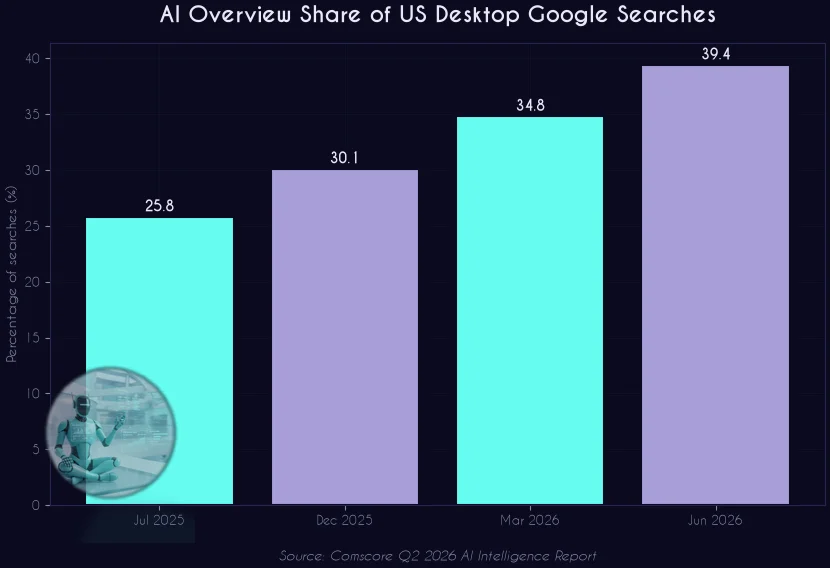
AI Overviews now appear in 39.4% of all US desktop Google searches, according to Comscore data released September 22, 2026 — up from 25.8% in July 2025. That is not a trend line anymore; it is a structural shift in how people find your business. At Purple Crib Studios, we help brands across the US, UK, UAE, Canada, and Nigeria adapt to this new reality, so this guide breaks down what the 39% threshold means, which platforms now matter beyond Google, and the practical steps to stay visible when AI does the searching for your customers.
🚀 AI Overviews Are Now 39% of Google Search
Purple Crib Studios helps brands get cited by AI, not just ranked by Google. Book a free AI visibility audit.
💬 Get Your Free AI Visibility AuditTable of Contents
- 1. The 39% Threshold: What the Comscore Data Actually Says
- 2. Search Everywhere Optimization: Beyond Google
- 3. The Agentic Shift: When AI Shops For Your Customers
- 4. Content Quality as the AI Differentiator
- 5. Multimodal Search: Why Video and Images Now Drive Citations
- 6. The 30-Day AI Visibility Action Checklist
- FAQs
- Test Your Knowledge — Quiz
1. The 39% Threshold: What the Comscore Data Actually Says
On September 22, 2026, Comscore released its Q2 2026 AI Intelligence Report, and the headline number was stark: Google searches displaying an AI Overview reached 39.4% on US desktop, up from 25.8% in July 2025 (Search Engine Land). Bing's Copilot Search rose from 11.8% to 17.3% in the same period (Comscore). Meanwhile, separate tracking of 51,000 search events found that 7.53% of organic sessions now arrive through AI Overviews — a number that sounds small until you realize it did not exist two years ago.
39.4%
of US desktop Google searches now show an AI Overview (Comscore, June 2026)
17.3%
of Bing searches use Copilot AI answers (up from 11.8% in July 2025)
7.53%
of organic sessions arrive through AI Overviews (9-month tracking study)
What does 39.4% mean in practice? For nearly 4 out of every 10 desktop searches, Google is now generating its own AI-written answer before showing any blue links. If your SEO strategy is built around "rank in the top 10 and get clicks," that strategy works 60% of the time and loses relevance for the other 40% — and that 40% is growing every quarter. The question is no longer just "where do I rank?" but "does the AI cite me, summarize me, or skip me entirely?"
If you want a deeper look at the foundational shift, our earlier guide on moving from ranking pages to being cited by AI covers the mechanics in detail.
2. Search Everywhere Optimization: Beyond Google
Google still holds roughly 90% market share, but the growth of AI discovery engines like ChatGPT and Perplexity means marketers are no longer optimizing for a single search destination — they are optimizing for multiple platforms that each form their own opinions about brands (Search Engine Journal). BrightEdge calls this "Search Everywhere Optimization," and it is now critical because these platforms do not share the same ranking signals.
The Four AI Search Platforms You Need to Track
Google AI Overviews
39.4% of US desktop searches. Prioritises structured data, schema markup, and E-E-A-T signals. Cites top-10 ranking pages 92% of the time.
ChatGPT Search
Uses Bing index plus its own crawl. Favors conversational, question-answer formatted content. Brand mentions matter more than backlinks.
Perplexity
Answer engine with real-time web access. Cites sources inline. Values recency and factual precision. 150M+ questions answered monthly.
Bing Copilot
17.3% of Bing searches. Growing fast. Uses Microsoft Graph + GPT. Strong for commercial and shopping queries.
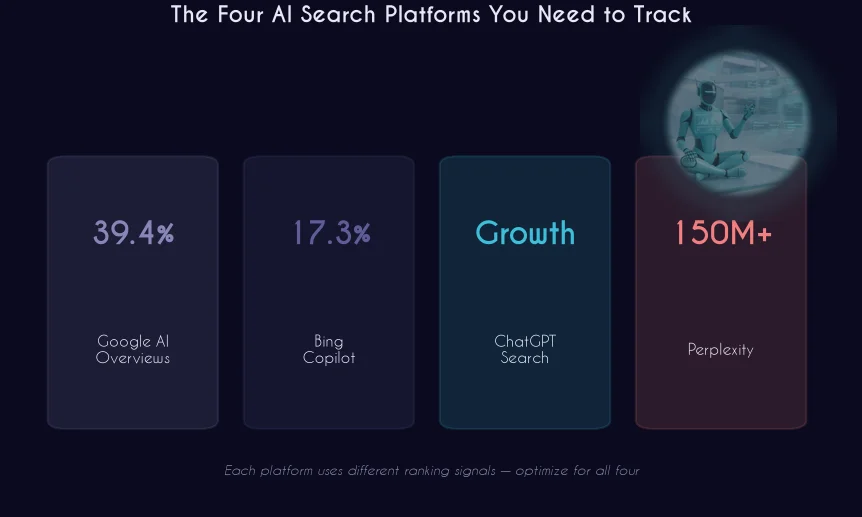
The key insight: each platform rewards different signals. Google AI Overviews lean on structured data and traditional ranking. ChatGPT favors brand mentions and conversational clarity. Perplexity rewards recency and source diversity. Bing Copilot integrates with Microsoft's commercial graph. A strategy that only targets Google is leaving 4 out of 10 AI search interactions completely unaddressed.
3. The Agentic Shift: When AI Shops For Your Customers
Here is a statistic that should make every marketing director sit up: AI agents now account for roughly 33% of organic search activity, according to BrightEdge internal tracking (Search Engine Journal, January 2026). These are not human users typing queries — they are bots like GPTBot, ClaudeBot, Perplexity Bot, and Google-Extended, fetching information in real time on behalf of users who asked an AI assistant to research, compare, or buy something.
This changes the optimization target fundamentally. When a human searches, you compete for attention and clicks. When an AI agent searches on behalf of a human, you compete for accurate retrieval and recommendation. The agent does not click your beautiful landing page — it reads your content, extracts structured facts, and reports back to the user. If your content is not machine-readable, the agent moves on.
Three things AI agents need from your site that traditional SEO never required:
- Plain-text information — agents do not render JavaScript. If your product specs live in a JS widget, the agent sees nothing.
- Structured data — schema markup for pricing, availability, reviews, and specifications lets agents accurately recommend you.
- AI-ready protocols — standards like MCP servers and llms.txt files guide AI crawlers to your most important content efficiently.
If you want to understand how to make your site agent-ready, our AI citation economy guide covers the specific tactics that earn AI recommendations.
4. Content Quality as the AI Differentiator
AI tools do not cite content that repackages existing information — they can generate that themselves. What they do cite are unique insights, original data, and trusted sources. This is the core finding from enterprise SEO analysis throughout 2026: content quality is no longer about word count or keyword density, it is about whether your content offers something an AI cannot generate on its own (Search Engine Journal).
Google reinforced this in its updated guidance, claiming authority as the ground truth for SEO, AEO, and GEO outcomes and urging caution with third-party SEO tools that may not reflect actual AI search behavior (Search Engine Journal). The implication: Google's own tools and documentation are now the primary reference for how AI search works, not third-party rank trackers.
What AI actually cites (and what it ignores):
- ✅ Unique insights and original research
- ✅ Concise, structured answers to specific questions
- ✅ First-hand experience and case studies
- ✅ Data, statistics, and named sources
- ❌ Repackaged listicles with no original angle
- ❌ Thin content that restates what 100 other pages say
- ❌ Content hidden behind JavaScript rendering
The practical takeaway: open with concise, insight-led summaries. Structure with tight sections and clear headings. Lead with story, then data. Write for ingestion — use questions, definitions, and concise examples that LLMs can absorb and quote directly.
5. Multimodal Search: Why Video and Images Now Drive Citations
Text-based search is no longer the sole player. Multimodal search — combining text, voice, image, and video — is becoming the standard, and the numbers are striking. BrightEdge data shows a 121% increase in ecommerce-related YouTube citations for AI Overviews in 2026. Google's AI is increasingly pulling product information, reviews, and recommendations from video content, not just text pages.
This is not a side trend. It means that brands investing only in written content are missing a citation channel that has more than doubled in a year. The platforms AI tools regularly pull from include Reddit, YouTube, and key social networks — all of which reward different content formats:
- YouTube — the strongest correlation with AI citations (0.737 correlation coefficient per our own GEO research). Product demos, tutorials, and expert interviews get cited.
- Reddit — authentic user discussions surface in AI Overviews for commercial and comparison queries.
- Images with alt text and schema — visual search is growing; detailed technical markup for images and videos is now essential.
Repurposing content across formats is no longer optional. A blog post becomes a video script becomes a carousel becomes a podcast clip — and each format opens a different AI citation pathway. For more on how Purple Crib approaches this across channels, see our guide on distribution strategy beyond SEO.
🚀 Is Your Brand Getting Cited by AI — or Skipped?
Message Purple Crib Studios on WhatsApp for a free AI visibility audit across Google, ChatGPT, Perplexity, and Bing.
💬 Start My AI Visibility AuditRather Have Experts Handle This?
Purple Crib Studios offers done-for-you AI SEO and GEO services across the US, UK, UAE, Canada, and Nigeria. Get a free 5-point AI visibility audit in 48 hours.
Explore Our AI SEO Services6. The 30-Day AI Visibility Action Checklist
Here is the month-long restructure we recommend. Each week has one focus — do not stack them.
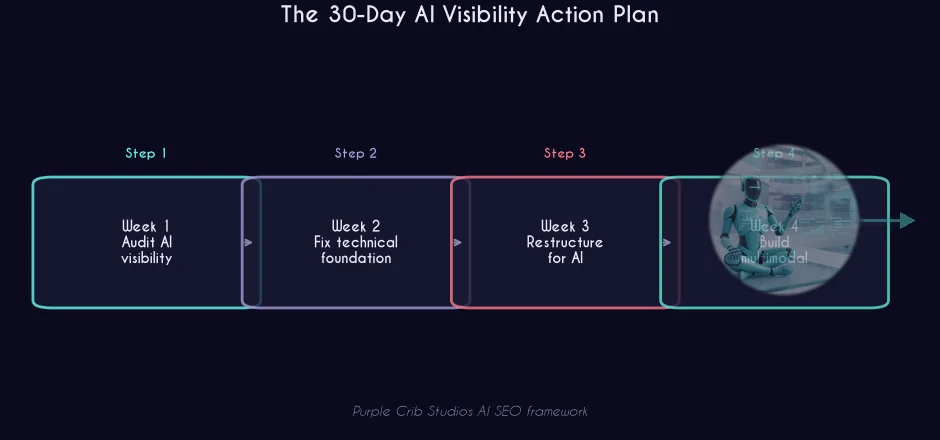
- ✅ Week 1 — Audit your AI visibility. Search your brand name and top keywords on Google AI Overviews, ChatGPT, Perplexity, and Bing Copilot. Screenshot what each platform says about you. Note whether you are cited, summarized accurately, or absent.
- ✅ Week 2 — Fix your technical foundation. Ensure robots.txt allows AI crawlers (GPTBot, ClaudeBot, PerplexityBot, Google-Extended). Deploy schema markup for products, FAQs, and articles. Test that core content loads without JavaScript.
- ✅ Week 3 — Restructure content for AI ingestion. Add question-based H2/H3 headings. Open each section with a concise answer. Create or update your llms.txt file. Add structured data for any video or image content.
- ✅ Week 4 — Build multimodal presence. Publish one YouTube video answering a top customer question. Post one Reddit thread or AMA. Add detailed alt text and image schema to your top 10 pages.
- ✅ Track brand mentions, not just rankings. Set up alerts for your brand name across AI platforms. Brand mentions are 3x stronger than backlinks for AI visibility.
- ✅ Repeat quarterly. AI search behavior shifts fast. Re-audit every 90 days and adjust.
FAQs
What percentage of Google searches now show AI Overviews?
According to Comscore's Q2 2026 AI Intelligence Report released September 22, 2026, AI Overviews now appear in 39.4% of US desktop Google searches, up from 25.8% in July 2025. Bing's Copilot Search grew from 11.8% to 17.3% in the same period.
What is Search Everywhere Optimization?
Search Everywhere Optimization is the practice of optimizing your brand's visibility across multiple AI search platforms — Google AI Overviews, ChatGPT, Perplexity, and Bing Copilot — rather than just traditional Google rankings. Each platform uses different ranking signals, so a single-platform strategy leaves a growing share of AI search interactions unaddressed.
How much of organic search activity comes from AI agents?
According to BrightEdge internal tracking, AI agents like GPTBot, ClaudeBot, Perplexity Bot, and Google-Extended now account for roughly 33% of organic search activity. These agents fetch information in real time on behalf of users, meaning content must be machine-readable, not just human-readable.
How do I get my content cited by AI Overviews?
AI tools cite unique insights, original data, and trusted sources — not repackaged content. To earn citations: open with concise summaries, use question-based headings, add structured data (schema markup), publish across multiple formats including video, and ensure your content is accessible without JavaScript rendering.
Why does video content matter for AI SEO in 2026?
BrightEdge data shows a 121% increase in ecommerce-related YouTube citations for AI Overviews in 2026. Google's AI increasingly pulls product information and recommendations from video content, making YouTube the platform with the strongest correlation (0.737) to AI citations.
What is the difference between SEO, GEO, and AEO?
SEO (Search Engine Optimization) covers traditional ranking. GEO (Generative Engine Optimization) targets visibility in AI-generated answers like Google AI Overviews. AEO (Answer Engine Optimization) focuses on being the answer AI engines cite. Google's 2026 guidance positions all three as evolving layers built on the same SEO foundations — technical health, quality content, and structured data.
Test Your Knowledge — AI Visibility Quiz
6 quick questions based on this article. Tap an answer to see if you got it right.
📌 See More Content Like This on Google
Want Google to show you more of Purple Crib's expert content on SEO, GMB, and AI marketing? It takes one click — add us as a preferred source and Google will prioritise our articles in your Search results.
📌 Make Google Work for You
Tell Google you want to see more Purple Crib content in your Search results.
Click the link below → check the box → done. Google will show more of our content to you from now on.
🔍 Add Purple Crib as a Google SourceHow it works — 3 simple steps:
- Click the button above (or copy this link: https://google.com/preferences/source?q=https://www.purplecrib.ng)
- Check the box next to Purple Crib on the Google Search preferences page
- Google will now show more of our content when you search for SEO, GMB, AI marketing, and digital strategy topics
Share this with a colleague who wants to stay ahead of Google and AI trends too 👇
Sources & Further Reading
- Search Engine Land — Google AI Overviews Now Appear in 39% of US Desktop Searches (September 2026)
- Comscore — Q2 2026 AI Intelligence Report
- Search Engine Journal — 5 Key Enterprise SEO and AI Trends for 2026
- Search Engine Journal — Google's New Guidance Claims Authority Over SEO, Tools, and AEO/GEO
- Search Engine Land — What 9 Months of AI Overview Data Shows (51,000 Tracked Events)
- KeywordsEverywhere — Google AI Overviews: Tracker, Timeline and Statistics
#AISEO #GEO #AIOverviews #SearchEverywhereOptimization #AIVisibility #GenerativeSearch #ChatGPTSearch #Perplexity #BingCopilot #SchemaMarkup #MultimodalSearch #AgenticSearch #PurpleCribStudios