October is budget season, and the 2027 planning conversations happening in boardrooms right now will decide who grows next year and who stalls. Every channel owner walks into the planning meeting with a slide claiming their channel is number one, yet 2026 delivered zero-click search, AI answers, and shrinking organic reach that rewrote what "working" even means. Purple Crib Studios built this guide to help you cut through the noise and build a 2027 marketing budget that survives contact with reality.
🚀 Planning Your 2027 Marketing Budget?
Purple Crib Studios builds data-backed budget frameworks for brands across the US, UK, UAE, Canada, and Nigeria.
💬 Chat With Us on WhatsAppTable of Contents
- Why the 2027 Budget Conversation Is Different
- Channel ROI: What the 2026 Data Actually Says
- The 60/40 Rule: Brand vs Performance Spending
- The 7-Bucket 2027 Budget Framework
- CFO-CMO Alignment: How to Defend Your Budget
- The Global Playbook: Budgets by Market
- Your 2027 Budget Checklist
- Test Your Knowledge — Quiz
- FAQs
1. Why the 2027 Budget Conversation Is Different
The budget template you used in 2025 is already obsolete. Three shifts in 2026 changed the math that 2027 budgets are being built on:
- Zero-click search went mainstream. Roughly 73% of Google searches now end without a click, which means the top of your funnel increasingly happens inside an AI answer, not on your website.
- AI answers became an ad surface. Ads are appearing inside AI assistants, creating the first genuinely new paid channel in a decade, with no proven playbook yet.
- Owned channels got more valuable, not less. When rented reach gets noisier and more expensive, email lists, communities, and first-party data become the assets that keep paying. Our first-party data strategy guide covers this shift in depth.
Meanwhile the macro signal is not a recession in marketing spend. Marketing Week reports that 83% of B2B CMOs expect marketing investment to rise in the year ahead. The money is moving, not disappearing. Gartner's 2026 benchmarks show budgets under pressure in some sectors while AI talent and data quality get urgent funding priority. The winners in 2027 will not be the teams that spend more. They will be the teams that allocate better.
2. Channel ROI: What the 2026 Data Actually Says
Start the allocation conversation with the return numbers, not the vendor pitch. Here is what the current benchmark data shows per dollar spent, based on 2026 industry studies:
$36-$42
Email marketing ROI per $1 spent — the highest-return channel in digital marketing, with top-quartile programmes clearing $42. Sources: Moosend and Tapfiliate 2026 benchmarks.
82% vs 78%
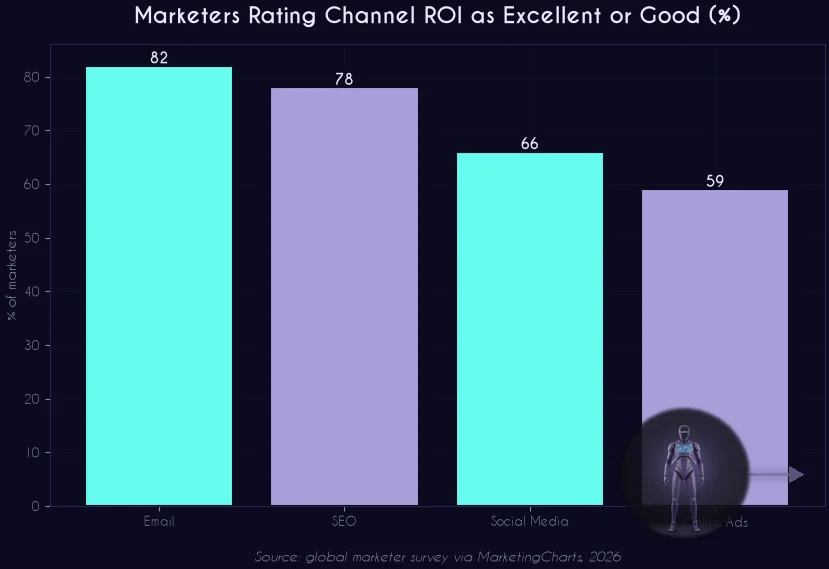
Email vs SEO rated "excellent or good" ROI by global marketers — email edges SEO 82% to 78%, per a global marketer survey reported by MarketingCharts. Both channels beat every paid channel on perceived ROI.
700 leaders, 12 industries
The scale of budget research available — WebFX surveyed 700 business leaders across 12 industries on how they plan to allocate marketing budgets, one of the largest allocation datasets available for planners. Read it at WebFX.
Three takeaways from the numbers. First, retention and owned channels (email, SMS, loyalty) consistently out-earn acquisition channels per dollar. Second, SEO and content remain the best compounding assets even as AI search reshapes how visibility is earned, a shift we broke down in our October AI Overviews reality check. Third, paid media is now a leverage layer on top of owned demand, not the engine itself.
3. The 60/40 Rule: Brand vs Performance Spending
The most validated finding in marketing budget research remains the Binet and Field 60/40 principle: roughly 60% of budget to long-term brand building and 40% to short-term performance activation. Brands that invert this ratio show a documented pattern: strong short-term sales spikes followed by flat or declining growth, because performance marketing harvests demand that brand building creates.
In the 2026 climate, the temptation to go 100% performance is stronger than ever, because attribution dashboards make performance spend look provable while brand spend looks like faith. Resist it. The practical 2027 reading of 60/40:
- Brand budget (≈60%): creative that builds memory, distinctive assets, PR and thought leadership, sponsorships, YouTube and podcast presence, community programmes, and organic content systems.
- Performance budget (≈40%): search and shopping ads, retargeting, lifecycle email automation, conversion optimization, and paid social with a clear revenue target.
If your brand is early-stage or under five years old, run closer to 50/50, then shift toward 60/40 as your market matures. And note that 60/40 refers to total marketing investment, including salaries and tools, not just media spend.
4. The 7-Bucket 2027 Budget Framework
Instead of arguing channel-by-channel, allocate into seven buckets with a percentage range each. This is the framework we use with clients planning 2027 budgets:
The 7 Buckets (recommended share of total)
1. Brand & Creative — 25%
Campaign creative, distinctive assets, video production, brand refresh work. The demand-creation layer.
2. Organic Search & Content — 20%
SEO, editorial, AI-readiness (llms.txt, structured data), thought leadership. The compounding layer.
3. Paid Media — 20%
Search, social, retargeting, and small AI-surface experiments. The leverage layer.
4. Owned Audience & Lifecycle — 15%
Email, SMS, loyalty, community, first-party data infrastructure. The retention layer.
5. Conversion & Experience — 8%
CRO, landing pages, site speed, analytics. The multiplier layer. See our CRO science guide.
6. MarTech & Data — 7%
CRM, automation, measurement, clean-room tooling. The infrastructure layer.
7. Test Fund — 5%
Ring-fenced experiments: new channels, AI ad surfaces, new formats. Teams that skip this bucket are permanently late to the next shift.
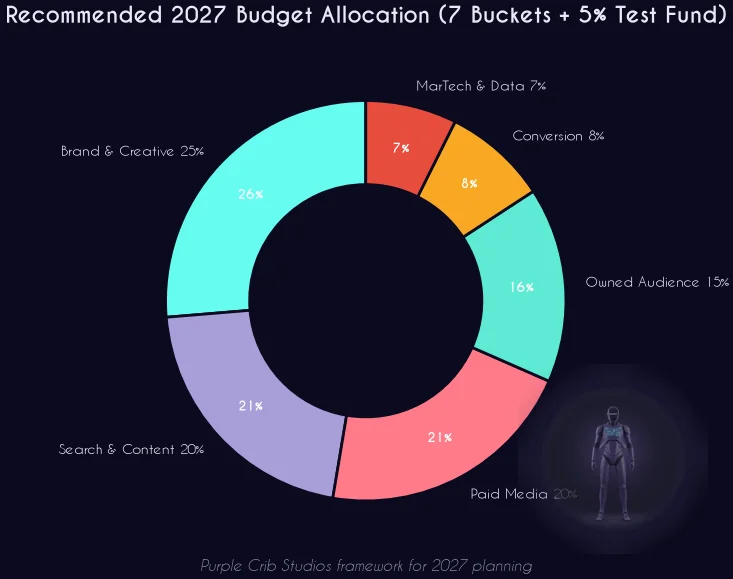
Two rules make the framework work. Never let the test fund get raided to cover overruns in paid media, and review bucket performance quarterly rather than re-planning annually, because in 2027 conditions a yearly-only plan will drift within one quarter.
5. CFO-CMO Alignment: How to Defend Your Budget
The budget meeting is won before it starts. Finance teams increasingly expect marketing to speak the language of unit economics, not impressions. Four shifts that win the CFO conversation in 2027 planning:
- Lead with revenue per dollar, not channel metrics. Bring the email $36+ ROI benchmark and your own cohort numbers, not open rates.
- Present marketing as an asset portfolio. Email lists, content libraries, and brand equity appreciate. Frame spend as building balance-sheet assets the company owns.
- Build a kill criteria list. Name in advance the conditions under which you will cut a channel. CFOs trust budgets that contain their own stop-losses.
- Budget AI as a line item, not a buzzword. Gartner's 2026 benchmarks show AI talent and data quality drawing urgent funding. A specific, modest AI allocation with a stated purpose reads as discipline; a vague "AI transformation" line reads as risk.
Be honest about the tension: with 83% of B2B CMOs expecting investment to rise, some teams will over-promise. The 2027 plans that survive Q2 scrutiny are the ones whose projections were conservative and whose dashboards tie spend to revenue from day one.
6. The Global Playbook: Budgets by Market
Purple Crib Studios operates across five markets, and the same framework needs local calibration. What changes by market is not the buckets but the weighting and the currency math:
- United States: Highest CPMs in paid media, most competitive AI search adoption. Push more into the test fund and brand creative differentiation.
- United Kingdom: Mature market with strong brand-building traditions. 60/40 holds well; invest in distinctive creative to cut through a crowded field.
- UAE: Mobile-first, WhatsApp-led commerce. Weight the owned-audience bucket toward WhatsApp and influencer partnerships; paid search CPCs remain high in key verticals.
- Canada: Bilingual execution doubles content costs in some verticals, but loyalty and email programmes perform strongly. Budget for French-language creative from day one.
- Nigeria: Lowest media costs of the five markets, so the same naira budget buys more reach. Weight toward mobile-first creative, WhatsApp lifecycle, and community-led brand building, where trust converts better than polished ad formats.
For currency planning, budget in USD as the base and convert locally (₦, £, CAD, AED), because ad platforms and most MarTech bill in dollars. A naira-denominated plan without a USD base line hides FX risk that has bitten many Nigerian marketing teams in recent years.
7. Your 2027 Budget Checklist
Work through this before you submit your 2027 plan:
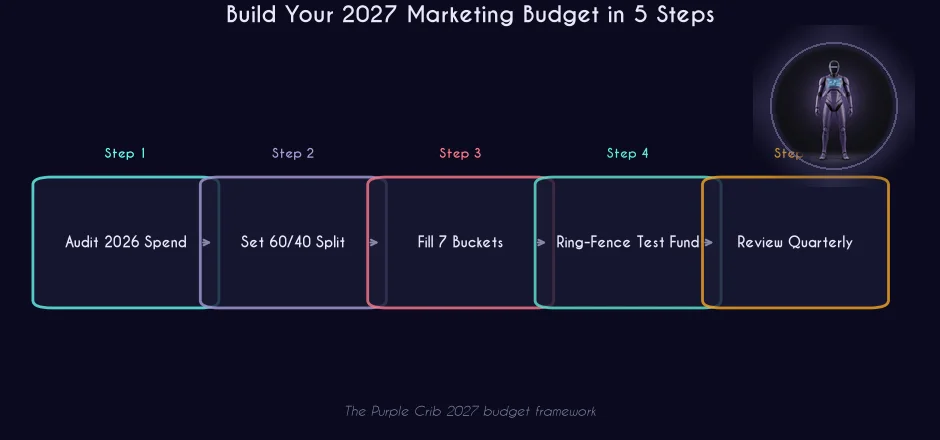
- ✅ Audit 2026 spend against revenue per dollar by channel, not vanity metrics
- ✅ Set the brand/performance split explicitly, starting at 60/40
- ✅ Allocate all spend into the 7 buckets with percentage ranges
- ✅ Ring-fence a 5% test fund that cannot be raided for overruns
- ✅ Move email and lifecycle budget up if it is under 15%
- ✅ Add an AI line item with a specific, measurable purpose
- ✅ Document kill criteria for every major channel
- ✅ Base the plan in USD if you operate across multiple currencies
- ✅ Schedule quarterly budget reviews instead of annual-only planning
- ✅ Tie every bucket to one revenue metric the CFO already tracks
The teams that enter 2027 with a bucketed, kill-criteria, test-funded budget will outperform the teams that simply scale whatever they did in 2026. Build the framework, defend it with unit economics, and let the compounding channels do what they do.
🚀 Want a Second Pair of Eyes on Your 2027 Plan?
Send us your draft budget and we'll pressure-test the allocation against 2026 benchmark data.
💬 Get a Free Budget ReviewRather Have Experts Handle This?
Purple Crib Studios offers done-for-you digital marketing strategy across the US, UK, UAE, Canada, and Nigeria. Get a free 5-point audit in 48 hours.
Explore Our ServicesFAQs
How much should a business spend on marketing in 2027?
Most growing businesses allocate 7-12% of gross revenue to marketing, with early-stage brands going higher to build share. The more important question is allocation: use the 7-bucket framework so the split between brand, performance, owned audience, and infrastructure is deliberate rather than accidental.
What is the 60/40 rule in marketing budgets?
The 60/40 rule, from decades of Binet and Field research, recommends spending roughly 60% of total marketing investment on long-term brand building and 40% on short-term performance activation. Brands that overweight performance see short-term spikes followed by flat growth because they harvest demand without recreating it.
Which marketing channel has the highest ROI in 2026?
Email marketing remains the highest-ROI digital channel at $36-$42 returned per $1 spent, with 82% of global marketers rating its ROI as excellent or good, slightly ahead of SEO at 78%. Owned and retention channels generally out-earn paid acquisition channels per dollar.
Should AI tools get their own budget line in 2027?
Yes. Gartner's 2026 benchmarks show AI talent and data quality drawing urgent funding priority. Budget AI as a specific line item with a measurable purpose, such as content production acceleration or lifecycle personalization, rather than a vague transformation fund. A 5% test fund also lets you experiment with new AI ad surfaces safely.
How often should a marketing budget be reviewed?
Quarterly, at minimum. Annual-only plans drift fast in 2027 conditions given zero-click search, new AI ad surfaces, and shifting channel economics. Each quarterly review should check revenue per dollar by bucket against the kill criteria you set at planning time.
How do I defend a brand-building budget to my CFO?
Lead with unit economics instead of channel metrics, frame owned assets like email lists and content libraries as appreciating balance-sheet items, publish kill criteria for every channel, and keep projections conservative. Budgets that contain their own stop-losses earn finance trust faster than aggressive growth promises.
Test Your Knowledge — 2027 Marketing Budget Quiz
10 quick questions based on this article. Tap an answer to see if you got it right.
Enjoyed this? One click tells Google to show you more Purple Crib content in Search.
Add on GoogleSources & Further Reading
- Moosend — Email Marketing ROI Benchmarks
- Tapfiliate — Email Marketing Benchmarks 2026
- MarketingCharts — Global Marketers Give High ROI Ratings to SEO and Email
- WebFX — Digital Marketing Budget: Planning & Allocation (700 business leaders)
- Marketing Week — 83% of B2B CMOs Expect Marketing Investment to Rise
- Gartner — B2B Budget and Strategy Benchmarks 2026
Hashtags: #MarketingBudget #MarketingStrategy2027 #DigitalMarketing #BudgetPlanning #BrandBuilding #PerformanceMarketing #EmailMarketing #MarketingROI #CMOLife #MarketingFramework #GrowthStrategy #FirstPartyData #MarketingAllocation #GlobalMarketing #PurpleCribStudios