Social commerce is no longer a sidebar experiment. The global market pulled $997.8 billion in 2024 and is projected to reach $1.64 trillion by the end of 2026, according to aggregated industry forecasts. At Purple Crib Studios, we help brands across the US, UK, UAE, Canada, and Nigeria turn social channels from awareness tools into revenue engines — so this October 2026 guide breaks down what social commerce actually means right now, which platforms are winning, and how to build a shoppable content strategy that converts without burning ad spend.
🚀 $1.64 Trillion Is Moving Through Social Apps Right Now
Purple Crib Studios builds shoppable social strategies that convert followers into customers — let's talk.
💬 Chat With Us on WhatsAppTable of Contents
- 1. The $1.64 Trillion Market: What Changed in 2026
- 2. Platform Breakdown: Where Social Shoppers Actually Buy
- 3. TikTok Shop and the Flip Stories Algorithm Boost
- 4. Creator Trust: Why Authentic Content Outperforms Ads
- 5. The Shoppable Content Audit Checklist
- FAQs
- Test Your Knowledge — Quiz
1. The $1.64 Trillion Market: What Changed in 2026
The numbers tell the story. Social commerce grew from roughly $1.2 trillion in 2025 to a projected $1.64 trillion by end of 2026, representing a compound annual growth rate of 30.8% since 2020. Hostinger reports that 53% of global social media users now purchase directly through social platforms, a figure that was under 40% just two years ago. This is not a trend layering on top of e-commerce — it is e-commerce being absorbed into the social feed itself.
What changed in 2026 specifically is the maturity of in-app checkout. Instagram Shop, TikTok Shop, Pinterest Shopping, and YouTube Shopping all now offer end-to-end purchasing without leaving the platform. The friction that used to kill conversion — the jump from social post to product page to checkout — has been removed. For brands, this means the distance between "that looks interesting" and "I bought it" can now be measured in seconds, not sessions.
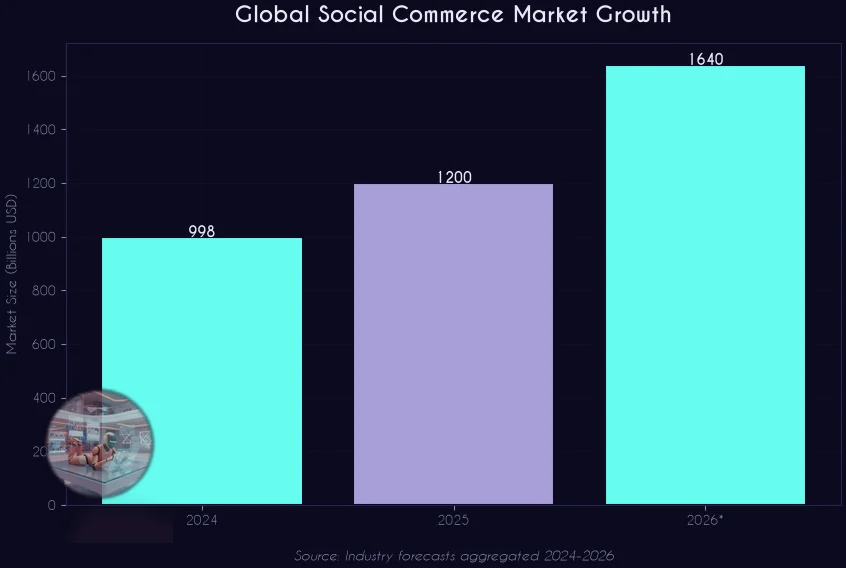
The regional picture matters for Purple Crib's markets. North America leads in transaction value, but the UAE and broader Middle East show the fastest adoption curve, with BigCommerce noting that Gulf-region social commerce grew 40% year-over-year. Nigeria's social commerce scene is dominated by WhatsApp and Instagram DMs — a different infrastructure than the West's in-app checkout, but equally a social-first buying behavior.
2. Platform Breakdown: Where Social Shoppers Actually Buy
Not all platforms convert equally. Here is the October 2026 landscape based on current data from eMarketer and Tidio:
📱 TikTok Shop
51% of US social buyers
The breakout platform of 2026. Live shopping events drive impulse purchases, and the algorithm actively rewards product-tagged content. Flip Stories now get an algorithmic boost, creating a window for brands before the format saturates.
📷 Instagram Shop
56% of Millennial social buyers
Millennials remain the most active social commerce demographic per Tidio, making up 33% of all purchases. Instagram's visual-first format plus in-app checkout makes it the default for fashion, beauty, and lifestyle categories.
Dominant in Nigeria, India, LATAM
Not a formal commerce platform, but the de facto social commerce channel in markets where formal checkout infrastructure is thin. Catalogs, WhatsApp Business, and payment links make it a full funnel in markets like Nigeria.
Highest average order value
Pinterest users come with intent — they are planning, not scrolling. Shopping pins and visual search make it the highest-AOV platform for home, decor, and fashion. Underused by most brands.
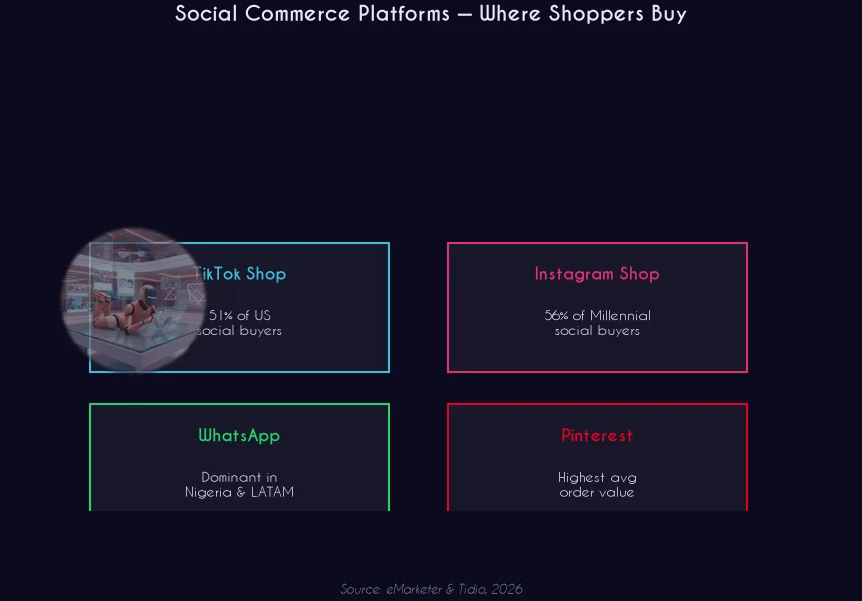
The strategic takeaway: no single platform covers all markets. A brand selling in the UAE needs Instagram Shop and TikTok. A brand selling in Nigeria needs WhatsApp Business and Instagram DMs. A brand selling decor in Canada needs Pinterest. Platform selection is a regional decision, not a global one. For a broader look at how social fits into the full marketing mix, see our guide on distribution strategy beyond SEO.
3. TikTok Shop and the Flip Stories Algorithm Boost
TikTok is the platform reshaping social commerce fastest in 2026. eMarketer projects that over half of US social buyers (51%) will shop on TikTok this year — a number that was unthinkable in 2023. The growth is driven by two structural changes:
Live shopping events. TikTok Live sessions where creators demo and sell products in real time have become the highest-converting format on the platform. The urgency of live availability, combined with creator trust, drives impulse purchases at rates traditional e-commerce cannot match.
Flip Stories algorithmic boost. As SocialDay reports, TikTok is actively promoting Flip Stories and other photo formats with extra reach. This creates a window for brands: product photos presented as Flip Stories get distribution that standard video posts do not, at least until the format matures and everyone adopts it. Early adopters win.
However, the OECD's AI incident database notes that TikTok's $14 billion US sale and algorithm retraining on US data caused revenue drops for some creators in early 2026. The algorithm rewards different content patterns now — the "post a lot" playbook is dead, replaced by "post smart." This aligns with what we covered in our post on engagement depth and the interest-graph shift: quality beats volume on every platform in 2026.
4. Creator Trust: Why Authentic Content Outperforms Ads
The biggest lesson from 2026 influencer marketing data, per New Engen's September 2026 analysis, is that AI recommendations and creator trust are now the dual gatekeepers of purchase decisions. Users trust a creator they follow more than a brand they have never heard of, and social commerce amplifies this: the purchase happens in the same moment as the recommendation.
But there is a critical nuance. The trust only works when the content feels authentic. Pink Dog Digital identifies the key 2026 shift: AI has become a partner in content creation rather than a shortcut, but teams that used AI to mass-produce generic content saw the opposite of growth. The same principle applies to creators — a creator who genuinely uses the product will outperform a paid endorsement every time, and platforms' recommendation systems are now tuned to detect the difference.
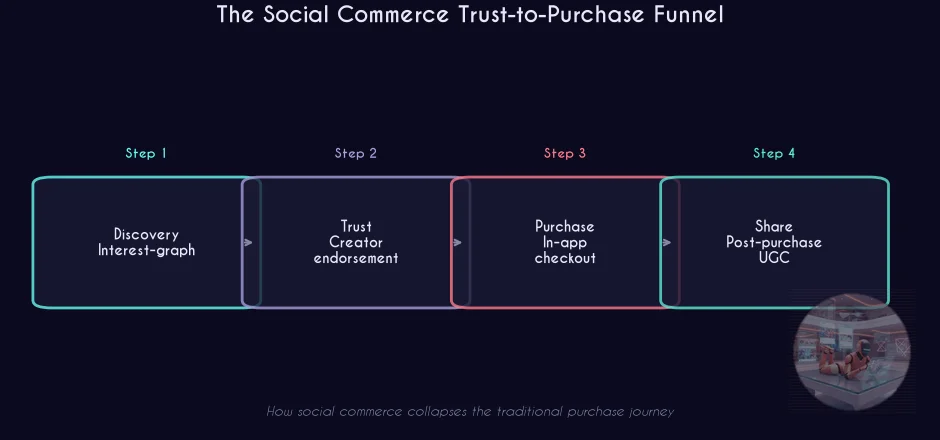
The trust-to-purchase funnel: Discovery (content finds the user via interest-graph) → Trust (creator endorsement or genuine use case) → Frictionless purchase (in-app checkout, one tap) → Share (post-purchase UGC amplifies the loop). Each step removes a barrier that existed in traditional e-commerce.
For brands, this means the most valuable social commerce investment is not ad spend — it is creator partnerships. Micro-creators (10K-100K followers) with niche, engaged audiences outperform macro-influencers on conversion rates, because their trust is concentrated rather than diluted. Our earlier guide on creator-led trust in 2026 covers this in depth.
5. The Shoppable Content Audit Checklist
Before scaling social commerce, audit your current presence. Here is the checklist we use with clients:
Shoppable Content Audit — 10 Points
- ✅ Product tags enabled — Are your Instagram, TikTok, and Pinterest posts product-tagged where possible?
- ✅ In-app checkout live — Can users buy without leaving the platform on at least one channel?
- ✅ Creator partnerships — Do you have 3-5 micro-creators actively using and posting about your product?
- ✅ Live shopping tested — Have you run at least one TikTok Live or Instagram Live shopping event?
- ✅ WhatsApp Business set up — If you sell in Nigeria, India, or LATAM, is your catalog and payment link flow live?
- ✅ Flip Stories format tested — Are you using TikTok Flip Stories for product photos before the format saturates?
- ✅ Post-purchase UGC loop — Do you encourage and reshare customer content after purchase?
- ✅ Platform strategy is regional — Are you on the right platforms for each market you sell in?
- ✅ Trust signals visible — Reviews, ratings, and real customer photos on product pages?
- ✅ AI for research, not replacement — Using AI to analyze performance and draft variations, not to mass-produce generic content?
If you scored under 7 out of 10, you are leaving revenue on the table. The good news: most of these fixes take days, not months.
🚀 Ready to Turn Your Social Into a Revenue Channel?
Purple Crib Studios builds shoppable social strategies for brands across five markets. Free 5-point audit in 48 hours.
💬 Get My Free AuditRather Have Experts Handle This?
Purple Crib Studios offers done-for-you social media marketing and social commerce setup across the US, UK, UAE, Canada, and Nigeria. Get a free 5-point audit in 48 hours.
Explore Our ServicesFAQs
What is social commerce in 2026?
Social commerce is the buying and selling of products directly within social media platforms, without leaving the app. In 2026, the global market is projected to reach $1.64 trillion, with platforms like TikTok Shop, Instagram Shop, and Pinterest Shopping offering in-app checkout. It differs from social media marketing because the entire purchase funnel happens inside the social platform.
Which platform is best for social commerce?
There is no single best platform. TikTok Shop leads in US adoption with 51% of social buyers shopping there, Instagram Shop leads with Millennial buyers (56% of social commerce customers), Pinterest has the highest average order value for visual categories, and WhatsApp dominates in Nigeria, India, and LATAM. Platform choice should be driven by your target market and product category.
How big is the social commerce market in 2026?
The global social commerce market reached $997.8 billion in 2024 and is projected to reach $1.64 trillion by the end of 2026, growing at a compound annual growth rate of 30.8% since 2020. 53% of global social media users now purchase directly through social platforms.
What are TikTok Flip Stories and why do they matter for social commerce?
TikTok Flip Stories are a photo-based format that TikTok is actively promoting with extra algorithmic reach in 2026. They matter for social commerce because product photos presented as Flip Stories get distribution that standard video posts do not, creating an early-adopter advantage for brands before the format saturates.
How do creators drive social commerce sales?
Creators drive social commerce sales through trust. A creator who genuinely uses a product and recommends it to their audience converts at higher rates than paid ads, because the purchase happens in the same moment as the recommendation. Micro-creators (10K-100K followers) with niche audiences outperform macro-influencers on conversion rates because their trust is concentrated rather than diluted.
Is social commerce relevant for Nigerian and African markets?
Yes. In Nigeria and much of Africa, social commerce primarily runs through WhatsApp Business and Instagram DMs rather than formal in-app checkout. The buying behavior is already social-first — customers browse on Instagram, message on WhatsApp, and pay via transfer or payment links. Brands that formalize this flow with WhatsApp catalogs and payment links see significant conversion improvements.
Test Your Knowledge — Social Commerce Quiz
6 quick questions based on this article. Tap an answer to see if you got it right.
📌 See More Content Like This on Google
Want Google to show you more of Purple Crib's expert content on SEO, GMB, and AI marketing? It takes one click — add us as a preferred source and Google will prioritise our articles in your Search results.
📌 Make Google Work for You
Tell Google you want to see more Purple Crib content in your Search results.
Click the link below → check the box → done. Google will show more of our content to you from now on.
🔍 Add Purple Crib as a Google SourceHow it works — 3 simple steps:
- Click the button above (or copy this link: https://google.com/preferences/source?q=https://www.purplecrib.ng)
- Check the box next to Purple Crib on the Google Search preferences page
- Google will now show more of our content when you search for SEO, GMB, AI marketing, and digital strategy topics
Share this with a colleague who wants to stay ahead of Google and AI trends too 👇
Sources & Further Reading
- eMarketer — US Social Commerce Forecast 2026
- Tidio — 11 Key Social Commerce Statistics to Know (2026)
- Hostinger — 2026 Social Commerce Statistics: Key Trends & New Data
- BigCommerce — Social Commerce in 2026: How It's Reshaping Ecommerce
- SocialDay — TikTok's Flip Stories Hands Early Adopters an Algorithmic Boost
- New Engen — Influencer Marketing Trends: September 2026
#SocialCommerce #SocialMediaMarketing2026 #TikTokShop #InstagramShopping #SocialCommerceStrategy #DigitalMarketing #CreatorEconomy #SocialShopping #WhatsAppBusiness #PinterestShopping #EcommerceStrategy #PurpleCribStudios #SocialMediaTips