In October 2026, the question for businesses is no longer "should we automate?" but "which AI agent platform should we build on?" Zapier, Make, n8n, and Lindy have all reinvented themselves around AI agents in the last twelve months, and the differences between them are now larger than ever. Here is a practical, no-fluff comparison to help Purple Crib Studios clients and readers across the US, UK, UAE, Canada, and Nigeria pick the right one.
🚀 Stop Drowning in Manual Tasks — Let AI Agents Handle Them
Purple Crib Studios builds custom AI automation systems for businesses worldwide. Get a free workflow audit in 48 hours.
💬 Chat With Us on WhatsAppTable of Contents
- 1. The Shift: From Integrations to AI Agents
- 2. Zapier Agents: Fastest Path to Automation
- 3. Make AI Agents: Visual Workflows With Brains
- 4. n8n 2.0: The AI-Native Power Tool
- 5. Lindy: Your AI Teammate With Approval Controls
- 6. Side-by-Side Comparison
- 7. Decision Framework: Which Platform Fits Your Business?
- 8. Real Cost Analysis Across Markets
- 9. 7-Day Implementation Checklist
- Test Your Knowledge — AI Agent Platforms Quiz
- FAQs
1. The Shift: From Integrations to AI Agents
Two years ago, automation platforms were simple pipe layers: "when this happens in app A, do that in app B." That model still works, but the game has changed. In 2026, Gartner projects that 40% of new business applications will embed AI agents by year-end. The platforms that survived did so by rebuilding themselves around autonomous AI agents that can reason, branch, call tools, and make judgment calls — not just follow rigid if-then rules.
This matters for your business because the cost of manual work has not gone down, but the cost of AI-powered automation has. A workflow that used to require a developer, a scheduler, and a human reviewer can now run end-to-end on a single platform for under $50 a month — if you pick the right one. We covered the basics of AI workflow automation for small business in an earlier guide; this article goes deeper into platform selection. For businesses in Nigeria, where labour costs are lower but talent scarcity is higher, AI agents fill critical gaps. In the UAE and US, they compress operational costs at scale.
The four platforms below have taken fundamentally different architectural approaches. There is no universal winner — there is a right answer for your specific business shape.
2. Zapier Agents: Fastest Path to Automation
Zapier remains the undisputed king of breadth: over 9,000 app integrations, the shortest setup curve in the industry, and a new Zapier Agents feature that lets you create autonomous agents from natural language. You describe what you want the agent to do, connect your data sources, and it handles the rest — classifying leads, summarising messages, drafting responses, and triggering follow-up sequences across connected apps. For a broader look at the AI tools landscape, see our 5 AI Tools for Business in 2026 guide.
Where Zapier wins: Non-technical teams can ship a useful automation in 15 minutes. If your marketing, sales, or customer success team needs to move fast without hiring a developer, Zapier is the path of least resistance. The audit logging, SOC 2 compliance, and GDPR features make it deployable in regulated environments.
Where Zapier struggles: Volume. Zapier charges per task, and at scale the bills climb fast. Real-world reports show businesses hitting $4,000 to $8,000 per month on workflow volumes that would cost a fraction on n8n. For complex branching, looping, and error handling, Zapier's execution model starts to creak.
Best for: Non-technical teams, moderate workflow volumes, speed-of-setup priority. Typical use cases: lead classification and CRM routing, form-to-task conversion, customer message summarisation, and internal knowledge-base search before drafting responses.
3. Make AI Agents: Visual Workflows With Brains
Make occupies the sweet spot between Zapier's simplicity and n8n's depth. Its visual scenario builder is the most expressive of the three major platforms — multi-step workflows with branching, looping, error handling, and aggregation logic are genuinely pleasant to design. The new Maia AI assistant builds scenarios from natural-language descriptions, and Make AI Agents (currently in open beta) can reason, choose next steps, and trigger workflows across 3,000+ integrations.
Where Make wins: When your automation needs visible branching logic. A client-onboarding workflow might receive a signed form, extract fields, check for missing data, create records in multiple systems, ask for human review on ambiguous cases, and schedule the next step — all visible on a single canvas. Make's pricing is also competitive, generally below Zapier on equivalent workloads.
Where Make struggles: The AI Agent feature is open beta, which means functionality and pricing may shift. For mission-critical processes, that uncertainty matters. Make is also cloud-only — no self-hosting option for regulated industries.
Best for: Small-to-mid-size businesses that need more workflow expressiveness than Zapier but cannot take on n8n's technical depth. Billing uses credits: one operation generally equals one credit, with additional token-based charges for AI usage.
4. n8n 2.0: The AI-Native Power Tool
n8n had the most ambitious 2025 to 2026 transformation of any platform on this list. The 2.0 release shipped roughly 70 dedicated AI nodes with deep LangChain integration, persistent agent memory, and native vector store support — making it the most AI-native automation platform on the market. It supports both cloud-hosted and self-hosted deployments, with the open-source Community Edition being genuinely production-grade.
Where n8n wins: Cost at volume. n8n charges per workflow execution, regardless of how many steps that workflow contains. For high-volume workflows with many internal steps — typical of real AI agent loops — the savings versus Zapier can reach 80 to 90%. Self-hosting gives regulated industries in the UK, UAE, and elsewhere a path to data residency compliance that no competitor offers.
Where n8n struggles: The on-ramp. n8n expects technical fluency. Non-developer departments will not self-serve effectively. You need a developer or automation engineer to build, maintain, and operate n8n workflows. For organisations without that capability, n8n via a specialist agency partner is viable — but pure self-service it is not.
Best for: Developer-led teams, regulated industries requiring self-hosting, high-volume AI agent workloads where cost-per-execution matters. n8n's paid plans include unlimited users, unlimited workflows, and unlimited workflow steps, with the main constraint being the plan's execution allowance.
5. Lindy: Your AI Teammate With Approval Controls
Lindy takes a fundamentally different approach. Instead of a visual workflow canvas, Lindy positions itself as an AI assistant or teammate — a no-code platform for building custom AI employees that handle email triage, scheduling, lead qualification, research, and multi-step tasks. With 1,000+ integrations including Gmail, Google Calendar, HubSpot, Salesforce, Slack, Shopify, and Xero, Lindy covers the core business app surface.
Where Lindy wins: Approval controls. Lindy lets you require human approval before sending emails, updating tickets, posting to channels, or publishing documents. This matters because agent behaviour is not perfectly deterministic. A useful automation should pause when confidence is low, when a recipient is external, or when a change is difficult to reverse. Lindy's approval layer is the most mature of any platform on this list.
Where Lindy struggles: Scale and price. Lindy's plans start at $49.99 per month (Plus) and go up to $199.99 (Max). For businesses running hundreds of automations daily, the usage-based pricing adds up. Lindy also has a smaller integration library than Zapier or Make.
Best for: Individual professionals and small teams who want assistant-style automation with built-in human oversight. Particularly strong for inbox triage, meeting follow-up, scheduling, and customer communication where you want a human in the loop before actions go out.
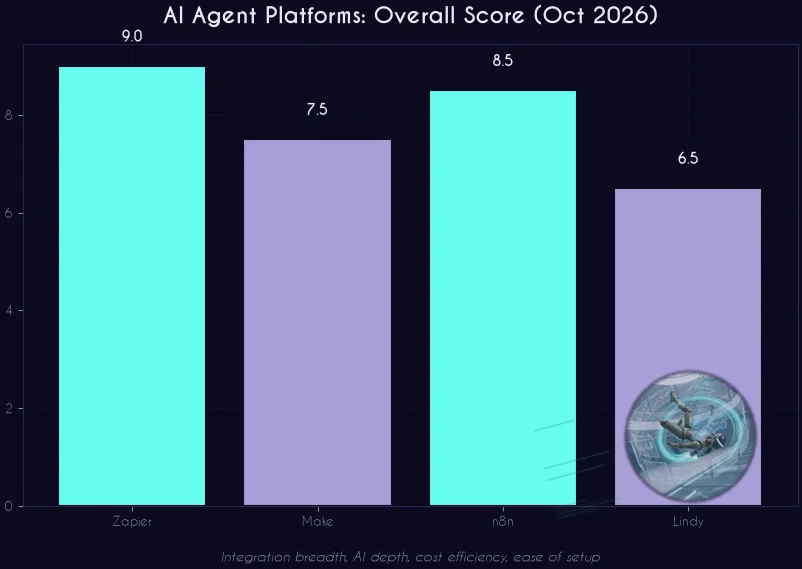
6. Side-by-Side Comparison
7. Decision Framework: Which Platform Fits Your Business?
The most common 2026 deployment pattern is not "pick one platform" — it is multi-platform. Businesses typically run Zapier for fast departmental automation that non-technical teams can self-serve, and n8n for the high-volume AI agent infrastructure that powers production-grade workflows. Our earlier AI Team Operating System guide covers the workflow patterns that run well on these platforms. Make appears in roughly a quarter of businesses as the primary platform where neither Zapier's pricing nor n8n's technical depth is the right fit.
Use this framework to decide:
🟢 Choose Zapier if: Your team is non-technical, your workflow volume is moderate (under a few thousand runs per month), and speed of setup beats fine-grained control. Best for marketing, sales, and customer success departments.
🔵 Choose Make if: You need visible branching logic, multi-step scenarios with error handling, and a visual canvas for auditing complex workflows. Best for operations teams and mid-size businesses.
🟣 Choose n8n if: You have a developer on the team, your workflow volumes are high, you need self-hosting for data residency, or your AI agent ambitions are serious. Best for engineering-led companies and regulated industries.
🟠 Choose Lindy if: Your work is inbox-centric (email triage, scheduling, follow-ups), you want built-in human approval before external actions, and you prefer an assistant model over a workflow canvas. Best for individual professionals and small teams.
8. Real Cost Analysis Across Markets
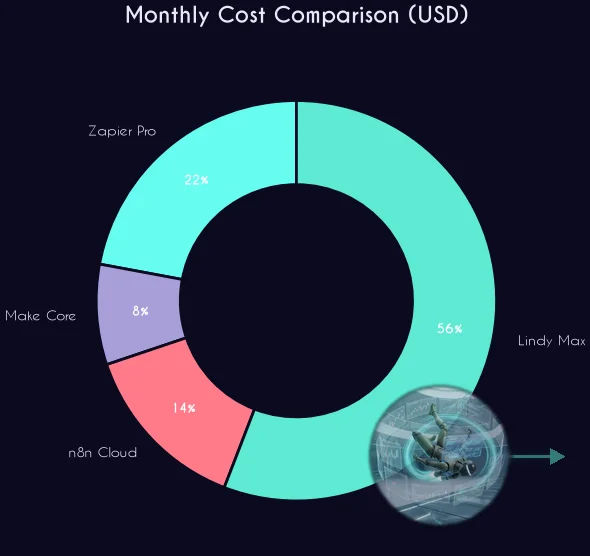
Pricing varies dramatically by platform and usage pattern. Here is what businesses can expect to spend per month based on typical small-to-mid-size automation needs:
Zapier (Pro)
$20-79/mo
Good for <2,000 tasks. Scales aggressively past that — watch for $200-800/mo at volume.
Make (Core)
$12-29/mo
10,000+ operations. AI token costs add on top. Best SMB value per operation.
n8n (Cloud)
$20-50/mo
Per execution, unlimited steps. Self-hosted is free. 80-90% savings vs Zapier at scale.
Lindy
$49-200/mo
7-day trial. Plus $49.99, Pro $99.99, Max $199.99. Most expensive but includes approvals.
For Nigerian businesses, n8n's self-hosted option is particularly attractive — you can run it on a $5/month VPS and pay nothing for the software itself. For UAE and US businesses with higher labour costs, the time savings from any platform pay for itself within the first month. For Canadian businesses, Make's competitive pricing and strong visual workflow design make it a natural fit for mid-market operations teams.
9. 7-Day Implementation Checklist
Ready to pick a platform and ship your first AI agent? Follow this 7-day plan:
- ✅ Day 1: List your top 5 repetitive tasks (email responses, data entry, lead routing, report generation, scheduling).
- ✅ Day 2: Map each task's trigger, steps, and outcome. Identify which need human judgment vs which are deterministic.
- ✅ Day 3: Pick your platform using the decision framework above. Sign up for a free trial or the free tier.
- ✅ Day 4: Build your first automation — start with the simplest task on your list. Test it end-to-end.
- ✅ Day 5: Add an AI step (classification, summarisation, or draft generation). Review the output quality.
- ✅ Day 6: Set up approval gates for any step that touches external recipients or irreversible actions.
- ✅ Day 7: Document the workflow, monitor costs for the first week, and plan your second automation.
🚀 Not Sure Which Platform Fits Your Business?
Purple Crib Studios helps businesses across 5 countries design and deploy AI automation systems. Free 30-minute consultation.
💬 Get Your Free Consultation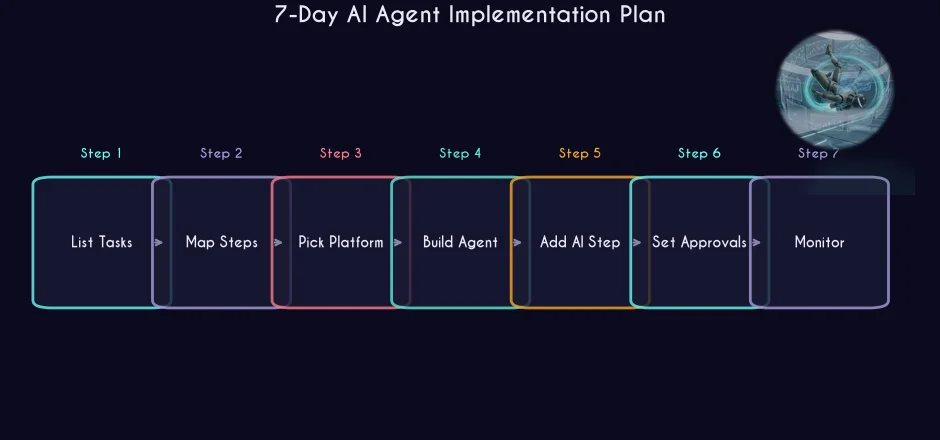
Rather Have Experts Handle This?
Purple Crib Studios offers done-for-you AI SEO and automation consulting across the US, UK, UAE, Canada, and Nigeria. Get a free 5-point audit in 48 hours.
Explore Our ServicesFAQs
Which AI automation platform is best for small businesses in 2026?
It depends on your team and needs. Zapier is best for non-technical teams that want fast setup. Make is ideal for visual, branching workflows. n8n offers the best value at scale and supports self-hosting. Lindy is best for inbox-centric work with built-in approval controls. Most businesses end up using two platforms — typically Zapier for quick departmental automation and n8n for high-volume AI agent workloads.
Is n8n really free to use?
n8n's Community Edition is free and open-source for self-hosting. You can run it on a $5/month VPS with no software cost. The cloud-hosted version starts at around $20/month. Paid plans add features like SSO, SAML, environments, and enterprise governance. You still need to account for infrastructure, model provider fees, and engineering time when self-hosting.
How much does Zapier cost at scale?
Zapier's Professional plan starts at around $20/month, but costs scale aggressively with volume. Businesses running thousands of tasks per day have reported bills of $4,000 to $8,000 per month. For high-volume workflows, n8n can deliver 80 to 90 percent cost savings versus Zapier on the same workload.
Can I use AI agents without a developer?
Yes. Zapier Agents and Lindy are both designed for non-technical users and can be set up in under 30 minutes. Make's Maia AI assistant also builds scenarios from natural language. n8n, however, expects technical fluency and is best suited for developer-led teams or businesses working with an automation agency.
What is the difference between Make AI Agents and Zapier Agents?
Zapier Agents are designed for speed and simplicity, connecting across 9,000+ apps with natural-language setup. Make AI Agents (currently in open beta) offer more visual control with branching logic, error handling, and aggregation, connecting across 3,000+ integrations. Make is better for complex, multi-step workflows; Zapier is better for fast, straightforward automations.
Which platform supports self-hosting for data privacy?
Only n8n offers a production-grade self-hosting option via its Community Edition. This makes n8n the clear choice for regulated industries in financial services, healthcare, and public sector where data residency is a hard requirement. Zapier, Make, and Lindy are all cloud-only platforms.
Test Your Knowledge — AI Agent Platforms Quiz
6 quick questions based on this article. Tap an answer to see if you got it right.
📌 See More Content Like This on Google
Want Google to show you more of Purple Crib's expert content on SEO, GMB, and AI marketing? It takes one click — add us as a preferred source and Google will prioritise our articles in your Search results.
📌 Make Google Work for You
Tell Google you want to see more Purple Crib content in your Search results.
Click the link below → check the box → done. Google will show more of our content to you from now on.
🔍 Add Purple Crib as a Google SourceHow it works — 3 simple steps:
- Click the button above (or copy this link: https://google.com/preferences/source?q=https://www.purplecrib.ng)
- Check the box next to Purple Crib on the Google Search preferences page
- Google will now show more of our content when you search for SEO, GMB, AI marketing, and digital strategy topics
Share this with a colleague who wants to stay ahead of Google and AI trends too 👇
Sources & Further Reading
- BraivIQ — n8n vs Zapier vs Make in 2026: The Honest UK Workflow Automation Shootout
- Aureliq — Best AI Automation Platforms for Small Businesses in 2026
- AI Tool Radar — Best AI Automation Tools 2026: n8n, Zapier, Make
- AI Central Resources — Zapier vs Make vs n8n (2026): True Pricing & Hidden Costs
- Digital by Default — Lindy AI Review 2026: Build Your Own AI Assistants
- n8n — Official Plans and Pricing
Hashtags: #AITools2026 #AIAutomation #Zapier #n8n #MakeAutomation #LindyAI #AIAgents #SmallBusinessTech #WorkflowAutomation #BusinessProductivity #DigitalTransformation #AIForBusiness #NoCodeAutomation #TechStrategy2026 #PurpleCribStudios