
Beyond Scraping: How WebMCP Turns Websites into Structured AI Tools
📌 See More Content Like This on Google
Want Google to show you more of Purple Crib's expert content on SEO, GMB, and AI marketing? It takes one click — add us as a preferred source and Google will prioritise our articles in your Search results.
📌 Make Google Work for You
Tell Google you want to see more Purple Crib content in your Search results.
Click the link below → check the box → done. Google will show more of our content to you from now on.
🔍 Add Purple Crib as a Google SourceHow it works — 3 simple steps:
- Click the button above (or copy this link: https://google.com/preferences/source?q=https://www.purplecrib.ng)
- Check the box next to Purple Crib on the Google Search preferences page
- Google will now show more of our content when you search for SEO, GMB, AI marketing, and digital strategy topics
Share this with a colleague who wants to stay ahead of Google and AI trends too 👇
Table of Contents
- The Shift to a Machine-Readable Web
- What is WebMCP?
- Declarative vs. Imperative: Choosing Your Integration Path
- Performance Gains: The End of "Guessing" Your UI
- The Amazon Origin: From MCP-B to W3C
- Security First: The Human-in-the-Loop Default
- How to Get Started Today
- Conclusion: Building for the Agentic Future
The Shift to a Machine-Readable Web
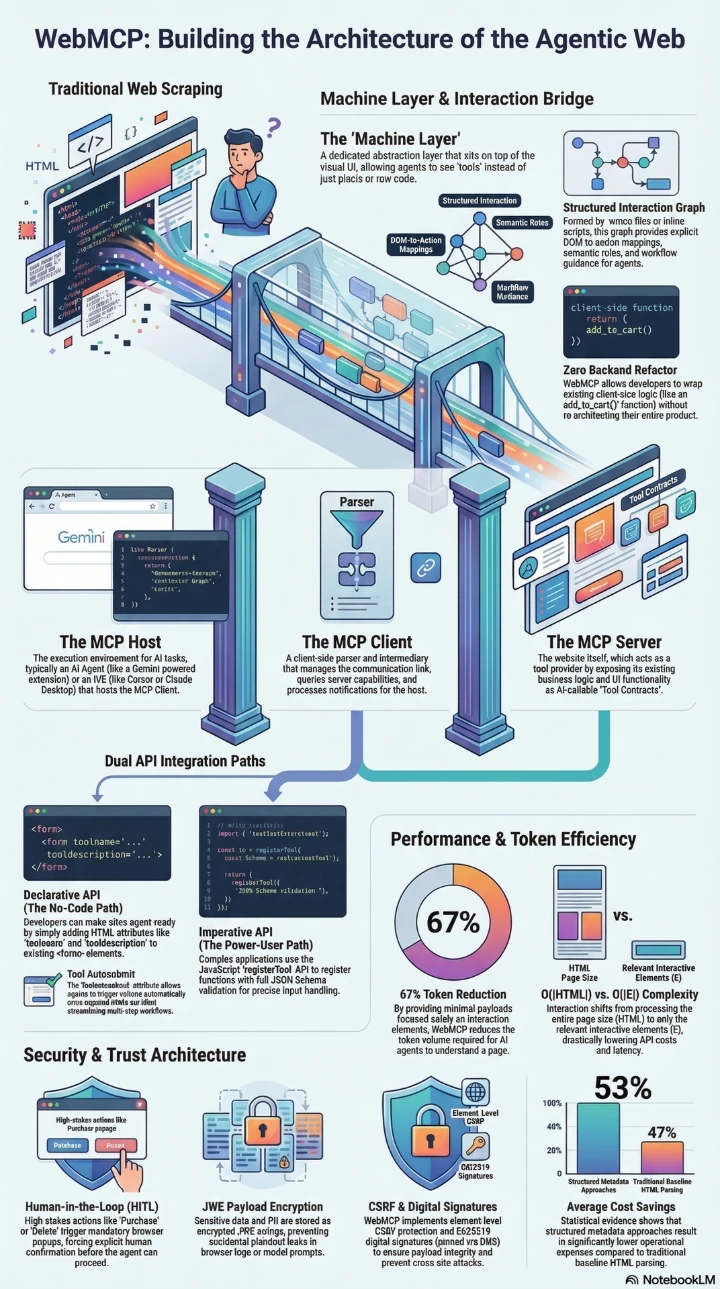
For years, AI agents have interacted with the web like humans: evaluating screenshots and parsing messy DOM trees to "guess" where a checkout button might be. This process is inherently brittle, slow, and expensive. WebMCP (Web Model Context Protocol) changes this paradigm by allowing websites to publish an explicit “Tool Contract” that agents can call directly.
What is WebMCP?
WebMCP is a draft proposal currently being incubated by the W3C Web Machine Learning Community Group. It introduces a browser-native API (navigator.modelContext) that enables web applications to expose their functionality as structured JavaScript tools. Unlike the original Model Context Protocol (MCP) by Anthropic, which often requires backend servers, WebMCP runs entirely client-side, leveraging the user's existing session and security context.
Declarative vs. Imperative: Choosing Your Integration Path {#api-paths}
Developers can make their sites "agent-ready" using two distinct API paths:
- The Declarative API (No-Code): Best for standard actions, this path uses existing HTML <form> elements. By adding attributes like toolname, tooldescription, and toolautosubmit, the browser automatically translates these forms into AI-callable tools.
- The Imperative API (Power-User): For complex, dynamic interactions—such as real-time dashboards or e-commerce filters—developers use navigator.modelContext.registerTool. This allows for full JavaScript logic and JSON Schema input validation.
Performance Gains: The End of "Guessing" Your UI
Traditional "screen scraping" by agents is token-intensive, often consuming $10^4$ to $10^5$ tokens for simple tasks. Benchmarks show that WebMCP provides a mean 65-78% token reduction and 34-63% lower API costs. By shifting from $O(\text{page_size})$ to $O(\text{interactive_elements})$, WebMCP achieves up to 37% latency improvements in production environments.
The Amazon Origin: From MCP-B to W3C
The protocol originated from Alex Nahas, a backend engineer at Amazon who built MCP-B (MCP for the Browser) to solve authorization hurdles within Amazon's internal services. By running MCP in the browser, agents could use existing SSO and session cookies. This project eventually merged with parallel efforts from Google and Microsoft to form the WebMCP standard.
Security First: The Human-in-the-Loop Default
WebMCP is designed with Human-in-the-Loop (HITL) safeguards to mitigate risks like the "lethal trifecta," where a malicious tab might attempt to hijack an agent.
- Explicit Interaction: High-stakes actions trigger an agent.requestUserInteraction() popup for manual confirmation.
- Cryptographic Protection: The protocol supports JWE encryption for sensitive payloads and Ed25519 digital signatures to ensure tool metadata has not been tampered with.
- Session Inheritance: Agents only possess the permissions of the currently logged-in user.
How to Get Started Today {#getting-started}
As of March 2026, WebMCP is available for early testing:
- Chrome Canary: Use Chrome 146 Canary or later.
- Enable Flags: Search for #webmcp-for-testing in chrome://flags.
- Playground: Visit WebMCP.sh, which features an in-browser PostgreSQL (PGlite) database for testing.
- SDK: Use the @mcp-b/webmcp-ts-sdk for dynamic tool registration in your applications.
Conclusion: Building for the Agentic Future {#conclusion}
The shift to an agentic web is as significant as the transition to mobile-first indexing. By implementing WebMCP as a progressive enhancement, developers ensure their brands are the most reliable ones for AI agents to recommend and interact with.
🚀 Want to Dominate Google Search in 2026?
Purple Crib Studios helps businesses rank higher with AI-powered SEO and Google Business Profile optimisation.
💬 Chat With Us on WhatsApp