
WebMCP is a W3C browser standard that lets your online store expose structured tools — search products, filter inventory, add to cart, check shipping, start checkout — that AI shopping agents can call directly instead of scraping your pages. For e-commerce, it turns your storefront from a display layer into an action layer, and the stores that get structured early will win the agent-driven traffic that is already reshaping retail: generative-AI referrals to U.S. retail sites jumped 693% year over year during the 2025 holiday season.
By Kayode Ajayi · Last updated
Get your store agent-ready with Purple Crib StudiosChat with us on WhatsApp → +234 818 000 2345What this guide covers
- What is WebMCP?
- Why online stores must care now
- How WebMCP changes the shopping journey
- Product discovery and search
- Why product data quality is the foundation
- How WebMCP changes checkout and conversion
- Cart, offers, and promotions
- Returns, support, and post-purchase
- Does WebMCP replace SEO?
- The technical preparation checklist
- UX, trust, and keeping humans in control
- Risks and mistakes to avoid
- What to do now
What is WebMCP?
WebMCP is a proposed W3C browser standard that adds a navigator.modelContext API, letting a website register structured “tools” that AI agents can discover and call directly — no DOM scraping, no simulated clicks. It was co-authored by Google and Microsoft engineers inside the W3C Web Machine Learning Community Group and is now in a public origin trial in Chrome. The page tells the agent exactly what actions exist, what inputs they expect, and what they return.
For online stores it helps to see WebMCP as one layer in a three-part agentic-commerce stack. The Model Context Protocol (MCP), open-sourced by Anthropic in November 2024, is the foundational “USB-C for AI” that standardises how models call tools. WebMCP brings that idea into the browser tab. And the Agentic Commerce Protocol (ACP) — co-developed by Stripe and OpenAI — standardises the money part: how an agent completes a purchase on a buyer’s behalf.
| Protocol | What it standardises | Where it runs | Owner |
|---|---|---|---|
| MCP | How AI models connect to tools and data | Server / desktop / cloud | Anthropic (open standard) |
| WebMCP | How a website exposes tools to in-browser agents | The browser tab (navigator.modelContext) | W3C (Google + Microsoft) |
| ACP | How agents complete a checkout and payment | Merchant checkout endpoints | Stripe + OpenAI (open standard) |
You do not have to adopt all three at once. But knowing the stack tells you where your store’s work sits: WebMCP makes your storefront usable, ACP makes your checkout completable, and clean data underneath makes both trustworthy.
Why must online stores care about WebMCP now?
Because AI is already sending real, high-intent traffic to stores — and converting it better than your other channels. Adobe Analytics, drawing on over a trillion visits to U.S. retail sites, found AI-referred retail traffic grew 393% year over year in Q1 2026, and in March 2026 that AI traffic converted 42% better than non-AI traffic — a record. Shoppers are not just researching with AI; they are buying.
The intent to hand off the purchase itself is already here. Salesforce research found that 48% of shoppers who already use AI for shopping are open to letting an AI agent make a purchase for them. This creates two shifts at once: your store now competes for agent-driven usage, not only human clicks, and the quality of your product data and commerce workflows matters more, because machines need consistency to act safely.
The more complex the store — large catalogs, many variants, layered shipping rules, multiple fulfilment locations — the more valuable structured access becomes, because that is exactly the complexity a shopper wants an agent to handle for them.
How does WebMCP change the shopping journey?
It collapses the classic funnel — search, browse, compare, click, cart, checkout — into a conversational loop: ask, filter, refine, select, buy. When a shopper tells an assistant “find a waterproof backpack under 70 euros with fast delivery,” a pretty product page is not enough. The agent needs structured attributes, reliable inventory, clear shipping data, and a predictable path to purchase.
| Stage | Classic funnel (human-led) | Agentic journey (WebMCP-enabled) |
|---|---|---|
| Discover | Keyword search, visual browsing | Natural-language intent matched to a structured search tool |
| Compare | Open tabs, eyeball specs | Agent reads normalised attributes and compares instantly |
| Decide | Flashy landing page wins | Cleanest data and clearest logic win |
| Buy | Manual multi-step checkout | Agent-completed checkout via ACP, human confirms |
The takeaway is uncomfortable but clarifying: product discovery is shifting from visual browsing toward machine-readable intent matching. The best products in an agentic result are often not the ones with the best photography — they are the ones with the cleanest data and the most usable commerce logic.
What does WebMCP mean for product discovery and search?
Search becomes a callable action rather than a page. Instead of parsing your search results HTML, an agent can invoke a structured search tool — the exact pattern WebMCP demonstrations use, registering a read-only searchProducts tool that returns structured data. Whoever exposes the cleanest search action gets used.
That raises the bar on the fundamentals. Product titles need to be precise. Descriptions need to be informative. Attributes — size, colour, material, compatibility, price range — need to be consistent across the whole catalogue. And your category taxonomy has to make sense, because a messy taxonomy is hard for both humans and agents to interpret. The stores that win here are not the ones with the most products; they are the ones with the best product organisation.
Why is product data quality the foundation?
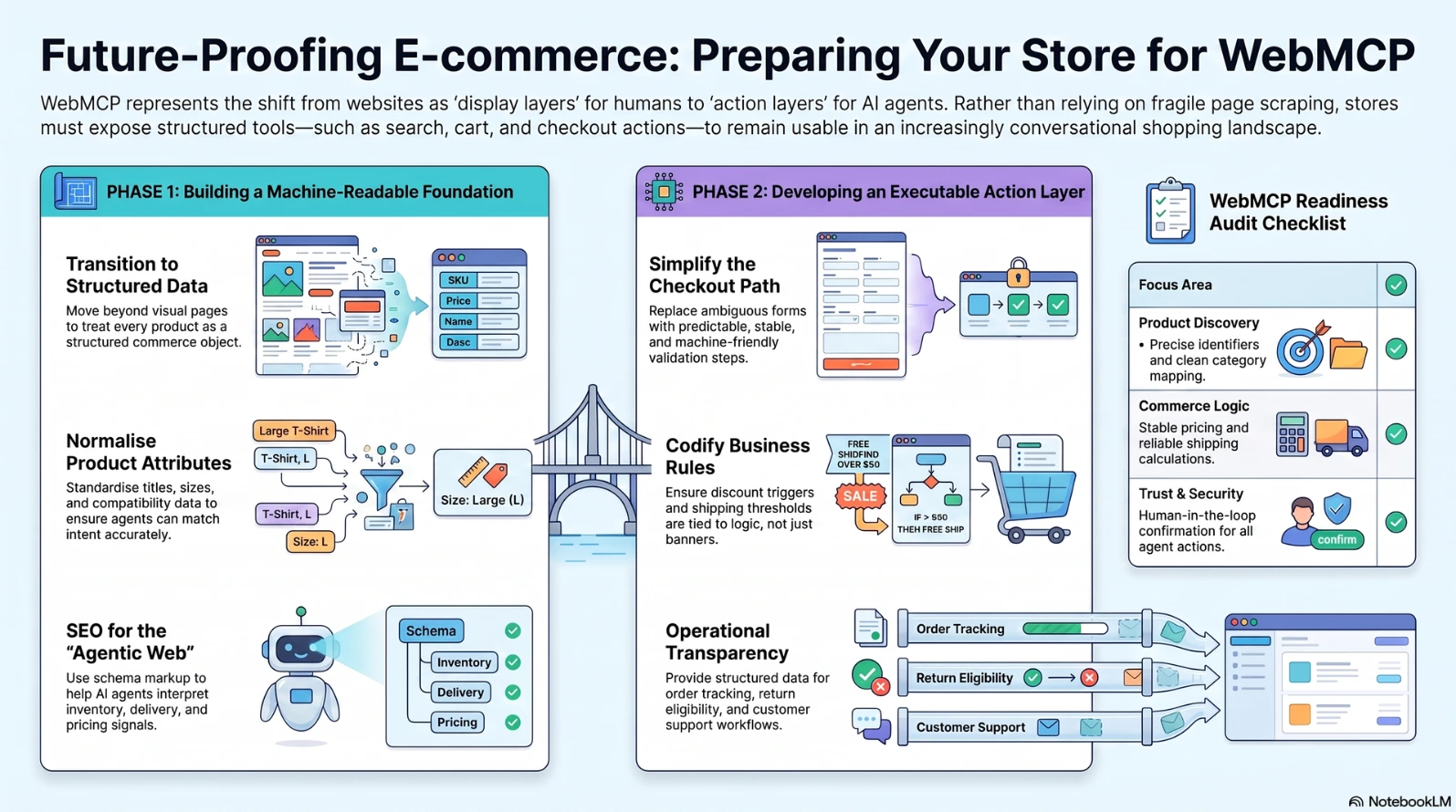
AI systems cannot reliably act on unclear, incomplete, or contradictory product data — so catalogue hygiene becomes a conversion strategy, not a housekeeping chore. Treat each product record as a structured commerce object. At minimum it should carry a stable product ID, name, price, availability, images, URL, category, variants, shipping details, and return information.
This is why the catalogue audit should happen now, before you add any agent layer. Broken attributes, duplicate listings, empty descriptions, and inconsistent variant naming create friction for human shoppers today and block automation tomorrow. It is worth stressing what Adobe also found: a large share of retail content is currently not machine-readable to AI models, so the winners and laggards are already separating. Adding AI access to a messy backend only amplifies the mess.
purplecrib.ng agent-ready, the highest-leverage work was not the fancy tooling — it was normalising structured data and registering a small set of well-described tools via navigator.modelContext.registerTool(). Clean inputs, clear tool descriptions, everything else follows.How will WebMCP change checkout and conversion?
Checkout is where the value shows up most: if an agent can move a shopper from discovery to payment without re-entering details or getting stuck, conversion friction drops sharply. This is already live — Stripe and OpenAI launched Instant Checkout in ChatGPT, starting with Etsy sellers and over a million Shopify merchants, so shoppers can buy without leaving the chat.
The mechanics matter for merchants. Under ACP, the store stays the merchant of record — you keep control of pricing, brand, returns, and fulfilment — while shared payment tokens let the agent pass payment securely without exposing card details. But checkout is also the most sensitive step. A machine needs clear confirmation states, predictable form behaviour, stable pricing, and transparent shipping and tax logic. If the flow is too dynamic or ambiguous, agents fail or abandon. The rule is simple: make the purchase path easier to understand, not just easier to click.
What about cart, offers, and promotions?
Promotions must live as structured business rules, not just visual banners — because an agent cannot “see” a hero image the way a shopper does. Discount codes, bundle offers, minimum-spend thresholds, free-shipping triggers, and time-limited campaigns all need to be interpretable. A shopper asking an assistant to “find the best deal” expects it to compare offers, validate eligibility, and land on the true final price.
So document how discounts stack, how shipping thresholds apply, and how bundles are calculated. The more opaque your promotion engine, the more likely it is to break in an agent-led journey — and a promotion an agent misreads is worse than no promotion at all.
What about returns, support, and post-purchase?
The agentic journey does not end at checkout — assistants will also track orders, start returns, request exchanges, and open support tickets, so post-purchase flows need the same structure as sales. A store with a simple return policy, clear eligibility rules, and a predictable return-request flow is easy for both users and agents to work with.
This reframes WebMCP as an operations issue, not just a storefront one. Order status, shipping updates, refund timelines, and support ticket creation all become candidate tools. If your team struggles to explain a post-purchase rule in plain language, an agent will struggle to execute it.
Does WebMCP replace SEO?
No — WebMCP adds an action layer on top of SEO; it does not remove the need to be understood and cited. Good SEO still gets you discovered and ranked; structured data still helps AI interpret your store accurately. The goal simply expands: from helping engines rank a page to helping agents use the site during a shopping task.
That makes structured data more valuable than ever. Product schema, offer data, breadcrumb structure, review signals, and shipping details all help systems read your store correctly. Design category pages to explain product differences clearly, product pages to answer real buying questions, and FAQs to address trust, delivery, and returns. These are SEO assets today and agent-readiness assets tomorrow — content built for two audiences at once, human shoppers and AI systems.
What does technical preparation for WebMCP look like?
Preparation starts with discipline in the backend, then exposes a small set of high-value actions as tools. WebMCP gives you three surfaces to work with: a declarative API (attributes on existing HTML forms), an imperative API (navigator.modelContext.registerTool() for stateful, multi-step logic), and a .well-known/webmcp manifest for discovery. Most stores start with the first two.
Pick the actions that actually matter to a shopper — search, filter, add-to-cart, check shipping, start checkout, start a return — and skip cosmetic controls like carousels and tooltips. Then make sure AI crawlers can even reach you: confirm your robots.txt allows agents like GPTBot, PerplexityBot, ClaudeBot, and Google-Extended, or those platforms cannot cite or use your store.
WebMCP readiness checklist
- Clean, stable product identifiers and URLs
- Accurate, consistent inventory and availability data
- Normalised category and attribute mapping
- Stable, predictable pricing logic
- Reliable shipping and tax calculations
- Transparent, rule-based return and refund policies
- Simplified form validation and strong error handling
- Product, Offer, FAQ, and Breadcrumb schema in place
- AI crawlers allowed in
robots.txt - A short set of well-described tools (search, filter, cart, checkout)
How do you keep humans in control?
Automation raises the trust bar rather than removing it — users must be able to review, confirm, and override any agent action. If an agent is acting on a customer’s behalf, they need to see prices, shipping, taxes, and product details before purchase, and they must always be able to use your store normally without depending on automation.
Accessibility belongs in the same conversation. A store that is machine-friendly but hard for real people to use fails both audiences. The best future-ready commerce experiences are structured, accessible, and transparent at the same time — and register tools only for views the user can actually see, so the agent never exposes actions that are not really available.
What mistakes should stores avoid?
The biggest mistakes are over-engineering too early, ignoring operations, and treating agent-readiness as a replacement for SEO or UX. Most stores gain more from data cleanup, better content structure, and stronger workflows than from chasing a rebuild.
- Over-building: not every store needs a dramatic overhaul — fix the data first.
- Tech over operations: if stock is wrong, policies are unclear, or pricing shifts unpredictably, no protocol saves you.
- Treating it as a replacement: WebMCP is an additional layer, not a substitute for SEO or good UX.
- Ignoring permissions and security: if an agent can act for a shopper, handle confirmation, authorisation, and error states carefully — trust failures in commerce are expensive.
What should online stores do now?
Start practical and incremental: audit your key journeys, clean the underlying data, then expose a few reliable tools. Walk your search, category, product, add-to-cart, checkout, returns, and support flows and mark every point where a machine would get confused or the data is incomplete.
Then improve the foundation — clean titles, standardise attributes, strengthen schema markup, and make business rules explicit. Review the backend systems behind the journey; if your own team cannot explain your inventory, pricing, or shipping logic, an agent will not use it reliably. Finally, treat content as infrastructure: product content, FAQs, policy pages, and category descriptions should all explain the buying process clearly. The earlier your store becomes clean, structured, and executable, the easier the shift to agentic commerce will be.
Ready to make your store agent-ready? Let’s talkPurple Crib Studios on WhatsApp → +234 818 000 2345Quick knowledge check
Test your WebMCP e-commerce readiness
1. What does WebMCP let a website do?
2. Which body is standardising WebMCP?
3. Which protocol handles agent-driven checkout and payment?
4. In an agentic result, which product tends to win?
5. Does WebMCP replace SEO?
6. What is the smartest first move for most stores?
Frequently asked questions
Is WebMCP live yet, or is it still just a proposal?
WebMCP is a proposed W3C standard from the Web Machine Learning Community Group and is in a public origin trial in Chrome, with Google and Microsoft engineers co-authoring the spec. It is early but real, with working reference implementations and a polyfill for browsers that don’t yet support it natively — which is exactly why preparing your data and structure now is low-risk and high-leverage.
What is the difference between WebMCP, MCP, and ACP?
MCP (from Anthropic) standardises how AI models connect to tools and data. WebMCP brings that into the browser tab so a website can expose tools to in-browser agents. ACP (from Stripe and OpenAI) standardises how an agent completes a checkout and payment. Together they cover discovery, action, and purchase.
Will an AI agent take over my customer relationship?
No. Under the Agentic Commerce Protocol you remain the merchant of record, keeping control of pricing, brand, returns, and fulfilment. The agent acts as a facilitator, and shared payment tokens let it transact without exposing card details or taking over your store.
Do I need to rebuild my store to prepare for WebMCP?
Usually not. The highest-value work is cleaning product data, standardising attributes, strengthening schema markup, and making business rules explicit. Over-engineering too early is a common mistake — most stores should audit their key journeys and fix the data foundation first.
Does WebMCP replace SEO for e-commerce?
No. WebMCP adds an action layer on top of SEO; it does not remove the need to be discovered, understood, and cited. Structured data, clear category logic, and strong content still drive both search ranking and AI citation, and they double as agent-readiness assets.
How do I make sure AI agents can even reach my store?
Check that your robots.txt allows the major AI crawlers — GPTBot, PerplexityBot, ClaudeBot, and Google-Extended. If those bots are blocked, the corresponding platforms cannot cite your content or use your tools. Allowing them is the baseline requirement for agent-driven discovery.
Is AI-driven shopping traffic actually worth preparing for?
Yes. Adobe Analytics reported AI-referred retail traffic grew 693% year over year during the 2025 holiday season and 393% in Q1 2026, and that AI traffic now converts better than non-AI channels. It is the fastest-growing traffic source in e-commerce, so structuring for it early is a competitive advantage.
Sources & further reading
- WebMCP specification — W3C Web Machine Learning Community Group
- Introducing the Model Context Protocol — Anthropic
- Developing an open standard for agentic commerce — Stripe
- Agentic Commerce Protocol documentation — Stripe / agenticcommerce.dev
- 2025 Holiday shopping data — Adobe Analytics
- Agentic Commerce Protocol support & shopper research — Salesforce
Related reading from Purple Crib Studios